Five artists are finalists for the William H. Gray memorial statue to be installed at 30th Street Station
The the winning artist for the $1.2 million statute in honor of Gray will be paid a $250,000 commission fee.
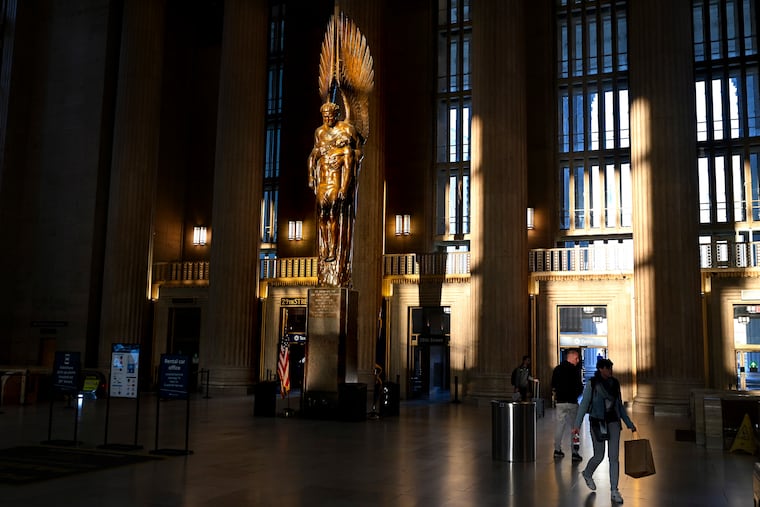
From 1979 to 1991, William H. Gray III represented Pennsylvania’s 2nd Congressional District. He was the first African American to chair the House Budget Committee and serve as majority whip, the House’s third-ranking position. While in Congress, Gray advocated for sanctions against South Africa and became close friends with Nelson Mandela.
In the 1980s, he helped raise millions of dollars to renovate 30th Street Station, which was named after him in 2020. In 2013, he died unexpectedly while at Wimbledon.
On July 22, five artists will present their proposals for the William H. Gray III 30th Street Station memorial. The presentation will be at the Cira Centre’s CYTO PHL event space.
“The statue honoring Mr. Gray will be a living memorial,” said Licy Do Canto, executive director of the D.C.-based William H. Gray III Memorial Foundation. “It’s about reimagining a public space to reflect the values Bill stood for: fairness, service, and commitment to community.”
The foundation announced an open call for artists in October and received 125 submissions from across the United States.
The foundation’s finalists — Nekisha Durrett, Nina Cooke John, Paul Ramírez Jonas, Kayrn Olivier, and Hank Willis Thomas — will each receive a $4,000 honorarium. The winner, who will be announced in September, will be paid a $250,000 commissioning fee.
The budget for the statue is $1.2 million and the plan is to unveil it in time for Philly’s celebration of the Semiquincentennial and the FIFA World Cup games.
Here are the finalists and their designs:
Nekisha Durrett, ‘Crystal Stair’
Gray was a pastor at North Philadelphia’s Bright Hope Baptist Church for 35 years, following his father and grandfather to the pulpit. D.C.-based artist Nekisha Durrett envisions fashioning Gray’s image into a 30-foot column-like structure that visitors will be able to enter for an interactive experience. She named it after Harlem Renaissance writer Langston Hughes’ popular 1922 poem “Mother to Son,” oft quoted by Gray in sermons.
In the artist’s words: Crystal Stair seeks to honor Gray’s spiritual lineage as well as his unshakable belief in justice, opportunity, and resilience.
Nina Cooke John, ‘Justice Interlaced’
Jamaican-born Nina Cooke John’s 22,000-pound bronze statue represents the connective power of rail travel. It speaks to Gray’s life that she described as grounded in Philadelphia and extending to D.C. The sculpture, inscribed with the words “DC Proud,” is meant to resemble a sleek, modern railway station. (Although, we aren’t sure how the words are going to go over in a Philadelphia train station.)
In the artist’s words: “Intertwined with the piers are ribbons of painted steel and bronze. These elements rise, curve, and intersect — like rail lines — symbolizing connection, transit, and influence."
Paul Ramírez Jonas, ‘Our Ancestors Knew We Were Coming’
Cornell University art professor Paul Ramírez Jonas’ sculpture is a family tree with branches that represent the different elements of Gray’s life: biological, familial, cultural, and relationship based. These aspects of his life culminated in his work on Earth and created a legacy for his biological sons and the lives he touched.
In the artist’s words: “We are holding those who came before us, and those who will come after us, in everything we do. I propose a monument that will invite members of the public to sit at the nexus where lineages pivot from ancestors to descendants.”
Karyn Olivier, ‘Platform’
For Platform, Philadelphia artist and Temple University professor Karyn Olivier imagines a church pulpit with stairs that lead to an elevated platform. The exterior of the pulpit, traditionally decorated with church symbols and biblical narratives, is replaced with iconography from Gray’s career: the seal of the United States Congress, the logo of the United Negro College Fund — where Gray served as president for 13 years — and the South African flag.
In 2021, a design by Olivier was selected for the Bethel Burying Ground Historic Memorial.
In the artist’s words: “My intention for this memorial is to allow neighbors, strangers, Philadelphians, daily commuters, and those just passing through on their journey to destinations far and wide, to ‘meet’ Gray and participate in the unfolding of his enormous legacy.”
Hank Willis Thomas, ‘Reverence’
Hank Willis Thomas, son of Philly-born artist Deborah Willis, proposes two bronze hands poised in prayer or deep contemplation, inviting passersby to pause. In 2017, Thomas’ sculpture of an Afro pick, All Power to All People, stood on the Thomas Paine Plaza. (It has since been acquired by the Pennsylvania Academy of the Fine Arts and is now permanently located there.)
In the artist’s words: “There is a universal resonance in the gesture — it speaks to stillness, reflection, resolve, and collective hope. This concept honors the strength found in faith and the action that flows from it."
The artists will present their designs on July 22 from 9 a.m. to 5 p.m. at Cira Centre, 2929 Arch St, Suite 250, Phila. The event will also be streamed live on the William H. Gray III Memorial Foundation’s website.
Correction: In an earlier version of the story, we reported William H. Gray was the pastor of New Hope Baptist Church. The story has been updated to reflect he was the pastor of Bright Hope Baptist Church.