Lawsuit: Register of Wills John Sabatina Sr. used a ‘hit list’ of targeted employees to make room for patronage hires
The internal spreadsheet listed 30 employees, with the suggestion to fire most of them: “We have enough immediate terminations to allow us several hires in the next two weeks."

Ian Ewing thought his job was secure in the Philadelphia Register of Wills office. A November 2023 performance review found that he was “exceeding expectations” as a records clerk, a position he had held for three years.
But in January 2024, Ewing said, an aide to newly elected Register of Wills John Sabatina Sr. informed him in the middle of the workday that he was being fired. Immediately.
“They said I can go upstairs and grab my belongings or they could have someone do it,” Ewing recalled last week. “I wasn’t given any reason.”
What Ewing didn’t know is that the Sabatina administration had created an internal list of employees it was planning to fire to make way for new hires. Ewing was on it.
“It was a hit list,” said Ewing’s lawyer, Timothy Creech. “It wasn’t to save money. It was specifically to hire their own people.”
The city recently agreed to pay Ewing $40,000 to settle his lawsuit that claimed that he was fired for not supporting Sabatina’s campaign, in violation of his First Amendment rights.
Sixteen other former register of wills employees have filed similar suits since early 2024, costing Philadelphia taxpayers $656,000 in legal settlements so far, according to court documents and information provided by the city’s law department.
Sabatina’s so-called hit list was recently produced by city lawyers during the discovery phase in those civil cases.
The document sheds new light on the costly fallout that follows leadership changes in the register of wills office, a time-honored patronage den whose employees do not have the civil-service protections afforded other city workers.
Sabatina and a spokesperson for the city’s law department declined to comment last week on any of the open lawsuits or the spreadsheet of targeted employees.
Creech, who is representing 11 of the fired employees, said he has been taken aback by the cutthroat politics within a relatively obscure office in City Hall. It does nonpolitical work, such as issuing marriage licenses and processing inheritance-related records.
The office employs approximately 100 people with an annual budget of about $5.2 million.
“I learned a lot about how the sausage is made,” said Creech, who compared Sabatina to a “Tammany Hall”-style party boss, a reference to the former New York City political machine. “Real people lose their jobs just so the political operatives can throw taxpayers’ money around. It’s all laid bare here.”
Ron Don’s legacy
The late Ronald R. Donatucci, first elected register of wills in 1979, ran the office for 40 years as a Democratic patronage operation, a throwback to the days of big city political machines that doled out jobs to people with the right connections.
Committee people. Campaign donors. That ward leader who’s married to the daughter of a South Philly politician who’s owed a favor or something.
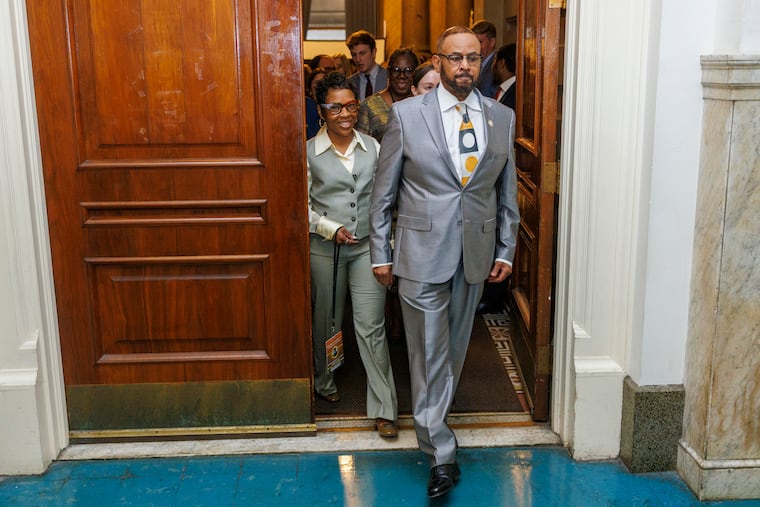
Donatucci, who served as a Democratic ward leader himself, was unseated as register of wills in 2019 by Tracey Gordon, a former deputy city commissioner. Gordon was then defeated in 2023 by Sabatina, an estate attorney and Northeast Philadelphia ward leader.
Turns out, when the office has two new bosses in four years, patronage hiring can turn into patronage firing.
Gordon’s single term in office led to five federal lawsuits filed by former employees who say she fired them after they declined to support her failed reelection campaign. Four of those cases have since been settled for a total of $400,000. One case is still being litigated.
Then, in January 2024, Sabatina began his house cleaning, which later triggered another wave of similar lawsuits. So far, the city has agreed to pay out a total of $256,000 in settlements to Ewing and eight other fired employees. The number is expected to grow, with some cases open and new cases still being filed.
As a candidate, Sabatina had criticized Gordon’s “hiring and firing practices” and said he wanted to “restore public trust in the office.”
But Sabatina’s hires have included many people with connections to the Democratic Party, The Inquirer previously reported: three Democratic ward leaders; 10 committee people; the wives of two other committee people; the daughter of a late City Council member; and the granddaughter of a former state representative.
Sabatina rehired one staffer, Patrick Parkinson, who was originally brought on by Donatucci in 2016, then fired by Gordon in 2022 because, Parkinson says, he refused to donate to her campaign. Parkinson now earns $99,825 a year — on top of $120,000 he received from the city to settle his wrongful-termination suit against Gordon.
This month, Doug Nesmith, a former supervisor in the office, filed a lawsuit alleging that Sabatina unlawfully fired him about a month after taking office in January 2024.
Nesmith, a former Democratic committeeman, alleges that Sabatina targeted him because he was a “prominent supporter of Gordon” when she ran for reelection. That violates his First Amendment rights, he alleges.
“This was not for performance, not to trim the budget, not to replace executive level employees,” his lawsuit claims. “It was to free up cash for Sabatina’s own patronage hires.”
Exhibit A in Nesmith’s lawsuit is the annotated spreadsheet that reveals the Sabatina administration’s strategy to free up money for new hires.
The spreadsheet, which Creech said appears to have been compiled by a Sabatina aide, listed 30 office employees, many of whom are described by their connection to Tracey Gordon or other political figures:
“Tracey niece,” “Tracey’s friend, 7th Ward committee person,” “Last Tracey hire,” and “Shariff Street referral at Tracey’s request,” a misspelled reference to the state senator and former state Democratic Party chairman.
The suggested action for most of those employees: “Terminate.” When: “Immediate.”
“We have enough immediate terminations to allow us several hires in the next two weeks,” reads a note at the bottom of the spreadsheet.
Some of the firings appear to have been planned before Sabatina even had replacements, according to another note on the page.
“We don’t have people lined up for all of these jobs,” the note reads, “and we need to make sure we use up all of the funds set aside in the budget for salary.”
’It definitely stung me’
Ewing, 29, said his confidence took a hit after his unexpected firing last year. It left him scrambling to find a job just after signing a new lease with his fiancée.
“There was a lot of anger and confusion,” he said. “It was extremely difficult at the time. It definitely stung me.”
Ewing has since found work as an assistant at a law firm. He said he was disheartened to see that he had been singled out for termination, despite having been told he was exceeding expectations.
“I worked hard there,” Ewing said. “I did my job. I was pretty apolitical.”
“It seemed there were people that had some sort of political connection or a ‘Godfather’ behind them and they didn’t get fired,” Creech added. “Then there were politically vulnerable people who were let go so [Sabatina] would have money to hire his own people.”
The Committee of Seventy, a good-government group, has for years called on Philadelphia officials to reform three independently elected row offices — register of wills, sheriff, and city commissioners. The committee has said the offices should be absorbed by city government or the court system.
“This list confirms what we all expected — that hiring in row offices is too often based on who you know instead of the ability to do the job,” said Andrew McGinley, the Committee of Seventy’s vice president of external affairs.
In March, the Pennsylvania Intergovernmental Cooperation Authority, Philadelphia’s fiscal watchdog, unanimously passed a resolution to recommend that City Council and Mayor Cherelle L. Parker abolish the register of wills office, along with the sheriff’s office.
City officials have taken no action.
Gordon, the former register of wills, ran unsuccessfully for Congress last year. City payroll records show that she now works as a services representative in the sheriff’s office.
McGinley said the lawsuits are the latest evidence that change is still needed.
“Patronage hires are only possible because of the needless independence of this office,” he said. “If these were civil service employees, this wouldn’t happen, and we’d save hundreds of thousands of taxpayer dollars wasted on settlements.”

The Inquirer’s journalism is supported, in part, by the Lenfest Institute for Journalism and readers like you. News and editorial content are created independently of The Inquirer’s donors. Gifts to support The Inquirer’s high-impact journalism can be made at inquirer.com/donate. A list of Lenfest Institute donors can be found at lenfestinstitute.org/supporters.