Real estate agents from major brokerages arranged questionable property deals around Temple University
The sales involving real estate agent Pat Fay around Temple University could lead to a spate of foreclosures and impact property assessments, tax bills, and student rentals.
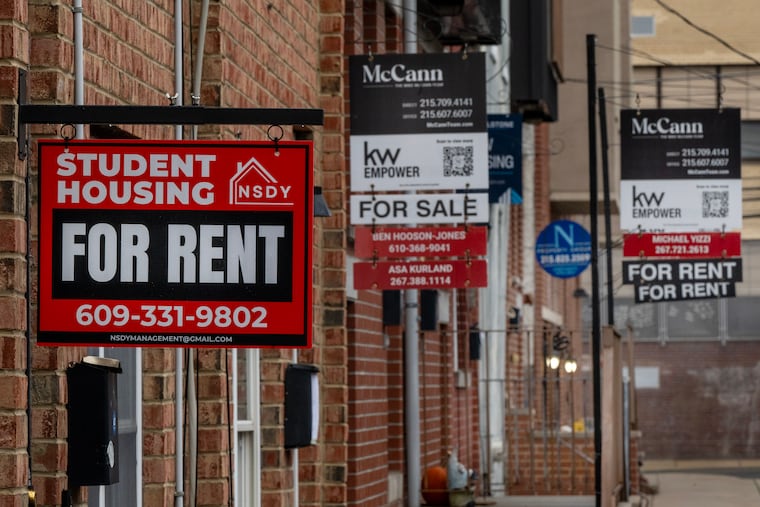
More than two dozen Philadelphia-area real estate professionals helped arrange $45 million worth of questionable deals around Temple University in which student rentals that had sat on the market for months abruptly sold for about double their asking prices, an Inquirer investigation has found.
In 52 settled or still-pending sales over roughly the last year, apartment buildings were listed for sale at an average price of $450,000, but found no takers. Within days of being re-listed for a higher price, the same properties sold for as much as $905,000 — at least on paper — to buyers who took out mortgages that far exceeded the original asking price.
Eight sellers or their agents now say they entered into the deals with the understanding that they would actually receive close to the original asking price — not the much higher amount that was officially listed on deeds and other public records. And an appraiser said that real estate agents on both sides of a proposed deal tried to pressure him to raise the valuation of a property.
The sales have raised concerns about possible mortgage fraud in the area around Temple, which could lead to a spate of foreclosures and affect property assessments, tax bills, and student rentals. At least one such property has gone into foreclosure over an unpaid mortgage, according to court records.
Solomon Wisenberg, a former assistant U.S. attorney in North Carolina and Texas who specialized in white-collar crime and bank fraud, said the people involved in the deals could face scrutiny from criminal investigators.
“I don’t know any fraud prosecutor who wouldn’t be interested in looking at that,” Wisenberg said. “Settlement statements have to reflect reality. If you don’t present an accurate picture to the financial institution that is financing the loan, you’ve got problems.”
Patrick C. Fay, a real estate agent in Coldwell Banker’s Old City office, was involved in every deal, representing at least seven buyers who purchased the properties through limited liability companies. One of those buyers had been convicted of an earlier mortgage fraud scheme.
Coldwell Banker cut ties with Fay in December, hours after The Inquirer published a story concerning 33 of his deals around Temple.
But Fay had a counterpart on the other side of every transaction. They included agents at major brokerages such as Keller Williams, Long & Foster, and eXp — as well as three agents who worked in the same Coldwell office as Fay and helped him close 13 sales.
Coldwell Banker’s national office said this month that it has launched an internal investigation into the matter.
Fay, who was one of the top agents in his Coldwell office, has denied wrongdoing. He declined to discuss specific sales.
“In my over 20 years in real estate, I have maintained an unblemished record with no ethical violations or complaints filed against me,” Fay wrote in a text message last week. “These claims are without merit.”
Steve Orbanek, a spokesperson for Temple University, said the university learned about the situation from The Inquirer’s previous report and is now investigating possible impacts on its student renters.
“It goes without saying that the university condemns any unlawful behavior, and we find these allegations deeply concerning, both for our students and neighbors who reside in the community,” he said.
‘Fat Pay’
Fay, of Moorestown, Burlington County, started arranging deals in December 2024 to purchase apartment buildings around Temple University that owners had been struggling to sell.
The value of those properties, which are largely marketed as student rentals, has fallen in recent years. A local landlords association said vacancy rates are up and rents down amid declining enrollment at the university, which has shed 10,000 students in under a decade.
Fay, who has used the handle “Fat Pay” on social media, had buyers willing to make a deal. However, in multiple cases identified by The Inquirer, that was true only after the sellers and their real estate agents agreed to sign a deed showing that the property had sold for much more than the original asking price.
Shaina Levin, a Coldwell agent who worked with Fay in his Old City office, represented a seller in one such deal on 15th Street. The property was initially listed for sale last July at $375,000. Records show Fay’s client bought it for $842,000 in September 2025 after securing a $673,600 mortgage.
“It’s a bonus when we can keep it in the Coldwell Banker family,” Levin posted on Facebook, referring to the sale. “Thanks Pat Fay for teaming up on this one. Congratulations to your buyer!”
» READ MORE: Properties around Temple U. weren’t selling — until a real estate agent nearly doubled the asking prices
In an interview, Levin said her client received an amount closer to the original listing price, not the $842,0000 sales price recorded on the deed.
She said the buyer contended that the higher sales price was tied to a planned renovation. City permit records show no evidence of construction or renovation work on the building.
Levin said that Fay’s proposal was “totally unconventional,” but that her office manager at Coldwell Banker ran it by the company’s legal department, which signed off.
“Legal said, ‘Yep, all good,’” Levin said. She referred additional questions about the sale to her manager, who declined to comment.
Fay’s buyer in that deal was UrbanNest Acquisitions, a limited liability company created the same month as the sale by Tanjania Powell-Avery, a former real estate agent from Pottstown, Montgomery County. Federal prosecutors with the Eastern District of Pennsylvania indicted Powell-Avery and two others in 2010 for participating in a mortgage fraud ring in the Philadelphia area. She pleaded guilty and was sentenced to five years’ probation and nine months’ house arrest.
Powell-Avery declined to comment.
Two other colleagues of Fay’s at his former Old City office also brokered sales with him, according to data from the Multiple Listing Service, a shared database that real estate professionals use to track and arrange deals.
Karl Klotzbach represented sellers in eight deals with Fay over five months last year — more than any other seller’s agent, records show. The eight properties had originally been listed for a total of $3.4 million before they were each re-listed and sold for a combined $7 million.
Klotzbach did not respond to requests for comment.
Matthew Greene, another Coldwell agent, brokered four sales with Fay on North 12th Street. The properties were each listed for $450,000 last April, then re-listed at $879,000 the following month. In July, each property sold at the higher amount within days of one another, with all four sales backed by a separate $703,200 mortgage.
Greene would not discuss the sales.
“I’m happy to direct you to our legal team for any comment,” he said. Greene hung up the phone without providing any contact information.
Daryl Turner, the branch vice president at Coldwell Banker’s Old City office, referred questions to the company’s legal department. Andrea Gillespie, a national spokesperson for Coldwell Banker, which operates in 49 countries and territories, would not comment on the sales.
“We immediately disaffiliated Pat Fay and are continuing to investigate the matter internally,” Gillespie said in an email. “Coldwell Banker stands for trust and integrity, and we hold our agents to the highest ethical standards.”
‘This is my livelihood’
While sellers were eager to offload their toxic real estate investments, not every deal went smoothly.
John Sexton, an independent licensed appraiser with twenty years’ experience in the Philadelphia market, said in an interview that an appraisal company working for a lender contracted him last year to evaluate a property on North Park Avenue, near Temple’s campus. The sale was being brokered by Fay and Peter Lien, an eXp real estate agent representing the seller.
It was the kind of property common around Temple: a Victorian-era rowhouse that had been converted into a three-unit, nine-bedroom student rental. And, like similar properties in the area, it sat on the market unsold for more than two months, with no takers, at its $408,000 asking price.
The property was taken off the market in October, but then reappeared as a pending sale at $879,000, according to MLS data. Fay had found another buyer ready to pay more than double.
Sexton said he quizzed Lien about why a property that had not undergone recent renovations would suddenly jump in price. Sexton said Lien responded that an earlier broker simply “hadn’t been familiar with the real estate market” around Temple.
Sexton said the implication of these conversations was that Lien “had a person who would pay $879,000, so I should just do my job and mark it at $879,000.”
Sexton said he then received an unusual email from an individual named “Jay Jay,” who indicated he was working with Fay. The email included a list of nearby properties that had all sold in the $800,000 range, establishing that the sales price was reasonable.
Sexton looked into the comparable sales and found that they had all been brokered by Fay. “Jay Jay” also sent Sexton copies of leases for apartments in the same building, purporting to show units leasing for $2,500 a month. But when Sexton dug up sales listings for the same building from a few weeks earlier, they advertised that the units had been leased for closer to half that amount.
“Jay Jay” did not respond to an e-mailed request for comment.
Sexton said he called Fay to discuss the discrepancies, and the real estate agent accused him of being inexperienced and pushed him to approve the higher value.
“It’s a tough situation,” Sexton said. “You have two brokers pressuring you and sending you signed documents saying the sale price is valid.”
Sexton said after he told Fay he would need to further substantiate the higher asking price, Fay stopped responding.
The property never sold and is now off the market. Sexton never heard from Fay again.
“It’s infuriating to me, because he’s putting my license in jeopardy,” Sexton said. “This is my livelihood.”
In a text message, Fay denied “any claim that I have ever manipulated or influenced an appraisal in any fashion.” He did not respond to questions about the sale.
Lien said he could not comment on the failed deal.
“I was instructed by my brokerage that any press would have to go through our office, and we’re not allowed to speak on it,” said Lien, who works out of eXp’s King of Prussia office.
The manager of that eXP office did not return a request for comment.
‘Really bad stuff’
Daniel Perlman, a former prosecutor in the Maryland State’s Attorney’s Office who now practices white-collar criminal defense, said anyone who signed documents they knew to be false could potentially face legal problems.
“If there are documents that have incorrect information for a mortgage, then yeah, somebody has criminal liability,” Perlman said. “You’re under penalty of perjury for signing these documents.”
A spokesperson for the U.S. Attorney’s Office in the Eastern District of Pennsylvania said the office does not confirm or deny the existence of investigations, as did a spokesperson for the Pennsylvania State Real Estate Commission, which licenses agents.
Nick Pizzola, vice president of the Temple Area Property Association, which represents local landlords, said the COVID-19 pandemic has had a lasting negative impact on the off-campus real estate market, leaving landlords struggling to sign leases and pay their own mortgages.
Still, he said, the seller’s agents had to have known something was amiss when a buyer was offering double the asking price.
“Anyone who knows anything about real estate would have run away from those deals,” Pizzola said. “Some really bad stuff was happening.”
Most participants in Fay’s deals were reluctant to discuss their roles when contacted by The Inquirer this month. Some seller’s agents said their brokerages had instructed them to remain silent. Others claimed ignorance when it came to the details of the deals they had helped arrange.
In the March 2025 sale of an apartment building on the 2200 block of North Sydenham Street, for example, both the seller and his agent said they could not explain why the sales price did not match the amount listed on the deed.
The property initially went up for sale for $324,900 in December 2024 but was then re-listed and sold to Fay’s client in March 2025 for $789,000. The seller, Alvjod Dedaj, said he did not actually receive that higher amount. He referred further questions to his real estate agent at Long & Foster.
“I have no clue what’s going on,” Dedaj said. “I just cashed out a certain amount of money.”
Dedaj’s agent, Bob Kiziroglou, who works out of Long & Foster’s Devon office, said he, too, could not recall why the asking price suddenly jumped. He referred questions to Fay.
“Reach out to him, man, he’ll give you all the details,” Kiziroglou said.
A message left at Long & Foster’s Devon office was not returned.
The Broad Street office of Keller Williams Realty was another hub for deals involving Fay, with five of its agents representing sellers in eight sales. An office manager did not respond to requests for comment.
Wisenberg, who was a prosecutor in the Whitewater/Madison Guaranty Savings & Loan investigation, said he found it particularly suspicious that Fay arranged deals with mortgages that far exceeded the initial asking price, and with sellers receiving less than the stated purchase price.
“What’s he doing with the rest of the money?” Wisenberg asked.
Trouble brewing
Already, there are signs of trouble in the neighborhood around Temple.
In November, one lender, Easy Street Capital, filed to foreclose on a Park Avenue property that sold in late 2024 for $850,000 — more than double its value just two years prior.
While no buyer’s agent is listed in MLS data for the sale, Lien, the eXp agent, is listed as representing the seller. The buyer, Park Ave Enterprise LLC, is registered to an associate of Fay’s who participated in at least four other sales around Temple that he brokered.
According to court filings, the LLC defaulted on an $807,000 mortgage about four months after purchase.
The lenders that financed Fay’s purchases now bear the most risk of the overvalued and under-occupied rentals lapsing into foreclosure. A private lenders association in November warned its members of a “fraud scheme” operating around Temple University, and cities like Baltimore have seen hundreds of properties fall into foreclosure as a result of suspected mortgage fraud rings.
A spokesperson for City Councilmember Jeffery “Jay” Young, whose district encompasses the affected properties, said he was “not familiar with the situation.” He called mortgage fraud “a common and unscrupulous real estate practice that happens too often in our city.”
Orbanek, the Temple spokesperson, said the university is working to identify students who may be impacted by potential foreclosures and asked them to contact the university’s Essential Needs Hub, which connects student renters with supportive resources.
Joelle DelPrete, a former Temple grad student who works for the university, lives in an apartment unit that Fay helped purchase. He brokered a sale of the rental property to “18th Estates LLC” in December 2024 for $868,000. It had previously been listed for $385,000.
A few months later, DelPrete said, Fay texted her that he was the property manager, and he wanted her to sign a new lease so he could begin collecting rent.
“We assumed it was a totally legit company,” DelPrete said.
Soon, DelPrete said, unpaid water and trash collection bills started piling up, and maintenance issues went unanswered. In October, she found a document known as an Act 91 notice that was posted on an adjacent property in advance of foreclosure proceedings. It showed the owners — who had been represented in the purchase by Fay — had stopped paying its mortgage and owed roughly $25,000.
DelPrete and her three roommates are hoping to move out before her building goes into foreclosure.
“Especially living around Temple, you just gotta be careful and make sure everything is aboveboard,” she said. “If something feels off, it is off.”

The Inquirer’s journalism is supported, in part, by the Lenfest Institute for Journalism and readers like you. News and editorial content are created independently of The Inquirer’s donors. Gifts to support The Inquirer’s high-impact journalism can be made at inquirer.com/donate. A list of Lenfest Institute donors can be found at lenfestinstitute.org/supporters.
- Real estate agents from major brokerages arranged questionable property deals around Temple University
- Philly fumbles the cleanup, Delco draws the line, and savesies return | Weekly Report Card
- The best things we ate this week
- Can I take a loose sled from the bottom of the hill?
- Spotting snowy Elmo
- How to have a Perfect Philly Day, according to Provenance chef Nicholas Bazik
- Citywide Quest: Can you guess these historical sites across Philly?
- Off-season eats, arcades, and live music in Asbury Park | Field Trip
- He is house poor but happy in his Norris Square two-bedroom | How I Bought This House