Liberals erase history, too
The removal of a statue of one of Delaware’s signers of the Declaration of Independence — who was an enslaver — underscores the hypocrisy that sometimes surrounds the debate over historic landmarks.
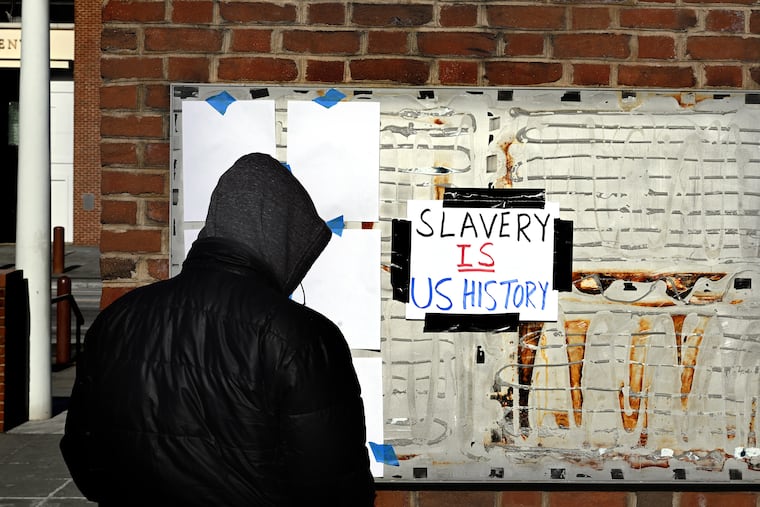
Suppose you’re the kind of liberal who — like me — was outraged by the Trump administration’s removal of an exhibit at the President’s House about nine people whom George Washington enslaved. It’s a whitewash of history, you might say, and an insult to democracy.
Well, are you also denouncing the removal of the Caesar Rodney statue from a plaza in downtown Wilmington? You should.
The statue of Rodney — a signer of the Declaration of Independence who enslaved about 200 people — was taken down by city officials during the racial reckoning of 2020. And last month, the Trump administration said it would be displayed in Washington, D.C., as part of the nation’s 250th anniversary celebrations.
Cue the culture wars: One side says the statue symbolizes racism, and the other says it embodies patriotism.
They’re both right. And that’s why the statue of Rodney belongs back in Delaware, surrounded by displays about his past as an enslaver. We can’t make sense of the past unless we address its complexities. And we can’t condemn the erasure of history if we’re erasing it ourselves.
That’s what my fellow liberals have been doing since 2020, by demanding the removal of monuments to those who were enslavers. We should instead seek to add information to the memorials, so Americans receive a fuller picture of slavery and its role in our founding.
The Trump administration doesn’t want that, of course, which is why it removed the panels about the enslaved people who labored at the President’s House Site at Independence National Historical Park. Last month, a federal district court judge ordered the panels be reinstalled. Sixteen of the 34 panels were returned to the site before a circuit court judge placed a stay on that order. The other panels will remain in storage until the courts issue a full ruling on the matter.
Meanwhile, protesters have converged upon the President’s House to demand that we “tell the complex stories,” as one leader said. She’s right. We need to face the fact that many people who fought for American freedom also endorsed slavery.
Rodney was one of them. He raced on horseback from Dover, Del., to Philadelphia on July 2, 1776, to cast his state’s decisive vote in favor of the Declaration of Independence, which was adopted two days later. The town fathers of Wilmington erected a statue in his honor in 1923, shortly before the 150th anniversary of the declaration.
But Rodney also enslaved roughly 200 African Americans at his family plantation. That’s why protesters demanded his statue’s removal in 2020, when the police murder of George Floyd led many communities around the country to reconsider their connections to slavery.
In agreeing to remove the statue, Mike Purzycki — the mayor of Wilmington at the time — pledged to conduct a discussion about it. But it’s hard to talk about something when you have hidden it. It’s out of sight, out of mind.
And that’s where some liberals want it to remain. “You can have him, D.C.,” said Wilmington Councilwoman Shané N. Darby, reacting to the news that the statue of Rodney would be moved to Washington. “I do not think he needs to have a statue in his honor at all.”
But giving the statue to Washington concedes way too much to President Donald Trump, who issued a proclamation in October 2020 condemning its removal from Wilmington as “part of an ongoing, radical purge of America’s founding generation.”
We can’t condemn the erasure of history if we’re erasing it ourselves.
The proclamation made no mention of Rodney’s past as an enslaver, because the Trump administration doesn’t want us to address that. All we need to know is that Rodney was a “patriot,” and that the people who denounced the Wilmington statue are engaged in “extreme anti-American historical revisionism,” Trump declared.
But the real revisionists are Trump and his disciples, who want to erase slavery from public memory. And that’s precisely what will happen if the Rodney statue disappears from Delaware.
Like the display at the President’s House, Rodney’s statue should include signage describing his complex relationship to slavery. Although he held human beings captive, Rodney introduced a bill to prohibit the importation of enslaved people into Delaware. And his will directed that the people he enslaved should be freed after he died.
Fewer people will know that history if the statue is gone. Even at Caesar Rodney High School in Camden, Del., students and recent graduates said they weren’t aware of Rodney’s past until the controversy flared over his statue in Wilmington.
So let’s bring it back, perhaps paired with a monument to enslaved people in Delaware. That’s what University of Delaware political scientist Theodore Davis Jr. proposed back in 2020, as the campaign to remove Rodney’s statue gained momentum. Davis, who is Black, understood that we should always be adding to history. Leave the subtracting to Trump.
Jonathan Zimmerman teaches history and education at the University of Pennsylvania. He is the author of “Whose America?: Culture Wars in the Public Schools.”