Coming from Germany, I got a warm welcome, but why do Americans love the cold?
Americans can’t seem to imagine life without air-conditioning. Staying cool has been one of the few things that, in these divided times, almost everyone I met could agree on.
As the end of my two-month stay in the United States approaches, I must admit that my time here was even more terrific than I expected. And I swear I’m not just saying that because I’m afraid of upsetting someone at the U.S. Department of State and losing my visa.
I cherish this country and its ideals. I cherish Philadelphia and its proud residents. I’ve come to adore the cheesesteak, the soft pretzel, and the roast pork hoagie. I am thrilled by the sight of passionate Eagles fans. The Gayborhood energizes me, while the trail along the Schuylkill soothes me. Cycling every day through the rectangular maze of South Philly’s streets, I felt safer than in my hometown of Berlin. (Even if I rarely stopped all the way at an intersection.)
But there is one thing I don’t understand. At all.
Americans, why do you love the cold?
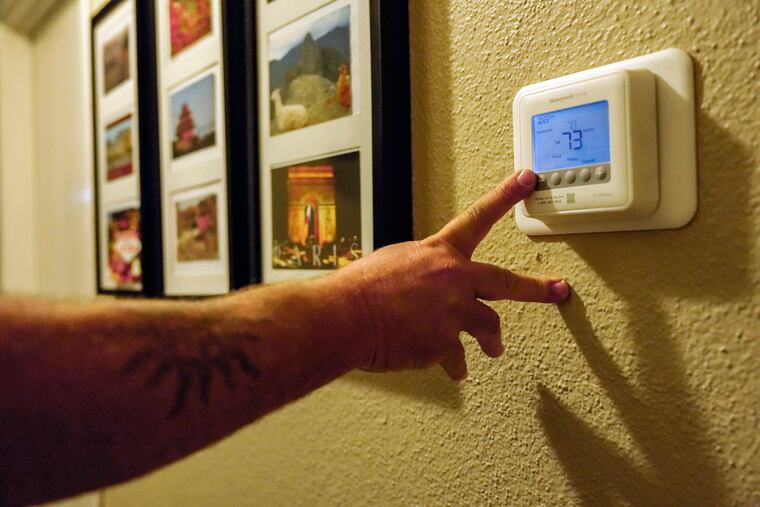
Your fridges are huge. You stuff every drink with enough ice to sink the Titanic. And you have the air-conditioning turned on. Everywhere. Always.
In fact, you can’t imagine life without AC. It has been one of the few things that, in these divided times, almost any American I met could agree on.
Nine out of 10 U.S. homes have air-conditioning. In Germany, it is less than one in five. Even in Mediterranean Italy, the share is only one in two households.
I tried to learn the Fahrenheit scale (where water freezes at 32 degrees and boils at 212 — finally, a temperature system that’s logical and intuitive!), but air-conditioning here only seems to have one setting anyway — full blast.
» READ MORE: On immigration, Trump doesn’t have a copyright on cruelty | Opinion
Am I in a restaurant or in the Siberian Tundra? Am I at an airport gate or in a cryogenic chamber? Am I on the Broad Street Line or the Polar Express?
Maybe it’s not a coincidence that your president dreams of annexing Greenland.
I caught a cold during my first week here. And then again. And again.
To be sure, I come from a place where the temperatures are not exactly balmy. During the long, gray, German winters, we pour gallons of cheap hot wine into our bodies to feel something in the numbing cold. First the warmth, then the headache.
Over here, I recently heard a radio commercial for AC financing. It advertised “ice-cold air the whole year long.” The fact that this is a promise and not a threat is baffling to me.
The American frost does not seem to come by accident, but by design. It is a status symbol. I found that the fancier the shop, the swankier the place, the more I had to wear a jacket.
In Germany, we speak of “social coldness.” Here, with people who are generally so warm in their personal connections, the expression gets a whole new meaning.
But the last thing I want to do is judge. This country is all about the pursuit of happiness. Everyone can follow that in their own manner. I am just curious: How does the cold affect your society? Does the chill really make you happy?
If so, I wonder, why doesn’t everyone who lives here get to enjoy this fabulous cooling sensation?
While office people with elaborate job titles can wear a suit and tie in August without producing embarrassing amounts of sweat, hundreds of thousands of people, often those now targeted by Donald Trump’s anti-immigration forces, labor each summer on construction sites or paving roads. They risk their health under the burning sun, drawing the short straw in a game of “the cooled vs. the cooked,” as a recent New York Times piece put it.
Texas and Florida have even recently implemented laws that ban counties from mandating water breaks for workers. Meanwhile, many of Philadelphia’s schools can’t afford to beat the heat.
Of course, for those who benefit from it, air-conditioning helps save lives — especially in the South and Southwest. More than 21,000 people have died of heat-related causes in the U.S. since 1999, with 2,325 deaths recorded in 2023, as heat waves become more common due to global warming.
» READ MORE: No matter what some lawmakers think, SEPTA is not a burden — it’s an opportunity | Opinion
But under these warming conditions, relying solely on AC is expensive — and dangerous. More than 13,000 people would perish during a two-day blackout in Phoenix, a recent study calculated. Ironically, due to their high energy demand, air-conditioners increase the risk of such a blackout. To cope with a planet that is literally on fire, the study’s authors recommend cool roofing and planting trees to line streets to generate shade.
Even if they have their limits, solutions like those seem much more sustainable than air-conditioning. The U.S. needs 424 terawatt-hours of electricity per year just to air-condition homes and commercial buildings for 340 million people. The whole African continent, with its 1.5 billion residents, consumes 700 terawatt-hours annually — total.
Air-conditioning keeps Americans living in a (nice, cool) bubble. It separates those who are inside from the outside, shielding them from reality. A reality that they themselves are helping to create.
Fortunately, I picked up some gear recently to protect me against overpowered cooling: a Gritty beanie that says “IT ME IT ME IT ME IT ME“ — a reminder of that glorious moment a few years back when the Flyers mascot nominated himself as Time magazine’s “Person of the Year.” When I am back in Berlin and wish to revive my Philly memories, I will go ice skating and gently pull it over my ears.
Adrian Schulz is a journalist with Der Tagesspiegel in Berlin and an Arthur F. Burns fellow at The Inquirer.