Food is health. Localizing its production and distribution is key.
Due to a failure to prioritize the needs of small family farmers, we must now turn inward and rely on our communities to design and implement a scalable, regionally coordinated food system.
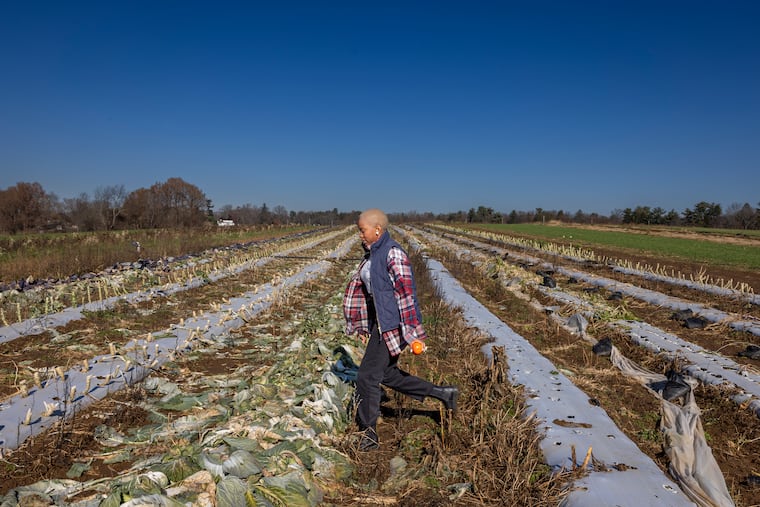
In September, I traveled from Philadelphia to Washington, D.C., for the National Farmers Union’s legislative convention.
Over the course of three days, I met with 13 congressional legislators or their staffers, spoke to representatives of the U.S. Department of Agriculture and the White House, as well as fellow farmers, to discuss a very real threat impacting our nation: the instability of our food system.
Across the United States, food system organizations — from regenerative farms and gleaning networks, to food access nonprofits and community grocers — are all under immense pressure because of federal funding cuts, rising tariffs, and labor shortages. The entire food chain is strained, and the effects are compounding.
Recently, during the government shutdown, families across the country were not receiving SNAP benefits. American farms and families are still struggling and need relief now.
Farmers suffer even as food prices rise
While food prices continue to rise, farmers make less than 16 cents on every food dollar spent, according to the National Farmers Union. Even worse, there has been a severe labor shortage because of outdated agricultural workforce policies, while large corporate farms are making record profits.
Suicide among farmers is at an all-time high, and the sixth highest among all occupational groups. As the largest Black food grower in Pennsylvania, I am seeing these challenges each and every day.
Earlier this year, the Trump administration, without congressional approval, canceled the Local Food Purchase Assistance Program: a $1 billion federal spending initiative that provided schools and food banks with funding to purchase food from local farms and ranchers.
When food is unstable, so is health, education, safety, economic opportunity, and environmental well-being.
In addition to the impact this will have on our children and our most vulnerable communities, the killing of this program is having a direct impact on small and first-generation farmers like me. My produce farm lost upwards of $150,000 between contracts with local food banks that were supported by the LFPA Program and the loss of the Agriculture Department’s Climate Smart Partnerships.
These drastic cuts have strained our operations and have impacted our ability to promptly pay our workers and ensure our communities have access to food that is not only locally and regeneratively grown, but also 100% chemical-free.
Food anchors social drivers
At the heart of this challenge is a simple truth: Food is the anchor to all social drivers of health. When food is unstable, so is health, education, safety, economic opportunity, and environmental well-being.
This is evident in North Philadelphia’s Kensington neighborhood, which is plagued by an opioid epidemic, crime, food apartheid, and nutrition insecurity.
According to a 2019 report released by the city of Philadelphia and Drexel University’s Dornsife School of Public Health, Upper Kensington ranked last out of 46 Philadelphia neighborhoods in terms of health factors and health outcomes.
Addressing food access through a regenerative and localized lens is not just a response — it is a long-term strategy for national security.
In my September conversations with members of Congress, it became abundantly clear that an updated Farm Bill would not be passed into law by the Sept. 30 deadline. And it wasn’t.
Due to this failure to prioritize the needs of small family farmers, we must now turn inward and rely on our communities to design and implement a scalable, regionally coordinated food system.
This is possible by supporting local farmers and workers through fair, reliable markets, reducing food waste via efficient, community-based recovery, and empowering neighborhoods with increased food sovereignty and local ownership.
I founded FarmerJawn Agriculture seven years ago, and I know that for a community or nation to be healthy, it must be well-fed. Food is medicine. Good food means good health.
Despite the challenges we face, this idea is more relevant now than ever. I am eager to launch CornerJawn, a farm-to-store operation that will reimagine the corner store as a preventative healthcare hub.
CornerJawn will increase access to fresh and nutrient-dense food that is both convenient and affordable through a dignified pricing model.
It will enhance urban living for the strategically forgotten communities that are now seeing record development in hopes of creating, what? Wealth? True wealth is measured in longer lives with beautified communities and healthier families.
We must treat food like medicine, invest in those specialty farms that feed us, and watch our country thrive.
Remember: Agriculture is the Culture.
Christa Barfield, a.k.a. FarmerJawn, is a healthcare professional turned regenerative farmer, an entrepreneur, an advocate for food justice, and a James Beard Award winner. As the founder of FarmerJawn Agriculture, she manages 128 acres across three counties in Pennsylvania, making her the largest Black food grower in the state.