N.J.’s Tom Kean Jr. is back. Can he save a political dynasty?
Already locked in a tight reelection fight, the Republican congressman disappeared for four months while being treated for depression. Has his absence handed Democrats a potent new weapon?

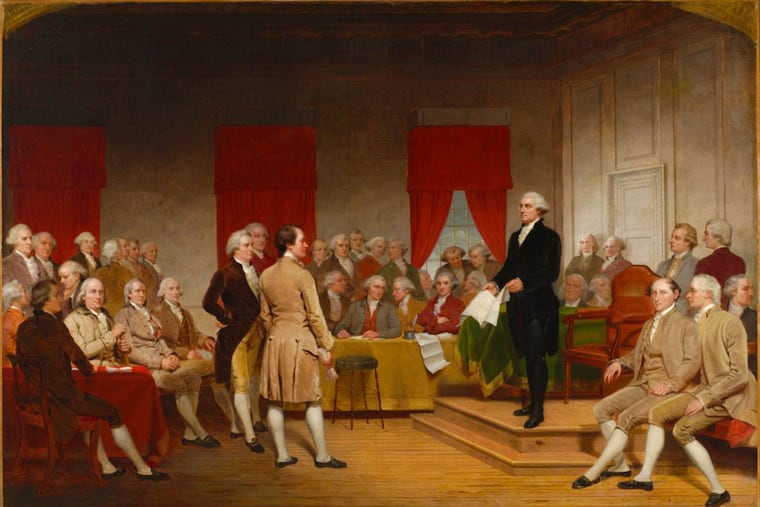
Rep. Tom Kean Jr. has always felt the mighty weight of his family’s history at the apex of political power in New Jersey, stretching back to the nation’s founding, when his ancestor William Livingston served as a brigadier general with the colonial militia under George Washington and then as the state’s first governor. Since then, the family has churned out two U.S. senators, two governors, and three members of the House — including the embattled scion, who now carries the torch.
“There is certainly a sense of obligation based on the distinguished service of his ancestors,” says Leonard Lance, a longtime friend, who represented the district in Congress for a decade until 2019.
But the dynasty is at grave risk today after Kean disappeared for four months, missing 140 votes, with no explanation until Tuesday, when he said in a short speech on the House floor that he had been hospitalized with severe depression.
The race was tough to begin with for Kean, given the poisonous dislike of President Donald Trump in New Jersey and Kean’s unwavering fidelity to him. Now, Kean’s absence has handed Democrats a potent new weapon.
How, they ask, can he justify his vote for deep cuts in Medicaid and the Affordable Care Act through the Big Beautiful Bill, which deprived more than 300,000 Jersey residents of health coverage they might have relied on to address the same problem? What would he have done without his own cushy congressional coverage or his vast personal wealth, which he’s valued at a minimum of $12.4 million?
So far, Kean has declined to address that question.
» READ MORE: New Jersey’s Tom Kean ends his months-long absence from Congress, saying he was being treated for depression
What about the stock trades he made while absent from Congress? How is it possible, Democrats ask, that he was able to tend to his own finances but not the public’s business?
“This is the self-serving culture in Washington that New Jerseyans are rejecting, and the kind of behavior they are sick and tired of,” says his opponent, Rebecca Bennett, a former Navy helicopter pilot.
That one has nuance. Kean has said he knew nothing about the individual trades made by his stockbroker, even before his illness.
Still, the trades could prove costly for Kean. In his 2022 campaign, he promised to establish a blind trust, and four years later, he still has not done so. Plus, in that campaign, he scorched his Democratic opponent, Tom Malinowski, for his undisclosed stock trades and accused him of insider trading — even though Malinowski offered precisely the same explanation, saying his broker made trades without his input. Why should we trust Kean’s word, but not Malinowski’s?
And finally, what about Kean’s pledge of “full transparency” about his illness? What hospital did he use, and what kind of treatment did he receive? Were there complications, like substance abuse? And what’s the risk that this might happen again? A 2022 study published by the National Library of Medicine found that 30% to 85% of those who suffered severe depression have a relapse or recurrence.
Kean declined to answer questions on his condition. Full transparency, this is not.
Will any of this cost Kean at the polls in November?
Dave Wasserman of the Cook Political Report still rates the contest as a toss-up. The district was redrawn after the 2020 Census to strengthen the Republican vote, and while Gov. Mikie Sherrill carried the state by 14 points last year, she squeaked by in District 7 by just 2 points. Kean won by 5 points in 2024.
“This is definitely not helpful to Kean,” Wasserman says. “The question is to what extent it’s harmful.”
The damage may be limited, he says, because voters have set opinions about Kean after his four years in Congress and 21 years in the state legislature. And Trump’s standing among college-educated Republicans, like those in Kean’s wealthy suburban district, has not suffered the same drop as it has among working-class Republicans, Wasserman says, perhaps because it was weaker to begin with.
My bet is on Bennett, whose profile closely tracks that of the popular governor, Sherrill. Both broke barriers as helicopter pilots who served in the Mideast. Both are telegenic moms who call themselves centrist Democrats. And both have the gift of gab.
But who knows? Wasserman estimates that Republicans will spend about $2 million, and since Bennett is a newcomer, she may be vulnerable to personal attacks. Plus, Democratic primary voters just selected hard-left nominees in two neighboring districts — Adam Hamawy in the 12th and Analilia Mejia in the 11th — and Republicans may see that as an opportunity.
» READ MORE: A N.J. congressional candidate’s ties to a convicted terrorist mastermind deserve a careful look | Opinion
“She may need to be explicit about where she’s different from nearby Democrats,” Wasserman says.
And that could prove awkward, says Mike DuHaime, who ran Chris Christie’s campaigns for governor. “It puts her in a weird spot because a bunch of her most ardent supporters probably love those folks,” he says.
The Kean dynasty, of course, might survive a loss in November. Kean could run again, or a new generation could pick up the torch. But America seems to have grown weary of political families like the Clintons and Bushes. In November, we’ll find out if New Jersey has had enough of the Keans.
Tom Moran is the author of the Substack Jersey Lowdown and former editorial page editor of the Star-Ledger in Newark, N.J.