Ten years after Philly killed hitchBOT, the robots are back. Let’s be nice this time.
Other cities are putting delivery robots to work for the public good, but Philadelphia has a proposal to tax them out of existence, writes Lindsay Ouellette.
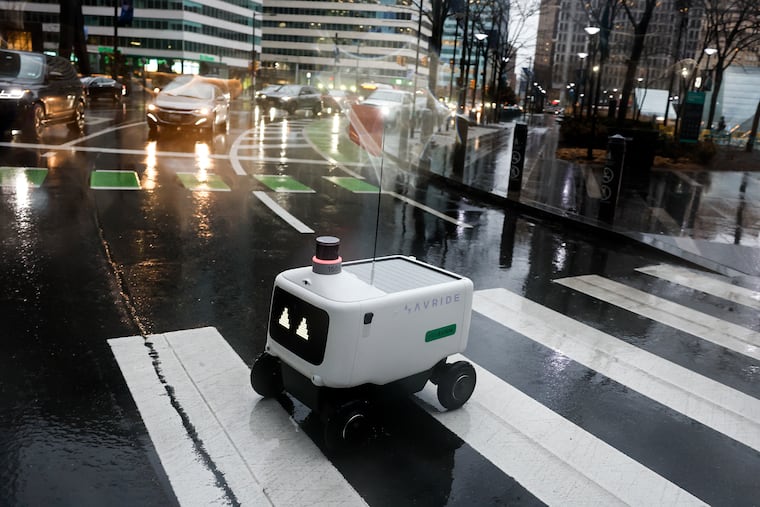
Philadelphia is known for some great things: the Declaration of Independence (happy 250th!), Rocky, and the cheesesteak. It is also known for “killing” hitchBOT, the famous hitchhiking robot that was dismembered in August 2015. A decade later, there’s a new bot in town: the Uber Eats delivery robot, operated by Avride.
When these robots first arrived, I had my own spontaneous encounter with one. I was surprised by how unsettled I felt, especially as someone who has spent years researching them. I am an expert in human–robot interaction, and my research focuses on why people abuse robots. I immediately wondered how long it would be before another robot made headlines in this post‑hitchBOT world.
It only took 18 days.
Since these delivery robots rolled into town, they have been making headlines for all the wrong reasons: getting beat up, hit by cars, and colliding with pedestrians. These coolers on wheels are having an effect on Philadelphians, and I do not blame my fellow city dwellers.
We are living in a cultural climate where artificial intelligence and automation are often framed as threats to jobs amid inflation and economic anxiety. Layer on top of that Philadelphia’s unique reputation as a destroyer of robots, and the reaction is hardly surprising.
With innovative technology, there is always disruption. When UberX and Lyft arrived, Philadelphians were up in arms about the traffic congestion caused by rideshare vehicles, a problem the city later officially acknowledged.
Yet in less than a decade, the norm quietly shifted. Today, many of us hail a rideshare instead of a taxi despite the unresolved congestion issue. The question now is whether we will react to delivery robots as another passing disruption, or whether we will choose to use them to actually improve city life.
Recently, Councilmember Jeffery Young proposed a $1,000 surcharge on deliveries made by autonomous delivery devices using city sidewalks. That may sound like mere regulation, but in practice it would push the robots out entirely. Before Philadelphia taxes these devices into irrelevance, we should look at how other cities are putting them to work for the public good.
West Hollywood, for example, has had delivery robots on its sidewalks since 2020. On Jan. 1, 2026, the city implemented a new program, the first of its kind, to use data and fees from these devices to improve and pay for sidewalk repairs. In this program, companies that operate delivery robots partner with an accessibility app used by blind and low-vision residents. As they travel city streets, the robots can report real-time obstacles such as blocked sidewalks, helping make navigation safer. The city then uses information gathered by the robots to map accessibility problems and prioritize sidewalk improvements.
The companies also pay a daily fee for each robot in their fleet, plus an advertising fee (about four dollars per day per device) with that advertising revenue directed into a sidewalk repair fund that is expected to bring in roughly $40,000 to $80,000 per year.
In other words, the robots are not just delivering takeout; they are quietly scanning the city, funding basic infrastructure, and making the streets more accessible.
There are a lot of potential benefits: using robot data to measure and assess street conditions, cutting down on short car trips by shifting them to small electric devices, and easing traffic congestion on already strained streets.
These are practical, achievable ways to use technology to help address the climate crisis and long‑neglected infrastructure. This moment should also demonstrate that it’s past time for us to stop pretending we can opt out of technological change altogether.
Philadelphia City Council should resist a blanket $1,000 surcharge that effectively bans delivery robots and instead work with residents, robotic operators, advocates, and experts in human–robot interaction to build a Philadelphia version of West Hollywood’s data‑and‑sidewalk‑repair model.
If we are going to share our streets with robots, we should make sure the companies profiting from them are paying their way and helping fix the sidewalks they roll on.
Will Philadelphia embrace that possibility, or will we become a city of Robo-NIMBYs, elected officials and residents alike?
Lindsay Ouellette is a Philadelphia-based social psychologist and human-robot interaction researcher who studies public responses to robots and emerging technologies. She recently earned her doctorate from Temple University, where her research examined aggression toward robots.