Drone units competition awards e-points for the most kills
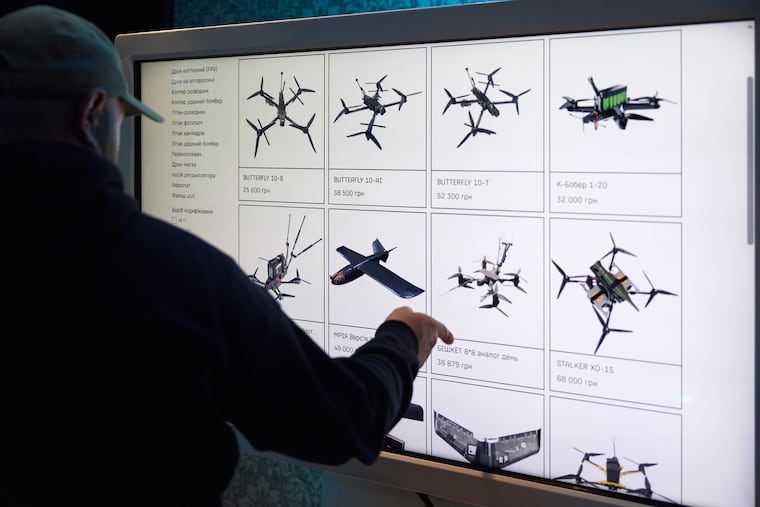
“Call it an Amazon for the military,” says Artem Moroz, head of investor relations at Brave1, whose company operates the online marketplace.
» READ MORE: DRONE GLOSSARY
EASTERN UKRAINE — The UAV Forces Battalion of the 59th Assault Brigade, commanded by a soldier known by the call sign Condor, has one of the best records in taking out Russian targets. I visited his battalion headquarters in the basement of an empty building in a rural area in the direction of Pokrovsk, a hotly contested town in the east.
The 31-year-old Condor was a young teacher of Ukrainian and world history in the northeastern Ukrainian city of Vinnytsia when Russia invaded the first time in 2014. At 23, in 2016, he volunteered to fight against Russian and collaborationist forces in Ukraine’s eastern Donbas.
“Since 2016, I have been promoted to be a commander of history,” he told me, ruefully.
Although he has five children at home — his daughter and four nieces whom he and his wife took in after the death of his older sister — he sees his daughter only twice a year. He managed to make it for one day to her graduation. “Of course, I do this for them,” he said.
Condor’s battalion holds a stretch of territory along the Pokrovsk front where his drone pilots sometimes operate only 1,500 feet from the zero line. “Ninety per cent of the hits we do are made by different types of drones,” he told me. “Only technology allows us to win.”
The 15-mile stretch from the zero line has become a kill zone because of Russian drone coverage — especially due to fiber optic drones, which can’t be jammed. To save lives, Condor’s unit now relies on so-called land drones: robotic carts that deliver supplies and ammo and carry out the wounded.
“The Orcs outnumber us, and they don’t care about loss of lives,” Condor tells me, referring to the Russians, as many here do, by the name of the goblin-like soldiers in The Lord of the Rings series. “In this new way of war, infantry and artillery and mortars still matter, but everything is controlled by air. Now a military is just a way of supporting drones.”
Points and prizes
The Ukrainian government instituted the Army of Drones bonus program last year to incentivize units to hit more targets and innovate. Members can earn e-points for hitting Russian soldiers and equipment and exchange those points for new equipment via an online store.
One underlying goal is to shake up the defense ministry’s old-style procurement bureaucracy to recognize the growing importance of unmanned warfare. Small drone teams play an ever-expanding role but need more men and more unmanned aerial vehicles, or UAVs, to protect the front line.
A whiteboard tacked to the wall of Condor’s headquarters is used as a monthly calendar on which the number of Russian troops and equipment destroyed by his drone team are tallied daily with a felt tipped pen. “Every day we markup Russian losses, the number of crew, or military targets. We earn points based on the type of target we eliminate,” he explained.
As drone warfare has evolved, the point system has shifted. A tank kill is now worth only eight points, while eliminating a drone pilot racks up 25. “Every day at least 14 are eliminated,” Condor tells me proudly, referring to enemy casualties. The average is one of ours for 10 of theirs. We even had days when it was 1 to 20.”
Every kill must be verified by a video. That’s no problem: drone pilots instantly send videos of their kills back to their commanders, and the messaging app Telegram has long been filled with Ukrainian — and Russian — drone footage of tanks and soldiers chased by drones, before a big flash indicates a hit and the screen shifts into fuzz.
Each month, the military puts together a list of the top drone units who have scored the most points. Condor’s UAV battalion came in first in January and sixth in May. “Ninety percent of the hits we do are made with drones,” he said.
Points can then be exchanged through the online Brave1 Market, where units can purchase all kinds of drones, components, robots, and other military gear.
“Call it an Amazon for the military,” I was told by Artem Moroz, head of investor relations at Brave1, the government program that encourages private tech start-ups, including through seed grants.
More than a thousand products in the online catalogue are linked to hundreds of private drone producers, who can verify prices and availability. The catalogue will soon introduce a review system, whereby soldiers on the front can rate the performance of what they buy with points.
For Condor, the competition speaks to the urgent need to recruit more drone pilots and navigators — and motivate exhausted drone teams on the front.
The Russians are catching up with Ukraine on technology, he said, “because their tech people are supported with unlimited government resources (and manufacturing capacity).
“We need European investment in drone production badly. It is the basis for our whole victory. We are like a Polygon” — the Ukrainian term for a testing ground — “for Europe.
“The Europeans are well supplied and organized but don’t know the realities of war. For them [working with Ukraine], it is an opportunity to understand the future.”
It is criminal for the United States to pass up the opportunity to learn more from Ukraine as well.