The President’s House court ruling is a crucial win for the power of truth | Editorial
“Each person who visits the President’s House and does not learn of the realities of founding-era slavery receives a false account of this country’s history,” wrote Judge Cynthia M. Rufe.
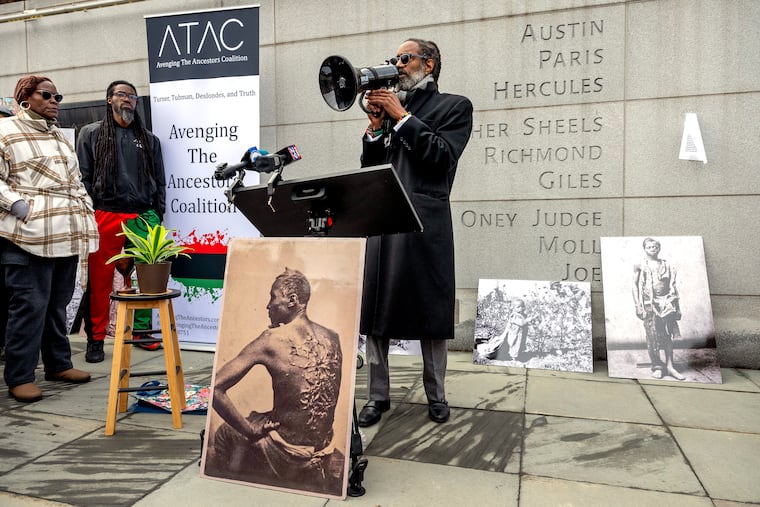
For one day at least, Donald Trump’s bigoted effort to whitewash history was foiled in Philadelphia.
A federal judge ordered the Trump administration to restore the slavery exhibits that were removed last month from the President’s House in Independence National Historical Park.
Fittingly, the legal rebuke came during Black History Month as Trump tries to rewrite America’s history of slavery, undermine voting rights, and rollback civil rights efforts designed to live up to the Founding Fathers’ vision of a country where all are created equal.
Even better, the ruling came on Presidents Day, a federal holiday first set aside to honor George Washington, who voluntarily gave up power, unlike Trump, who was criminally indicted for trying to overturn an election he lost.
In a poetic touch that feels conjured by Octavius V. Catto or William Still, the Trump administration lost in federal court on a lawsuit brought by the City of Philadelphia, which is headed by its first African American female mayor.
The President’s House exhibit was created to recognize the enslaved people who lived in Washington’s home in Philadelphia while he was president. Like the nearby Liberty Bell and Independence Hall, the President’s House is an essential part of American history.
Trump wants to airbrush the parts of American history that do not fit with his racist record and white supremacist messaging. But understanding how slavery shaped the economic, social, and political forces across the United States is crucial to addressing the systemic racism and inequality that persists today.
U.S. District Judge Cynthia M. Rufe called out Trump’s cruel attempt to take the country backward in unsparing terms. She began her 40-page opinion by quoting directly from 1984, George Orwell’s dystopian novel about a totalitarian regime:
“All history was a palimpsest, scraped clean and reinscribed exactly as often as was necessary. In no case would it have been possible, once the deed was done, to prove that any falsification had taken place.”
She compared the Trump administration’s claim that it can unilaterally remove exhibits it does not like to Orwell’s Ministry of Truth.
“As if the Ministry of Truth in George Orwell’s 1984 now existed, with its motto ‘Ignorance is Strength,’ this Court is now asked to determine whether the federal government has the power it claims — to dissemble and disassemble historical truths when it has some domain over historical facts,” Rufe wrote. “It does not.”
Rufe, who was appointed to the federal bench by former President George W. Bush, did not buy the Trump administration’s authoritarian argument. “[T]he government claims it alone has the power to erase, alter, remove and hide historical accounts on taxpayer and local government-funded monuments within its control.”
She added: “The government here likewise asserts truth is no longer self-evident, but rather the property of the elected chief magistrate and his appointees and delegees, at his whim to be scraped clean, hidden, or overwritten. And why? Solely because, as Defendants state, it has the power.”
Rufe dismissed those claims and ordered the federal government to “restore the President’s House Site to its physical status as of January 21, 2026,” the day before the exhibits were removed.
Initially, Rufe did not set a deadline to restore the displays. But she updated her order, requiring the exhibits to be restored by 5 p.m. Friday.
The Trump administration will likely do everything it can to drag out a resolution.
There is no time to waste in ending this racist charade.
The country is celebrating the 250th anniversary of the signing of the Declaration of Independence. It is a national embarrassment that the President’s House exhibits are missing while the city expects 1.5 million visitors this year.
Philadelphia is the birthplace of America. It is here that the founders declared their independence from King George III. Their list of grievances against the king echoes some of Trump’s abuses.
Judge Rufe’s order struck a blow for telling the truth, something Washington would appreciate.
“It is not disputed that President Washington owned slaves,” Rufe wrote. “Each person who visits the President’s House and does not learn of the realities of founding-era slavery receives a false account of this country’s history.”
Somewhere, the enslaved who labored at the President’s House smiled.
Say their names: Ona Judge, Hercules Posey, Moll, Giles, Austin, Richmond, Paris, Joe Richardson, Christopher Sheels, and William Lee.