After a Supreme Court ruling that was an affront to history, some states can’t wait to turn back the clock on voting rights | Editorial
After long ago overcoming racist efforts to dilute the power of voters of color, the conservative justices have unreasonably made it more difficult to challenge discriminatory legislative maps.
Those who cannot remember the past are condemned to repeat it. — George Santayana
Perhaps the most frustrating aspect of the U.S. Supreme Court giving its seal of approval to Republican attempts to turn back the clock on voting rights in America is that, after long ago overcoming racist efforts to dilute the power of voters of color, we now see similar vipers slithering past the corroded gates of hell that were supposed to hold them in check.
The court defied reason with an opinion that, in essence, neutered the 1965 Voting Rights Act by ruling government efforts to remedy past racism, which tipped the scales in favor of white political candidates, are also racist — unless those remedies can be tied to specific acts of past discrimination that made them necessary.
The decision has opened the door for states to attempt to invalidate any congressional district lines drawn to favor candidates of color.
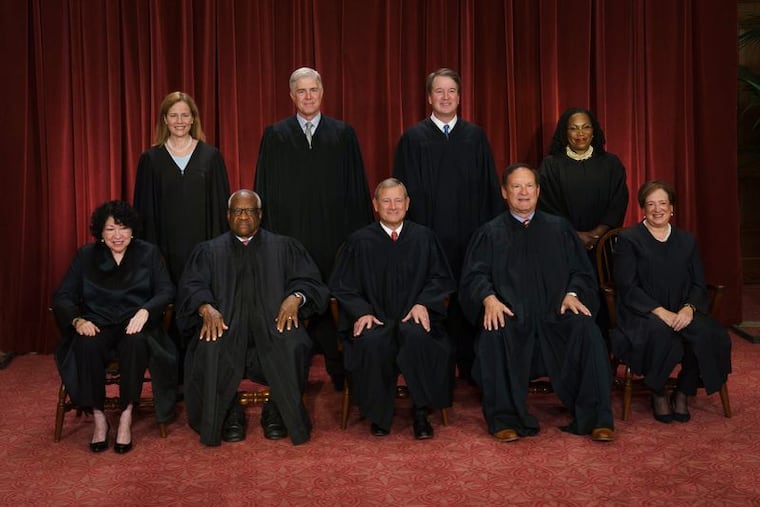
The court’s conservative majority, led by Chief Justice John Roberts, has given Republican-controlled state governments permission to abandon congressional district lines that were drawn after the Voting Rights Act was passed 61 years ago. The purportedly nonpartisan justices gave Republicans another assist Monday by granting a request to immediately finalize their ruling so legislatures can redraw district lines to favor GOP congressional candidates before the Nov. 3 midterms.
Some could hardly wait. A day after the initial ruling, Louisiana Gov. Jeff Landry suspended ongoing House primaries — in which about 42,000 votes had already been cast — so his state’s GOP-controlled legislature can produce a new map. Governors in Tennessee and Alabama have already called lawmakers into special session to make the changes.
This foul-smelling scheme seems so un-American, but actually it’s eerily similar to the post-Civil War, racially biased political machinations that occurred after President Abraham Lincoln was assassinated in 1865, just five days after Confederate Gen. Robert E. Lee surrendered to Union Gen. Ulysses S. Grant. The fate of Black people was subsequently left largely in the hands of new President Andrew Johnson, a former enslaver and vehement racist from Tennessee.
The 14th Amendment making Black people full citizens was passed by Congress in 1866 despite the veto of Johnson, who said making “our entire colored population” citizens would discriminate against “intelligent, worthy and patriotic foreigners … in favor of the Negro,” who, due to his “previous unfortunate condition of servitude,” is less informed “than he who, coming from abroad, has to some extent, at least, familiarized himself with the principles of a government.”
The 15th Amendment, which explicitly prohibited racial discrimination in voting by men, became law in 1870. (It would be another 50 years before women received the same privilege.) Despite the law, terrorist groups such as the Ku Klux Klan, Knights of the White Camelia, and the Pale Faces used lynchings, beatings, and other fear tactics to make sure formerly enslaved people — who in many Southern communities outnumbered their former masters — remained segregated and didn’t dare vote.
Such intimidation wasn’t limited to the South. On Oct. 10, 1871, Union Army veteran Octavius V. Catto was headed to the polls from the school where he taught to take part in only the second election open to Black Americans in Philadelphia. Black neighborhoods were terrorized that day, and Black men were shot for attempting to vote. Catto voted, but while walking home, was shot and killed by Frank Kelly, a white man with ties to a local white supremacist organization. Kelly was arrested and tried for murder, but acquitted by an all-white jury.
Under Johnson and his successors, Grant and Rutherford B. Hayes, the Reconstruction program aimed at raising Black people from former servitude to full participation in America’s democracy was eventually abandoned. Lee, former Confederate President Jefferson Davis, and other rebel leaders received little, if any, punishment for the rebellion. Many instead returned home and participated in activities to keep Black Americans subservient, which included not allowing them to vote.
Meanwhile, the Supreme Court, between 1873 and 1883, issued ruling after ruling that weakened laws passed to protect the rights of Black people. It undercut the Civil Rights Act of 1875 with an 1883 opinion that said the federal government lacked the power to initiate civil rights lawsuits, even though many Black people didn’t have the means to hire attorneys. In 1896, the high court ruled 8-1 in the infamous Plessy v. Ferguson case (Justice John Marshall Harlan being the only dissenter) that segregation laws were constitutional.
“If the civil and political rights of both races be equal, one cannot be inferior to the other civilly or politically. If one race be inferior to the other socially, the Constitution of the United States cannot put them upon the same plane,” said the court. The fallacy of that reasoning, of course, was that Black Americans were not being treated equally in politics either. Klan activity and the literacy tests and poll taxes that came later suppressed the Black vote. So much so that between 1901 and 1929, there were no Black members of Congress.
History tells us the Supreme Court is not unbiased, but rather like any other political entity, subject to the views of each justice based on experience and current associations. History also tells us it is the responsibility of Congress to course-correct, when necessary, with effective and durable legislation.