What my late father-in-law taught me about letting go with grace | Jenice Armstrong
Frost Douglass Turner showed me by example how to enjoy simple pleasures.
The day after Father’s Day, I got a call to meet my husband at the hospital.
His 95-year-old father, who’d moved in with us during the pandemic, was fading fast. I was shocked. His birthday was in less than a week.
The last time I’d seen him a few days earlier, he looked OK. Just a little dazed as the paramedics wheeled him away to the hospital to be checked. He had a urinary tract infection and aspirational pneumonia in one of his lungs, but I didn’t expect that was a big deal. At the hospital, he’d perked up and raved about the food. He’d sent a message for my husband and me to go on vacation. He said he’d spend a few days at the hospital recuperating. We were relieved, thinking he’d go from there to a rehabilitation facility where he could get his strength back and work on his swallowing.
But on June 19, we learned he’d aspirated again at the hospital — this time on an antibiotic crushed in applesauce. He was unconscious. Now, instead of checking into a rehabilitation facility, he would go to hospice. His nurse didn’t think he’d make it that far. Shortly after I got to his room, his breathing started slowing drastically. He was slipping away. Relatives told him goodbye over Zoom. We sang “Amazing Grace” as he took his last breath.
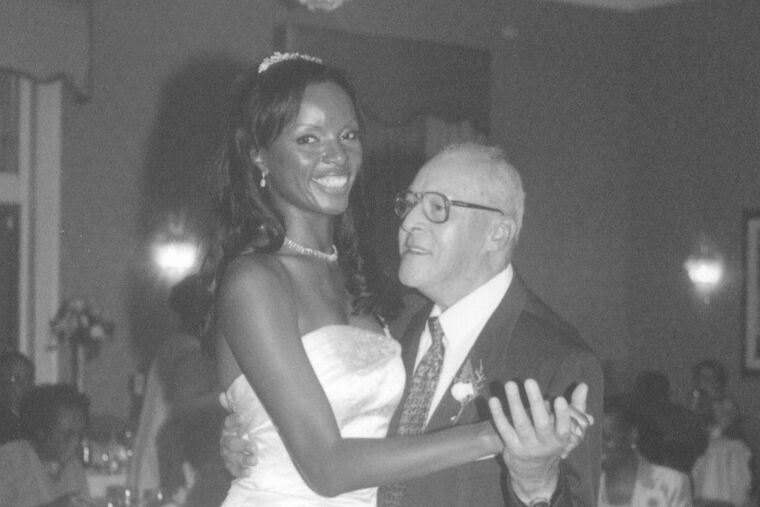
Frost Douglass Turner — son of Frank and Frosty Turner, who helped found the Jamaica, N.Y., branch of the NAACP — was gone. A World War II veteran, he followed his four older brothers into the military by enlisting in the Coast Guard shortly after his 18th birthday in 1943. He saw action in the Atlantic theater and was later deployed as a radioman in the Philippines.
» READ MORE: For our columnist, NAACP is all in the family
Our house felt eerily quiet after his death.
He was no longer there to ring his bell, summoning us only to have forgotten what he wanted. The sounds of classical music that my husband played for him no longer wafted through our house. I tossed the last container of strawberry Jello-O into the trash. When my husband brought his ashes home in a black box, we surrounded them with a few mementos, including his wine glass, white flowers, and sympathy cards.
I felt guilty about the times I had been too busy to spend time with him.
I tried instead to focus on the good moments we’d shared — watching Christmas movies and clinking champagne glasses on Valentine’s Day. Placing my birthday flowers in his room so he could enjoy them, too. In May, he traveled with us to the Outer Banks of North Carolina, where he feasted on lobster and seafood boil. When I rolled his wheelchair to a window so he could enjoy the view of the bay and the swimming pool, he asked, “What did I do to deserve this?”
What I should have asked was, “What did I do to deserve a sweet father-in-law like you?”
During the early years of our marriage when my father-in-law lived with us, I had chafed against it. It’s hard enough getting adjusted to living with a spouse without throwing in an elderly father-in-law who liked to join in our romantic, candlelit dinners.
But if you ever had a parent living with you, you would want it to be someone like Doug.
He rarely put up a fuss. A gentle soul, he would sit quietly and rarely say a word unless someone spoke to him first. When we’d take him on road trips, often, we’d forget he was even in the backseat. He knew all of our secrets but kept them to himself.
I learned a lot from him.
Yes, he taught me not to kill spiders, since they kill other household pests.
He also showed me by example how to enjoy simple pleasures like watching birds flying around outside a window. He ate heartily and without a lot of fuss. He was a master at accepting how things were instead of railing about how much better they could be. Mostly though, during the last seven months after he’d moved back in with us, Doug taught me by example about letting go with grace.
It was his final gift.