The whitewash is the lesson
The debate over history is here. It’s happening all around us. The only question is whether we have the courage to expose our young people to it.
I taught high school history in Vermont in the 1980s, during the waning years of the Cold War. When we got to Hiroshima and Nagasaki, I dug up the translation of a Soviet textbook and made copies of the pages that described America’s atomic attacks on Japan.
I gave the pages to my students and asked them to compare the Soviet account to the one in their textbook, which said the U.S. dropped the bombs because Japan wouldn’t surrender. By contrast, the Soviet book claimed that our real aim was to demonstrate our technological prowess and block the global spread of communism.
Many years later, I got an email from a former student who said that exercise opened her mind to the way different people think about the world. And it made her realize that history isn’t simply a record of names, dates, and events. It’s a debate about their meaning and significance.
We have a great opportunity to teach that lesson right now. And we don’t have to look abroad to find material for it.
The debate over history is here. It’s happening all around us. The only question is whether we can muster the will — and the courage — to expose our young people to it.
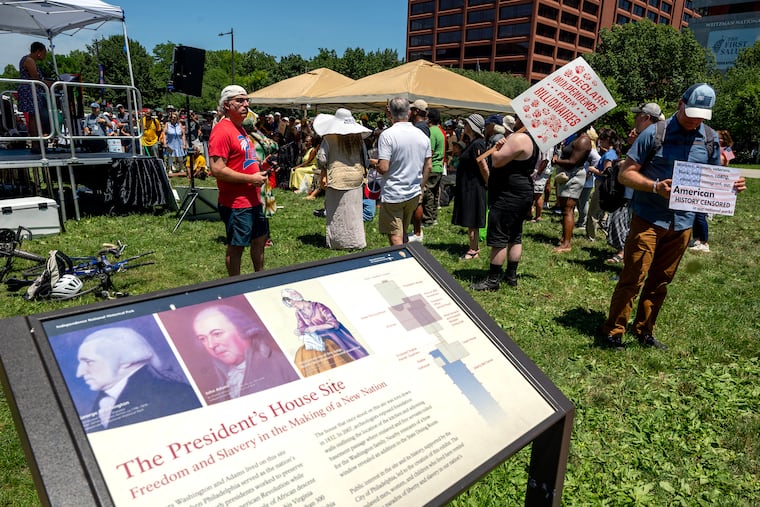
Consider the controversy over slavery exhibits at the President’s House here in Philadelphia. Back in January, the Trump administration ordered the removal of panels about the nine African Americans whom George Washington enslaved. And last month, a federal appeals court upheld the right of the White House to replace those panels with, yes, a different interpretation.
The administration’s new panels — which you can read online — acknowledge that Washington and other Founding Fathers practiced slavery. But the panels remove earlier language, highlighting its brutality. Instead, we are told, enslaved people living in the President’s House “experienced a greater modicum of autonomy than elsewhere.”
On July 4, protesters converged upon the site and taped printed copies of the original panels to the walls. “I know they’ll get torn down,” one demonstrator said, “but hopefully there’s enough people here today for the holiday that they’ll be seen, and maybe it’ll inspire someone else to do the same.”
Here’s who I hope will be inspired: America’s history teachers. They should give the text of the original panels — and also of the new ones — to their students, just as I shared American and Soviet interpretations of the atomic bombings.
And they should ask their students about the differences. Why did one of the earlier panels highlight “The Dirty Business of Slavery” — especially the buying and selling of human beings — and why did the Trump administration omit that? Why did it also leave out most of the details about Ona Judge, Martha Washington’s personal maid, who escaped to freedom in 1796?
Teachers should also share the Trump administration’s recent report attacking the Smithsonian’s National Museum of American History. There’s too much at the museum about racism and oppression, the White House says, and not enough about progress and freedom.
Again, is that right? Schools that are close enough to Washington, D.C., should take students to the museum and let them decide for themselves. Everyone else should assign the Trump administration report and rejoinders to it by historians and others.
Teachers have been doing lessons like that for a long time. In the 1980s, Oregon history instructor Bill Patterson had his students compare their state-approved textbook with A People’s History of the United States by radical scholar Howard Zinn.
And if you think this was all just an exercise in left-wing propaganda, think again. Patterson’s students wrote letters to Zinn and took issue with his interpretations, including his claim that the bombings of Hiroshima and Nagasaki were unnecessary.
I can’t remember what my own students decided about America’s use of atomic weapons in Japan. But I’m glad I didn’t give them a single interpretation of it. That’s not education; it’s indoctrination.
News flash: We disagree about our nation.
A few days after he returned to the presidency in January 2025, Donald Trump issued an executive order “ending radical indoctrination in K-12 schooling.” But in its first sentence, the order calls on schools to “instill a patriotic admiration for our incredible nation.”
That’s indoctrination, too. I know the White House doesn’t want the kind of debate I’m advocating here. But neither do some people on the left, who will inevitably dismiss my approach as “bothsidesism.”
Please. Our students need to come to their own conclusions about the President’s House, the Smithsonian, and everything else. If you only want them to hear your side, you’re in the same league as Trump and his disciples.
News flash: We disagree about our nation. On its 250th birthday, the best way to celebrate it would be to present our differences to our students openly and honestly. It’s not our job to tell them what to think. It’s their job to figure it out.
Jonathan Zimmerman teaches history and education at the University of Pennsylvania. His next book, “Schooling Citizens: How Education Can Save Democracy,” will be published in the spring by the American Philosophical Society Press.
Editor’s Note: An earlier version of this column incorrectly noted that the story of Ona Judge, a woman enslaved by George Washington, was not part of a new display at Independence Mall. She is, in fact, featured in the exhibit.

- College should be more challenging, but Harvard’s cap on giving A’s teaches the wrong lesson about hard work
- Memo to Democrats: No more purity tests. (I’m looking at you, Chris Rabb.)
- At Penn, we’re all Jews now
- Why I agreed to debate conservative podcaster Steven Crowder — and why it didn’t happen
- Challenge the high school student group inspired by Charlie Kirk, but don’t censor it