Letters to the Editor | May 15, 2026
Inquirer readers on declining rates of voter participation and redistricting efforts across the nation.
Be proactive
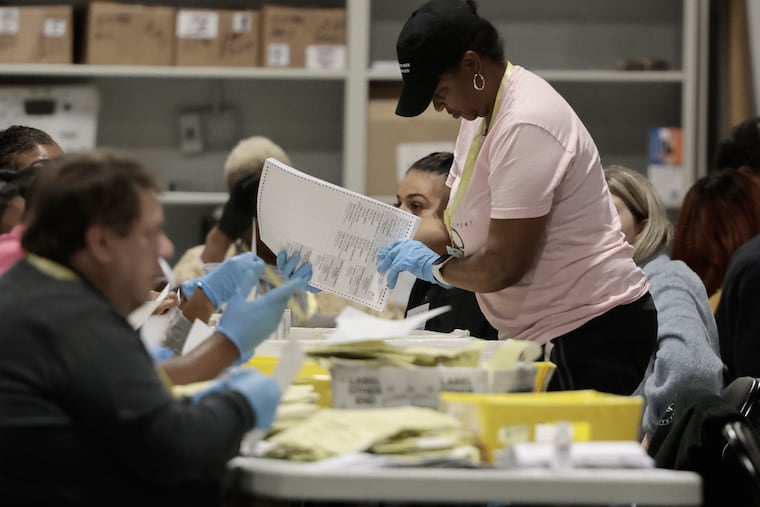
One-third of registered voters in Philadelphia, more than a quarter of a million people, did not vote in the November 2024 election. Why? Was it because they thought the two political parties and candidates were so alike that their vote did not make a difference?
After a year of this Republican president backed by a Republican-led Congress, what do the nonvoters think now? The Republicans have made Affordable Care Act health insurance more unaffordable, cut Medicaid, cut SNAP benefits, imposed Trump tariffs costing every American family about $1,000 every year, and collapsed the job market.
Donald Trump’s administration has deployed an untrained paramilitary force on our streets for mass deportation, and the Republican-led Congress gave them billions of our tax dollars. They are buying warehouses to detain immigrants — most of whom have no criminal record — with billions more of our tax dollars.
Trump’s administration has attacked Iran, costing both lives and $30 billion so far.
Every election is important for the well-being of our families and community. Be a voter, every time.
Ann Dixon, Havertown
Blame misplaced
Joel Naroff’s recent op-ed correctly identifies many of the historic and structural problems facing Philadelphia’s school system: declining population, aging buildings, shrinking tax base, and political resistance to reform.
However, Naroff misses the mark on charter schools. He argues charter schools “siphon off funds” from district schools. But only a portion of the per-pupil funding follows students to charters, meaning the district retains significant funding even after losing students.
But that framing is backward: Charter schools exist because families are seeking better service elsewhere. Instead of blaming competitors, a good business would ask, “Why are we losing customers?”
A true customer-centered model would empower parents and kids to choose their own paths. This includes expanding access to charter schools, increasing voucher and scholarship opportunities for kids in failing schools, and opting into the new federal scholarship tax credit.
In virtually every other sector of society, competition drives innovation and accountability. Education should be no different. Economically speaking, the Philadelphia School District must adapt and improve — or else it risks its continued decline.
The goal isn’t to bail out a failing business. The goal is to encourage it to better serve its customers and provide a better product.
Andrew Lewis, president and CEO, Commonwealth Foundation
Democratic representation
Republican-led redistricting efforts aim to diminish the voting strength of communities that are mostly Black. These efforts, if successful, could all but eliminate Black representation in Congress. Just as troubling is the loss of Democratic representation. Black districts led by Democrats fare better than Black districts led by Republicans. Democratic-leaning districts elect representatives who prioritize social services, economic growth, and development. Democratic representatives are in tune with the needs of their constituents. Good public education, creating job opportunities, affordable housing, and access to medical facilities all become priorities when Democrats take office. Many Black voters fear they will lose their voice in the years to come. A core tenet of American democracy is to ensure fair and equal representation for all. In these recent gerrymandering efforts, Black voters are being silenced. This silencing should alarm us all.
Celeste D’Alonzo, Philadelphia
Comparative analysis
Here we are, saddled with a war with Iran — a war brought on by our president, a war in which we as taxpayers have had no input, a war not condoned by our Congress, and engaged in without due congressional process. This war is being drawn out by the ego of our rapidly failing president.
I want to see (as every other American should want to see) copies of the American peace proposal and that Iranian response, which the president called a “piece of garbage.”
I want to read the “garbage” the Iranians ask for. I want others to read both our terms and Iran’s terms. I do not want to see this war continue because Donald Trump doesn’t want this war to end on anyone else’s terms but his.
Philip A. Tegtmeier Sr., Honey Brook
Equitable housing
The Inquirer recently published a letter to the editor from Councilmember Quetcy Lozada regarding the Turn-the-Key homeownership program. This submission is different: We are writing as residents of the Norris Square neighborhood, and speaking from the community directly affected by this issue. Our letter also responds to characterizations raised by columnist Daniel Pearson that were not addressed in the councilmember’s letter.
Characterizing the councilmember as an obstructionist oversimplifies a complex issue and ignores the data-driven reality of our community’s housing needs.
The Norris Square community is unified in promoting homeownership for working families, particularly among African American and Latino renters who are being disproportionately locked out of the housing market. We have already seen a nearly 18% population loss among these groups due to the saturation of market-rate housing and out-of-control, unregulated rents. Currently, many of our residents spend nearly 40% of their income on rent, making it impossible for them to save for a down payment.
Councilmember Lozada’s proposal to reform the city’s housing programs would strengthen them for all stakeholders — targeting families who otherwise could not afford to purchase a home, minimizing community opposition, reducing land transfer delays, and expediting construction timelines.
Our community refuses to let private developers or their stenographers reconfigure our Norris Square neighborhood. Our focus remains on economic equity for working people, irrespective of race, and a fair share of how public resources are allocated.
Nilda L. Pimentel and the Rev. Adan Mairena, Philadelphia
Created equal
It is evident America is now desperately ill and in the throes of a second civil war. The nine-hour prayer fest the White House is planning will fan the flames of this illness in a country dedicated to religious freedom. In my quandary of how best to communicate amid the epidemic of prejudice and ideological entrenchment we face, I decided to turn to America’s roots, our Declaration of Independence, for guidance. In doing so, I found it interesting that Thomas Jefferson did not say all men are born equal. He used the word created, thinking, I believe, in theological terms — equality in relationship with their Creator, not in birth opportunities provided. Nothing in this brave declaration specified a god who favors one religion over another. Or, in fact, that one must adopt a faith.
In Matthew 22:21, when Jesus says, “Render therefore unto Caesar the things which are Caesar’s, and unto God the things that are God’s” — to me, Jesus references the distinction between our relationship with God and the inequalities of birth, surroundings, and opportunities. This underscores that life is neither fair nor just — that some are born with far more opportunities for success and fulfillment than others. But God wants justice and opportunity for each of us.
It is up to the officials we elect to create these opportunities for safety and fulfillment. Doing so necessitates the election of those with the capacity to lead with courage, compassion, common sense, and awareness of the underpinnings of mature, honorable thinking. Not leaders who pit faiths against each other. Maturity is marked by the determination to make life as fair as it possibly can be — opening doors for better lives for all of our children. Prejudice and exclusion, in the same camp as irrationally expressed rage, whatever its form, take us in the terrifying opposite direction.
SaraKay Smullens, Philadelphia
Restore our elections
After reading Will Bunch’s recent column on the U.S. Supreme Court’s voting rights decision, I am left to wonder if — after all the subpoenas, investigations, non-investigations, accusations, denials, finger-pointing, and gerrymandering — America can survive its current electoral processes? Sadly, the young people will have to rebuild our country, its government, and its relationships with our allies around the world, all while fighting against the tyranny of the uber-wealthy who continue to play the corrupt game we call our elections. This is fixable — if there is a will to clean it up. First and most important, get rid of political action committees — because our politicians are beholden to them and not the people. Next, for national political office, we need totally federally funded elections. State and local folks can do the same. From there, we can move on and eventually fix all the rest.
Frank Friedman, Delanco
Join the conversation: Send letters to letters@inquirer.com. Limit length to 150 words and include home address and day and evening phone number. Letters run in The Inquirer six days a week on the editorial pages and online.