Elite units from Ukraine’s intelligence agencies hit key Russian sites
Ukrainians have had to innovate to strike back at the military sites from which Russia launches its attacks.
» READ MORE: DRONE GLOSSARY
EASTERN UKRAINE — Slava’s appearance had changed dramatically from a year ago when we last met in Kyiv. His eyes were weary, and his deep black beard was now grizzled with gray.
The 43-year-old former commercial director and journalist had volunteered early in the war, and now commanded an elite drone unit for HUR, the Ukrainian Defense Ministry’s military intelligence service. His unit conducts some of the country’s most dangerous missions. And those missions never end.
Operating from the zero line, his men are called in to launch long-range drones that attack sites deep inside Russia. Their goal is to destroy Russian military logistics at the source.
Before an assignment, they return to home base, pack up every conceivable drone and piece of equipment they may need, and head for the front lines to reinforce or assault.
“We do R&D in the trenches when we find a problem we didn’t expect,” he tells me.
The United States never gave the green light for Kyiv to use its longest-range U.S.-made ATACMS missiles to target Russian aerodromes or military production sites, so the Ukrainians have had to innovate to strike back at the specific locations from which Russia launches bombs, missiles, and Shahed drones.
Drones can’t substitute for ATACMS, which can cover a huge area and pack a much more powerful explosive payload than unmanned aerial vehicles, as Slava told me while we bumped along over a dirt road to a HUR testing site, somewhere heading east. “You need 20 to 30 drones to cover the same area as one of the missile systems,” he continued, “but in terms of the economics of war, the drones are much cheaper than a missile.”
The most stunning drone success story was Operation Spiderweb, which destroyed or damaged around 40 Russian warplanes, including supersonic bombers, worth billions of dollars. It was conducted by Ukraine’s chief internal intelligence agency, and HUR’s friendly rival, the SBU.
The June attack, at five different military airports, was done with 117 cheap FPV drones smuggled deep inside Russia within wooden containers on commercial flatbed trucks driven by unwitting Russians.
Less noticed in the West, however, on the very same day as Spiderweb, HUR hit two trains and a newly built part of a railway in the occupied Donbas region that “blew up a whole Russian logistical supply chain.”
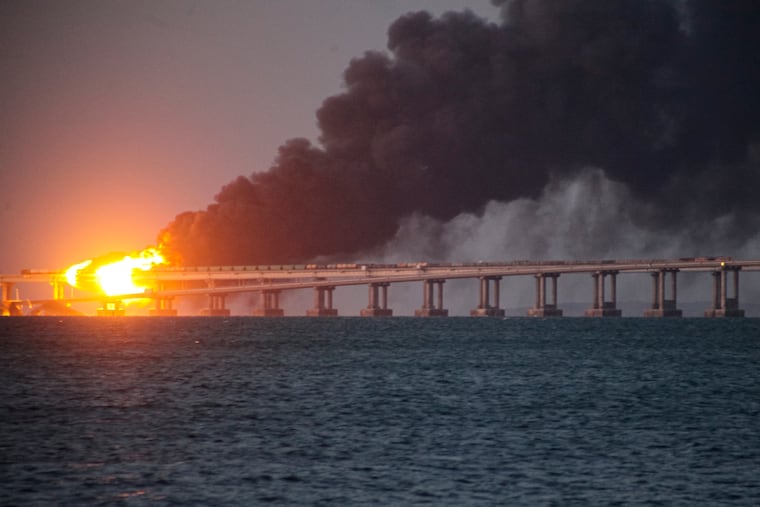
Two days later, an SBU sea drone hit the base of the Kerch Bridge from Russia to Crimea, which can no longer handle heavy trucks or rail traffic because of a previous Ukrainian strike.
“The main task is to make Crimea a big burden so army logistics can’t work, because for the Russians as well as us, logistics is crucial,” said Slava. “They reconstruct quickly, but even spotty hits increase the difficulty for them.”
“Sea drones pushed out the whole Russian fleet from the Black Sea,” he recalled with relish. Sea drones (which look like large covered rowboats) with hidden missiles shot down two Russian helicopters and a warplane in a single day.
In new developments, drones are starting to hit the Iranian-designed Shaheds, he told me, and, of key importance, “anti-Shahed interceptors are almost ready.” In another breakthrough, hitting a swarm of 30 FPV drones is now “nothing at all,” when last year the technology for that was just emerging.
“But the Russians learning quickly,” he added. “We always have to create new technology. Every three months, technology becomes obsolete.”
However, like every drone expert I met with, he believes U.S. war doctrine hasn’t caught up with the new era of drone warfare, which demands military decentralization and bottom-up initiative.
“The Russians are learning from us, but the U.S. is still based on old doctrines of war,” he said. “You should be more flexible. What America needs to understand is the need for decentralization. Not the generals’ world vision.”
In direct conflict with Russia today, the U.S. would be in trouble, Slava said. “If not speaking of deep strikes, but in direct contact, they could do nothing. Their tanks, armor, all would be hit by drones because their doctrine of war is obsolete. The reason we weren’t seized in first three days of the war is because Russian doctrine was still like in WWII.”
Europe, he said, grasps the shift because it sees Russian aggression up close.
“The Europeans are not just open, but ready to do whatever they can to learn from us. They are afraid, because they fear the future. The Poles have a fresh experience of war, transferred from generation to generation. They understand that if the Russians come, they will kill them just for the fact they aren’t Russians.
“The Europeans have plenty of training centers and invite our specialists to come there. War is constantly changing so they need to invite us to share our experience because we don’t have anything stable. Everything is constantly changing here.”
But Slava too bemoans the lack of resources that prevent Ukraine from pushing new technologies much further and faster. “Holding Russians back is a function of money for R&D. Either we get certain technology or someone sitting in the trenches.”
And either the Pentagon pays attention to Ukraine’s drone advances, or it falls behind Russia in hands-on knowledge of how to fight new wars to come.