What naysayers don’t get about ‘No Kings,’ the biggest protest in U.S. history
The “No Kings” movement brushed off its doubters with a record turnout that gave protesters hope in an age of insanity.
It was a career-defining moment for young Marlon Brando in The Wild One when a dancing girl asked his 1950s bongo-pounding biker-gang character, “What are you rebelling against?”
“Whaddya got?”
Brando’s Johnny Strabler would have felt right at home Saturday afternoon with about 300 rebellious souls who lined the busy shopping stretch of Baltimore Pike in front of the Springfield Mall — just one of the more than 3,300 protests from coast-to-coast and around the world that marked the third “No Kings” day since last June.
Whaddya got? What isn’t there in the second coming of Donald Trump for today’s rebels with way too many causes, as an American president flexing dictatorial powers bounces from his illegal, undeclared war on Iran one minute to trashing the Kennedy Center the next?
There were loud echoes from the 1960s in the peace signs and “No War” placards carried by marchers who’d been a tad too young for Vietnam, yet one also waved the “Gen Z revolution” flag of the straw-hatted pirate from the popular anime One Piece. Not to mention the matching-costumed eight-foot “Dinosaurs for Democracy” with their campaign sign, “Giant Meteor 2026.”
Sure, the demonstration was primarily about the war in the Middle East that costs nearly $2 billion a day and yet lacks congressional approval, and the secret police brutality of the regime’s immigration raiders, and the big spike in healthcare costs, and the cover-up of the Jeffrey Epstein files, and the massive grift. But for a few hours on a sunny yet bitterly cold Pennsylvania Saturday in late March, it was about more than the sum of its parts — it was something spiritual.
“You feel less isolated when you see everybody here, and then they feel less isolated,” Nancy Harris, a 62-year-old retired mental health crisis counselor from Prospect Park, told me over the steady car honks from supportive motorists. “And I think it just motivates people in general … just putting good vibes out into the universe.” Her purple-framed peace sign read, “All you need is love” on the flip side.
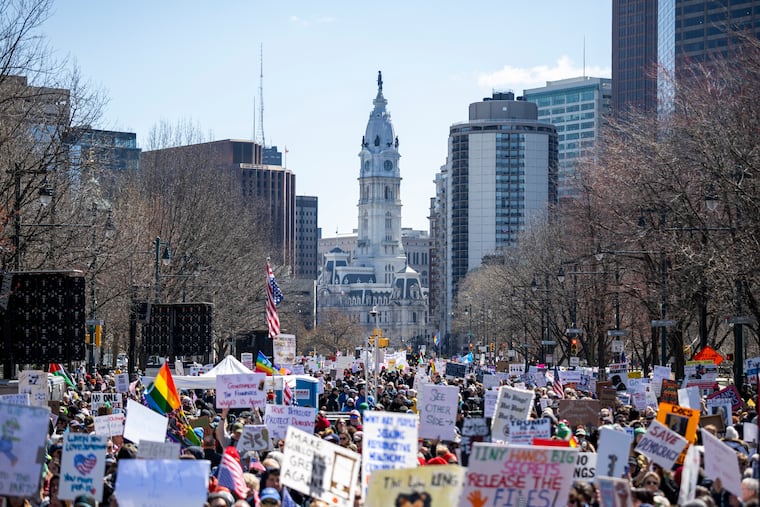
Harris was one of what organizers estimated was an incredible eight million Americans who took to the streets to register their utter disgust with the authoritarian bent and the increasing violence of the Trump regime. It was arguably the biggest one-day protest in just under 250 years of American history (unless you count the first Earth Day in 1970, which was more of a teach-in).
The size of the third “No Kings” event was remarkable, yet that was matched by the passion of the marchers, and by a movement with a growing sense of style. That was epitomized by Bruce Springsteen singing his protest anthem “The Streets of Minneapolis” before a massive Twin Cities crowd that also included Sen. Bernie Sanders and folk singer Joan Baez, who were both on the National Mall to hear the Rev. Dr. Martin Luther King’s “I Have a Dream” speech in 1963. The reverb of history was deafening.
Yet again, much of the mainstream media seemed not to hear it. For part of the weekend, America’s largest newsroom, the New York Times, buried news of the protests on its home page below six articles about the Iran war, and paired with a cynical news analysis questioning whether the “No Kings” movement has the right focus to be successful.
» READ MORE: Then they fight you: How the ‘No Kings’ protests are winning America | Will Bunch
Never mind that the sense of unity and shared community I saw Saturday in my home of Delaware County, or the prior two “No Kings” protests, is what has offered hope to the everyday citizens who resisted U.S. Immigration and Customs Enforcement raids in Minnesota and elsewhere, or to the voters in 30 consecutive jurisdictions who flipped seats away from Trump’s GOP.
True, the “No Kings” movement shouldn’t be above criticism. The protest’s mission can seem vague when compared with the pointed 1960s marches to end the war in Vietnam or racial segregation in the South, although allowing demonstrators to paint on its blank canvas is what creates such a large turnout against autocracy.
As Trump’s crimes against humanity worsen from Minneapolis to Minab, Iran, it’s fair to question whether “No Kings” needs to consider more assertive forms of nonviolent civil disobedience, even as that would risk conflict with America’s militarized police.
But leaders with the most prominent Trump-resistance group organizing “No Kings” answered that complaint Saturday when Indivisible’s Ezra Levin took to the stage in Minneapolis and announced that a nationwide general strike is planned for May 1, modeled after a successful local action that shut down much of that region in January.
Calling the plan “a tactical escalation,” Levin said that the May Day strike would be “saying, ‘No business as usual.’ No work, no school, no shopping. We’re going to show up and say we’re putting workers over billionaires and kings.”
And yet, what the small but growing chorus of naysayers — especially jaded pundits at some of the bigger media outlets — doesn’t understand is that the impact of “No Kings” isn’t so much political, in the realpolitik sense, as it is psychological.
It’s a hope-building exercise that reminds the citizens who want America to remain a democracy that we are the majority. That matters because a dictatorship only succeeds with a demoralized public.
“I feel better when I leave [“No Kings”] because I’ve been down the last two weeks,” Kristina Shickley, a 72-year-old speech pathologist from Ridley Park, told me. She was standing on the sidewalk in front of Springfield Mall with a gaggle of white female boomers, the group that has anchored the Trump resistance since his first term.
Her fellow protesters chimed in with similar reasons for coming out, with their hopes that even some Republicans in Congress might pull back from Trump-flavored extremism because of the growing wave of unrest, and their belief in a political science theory that a regime can fall if just 3.5% of the public takes to the streets (that would be about 11 million, so … almost there).
“All these people coming out,” Shickley said, “it gives you hope.”
Especially in Springfield, an old-school, mostly working-class suburb that’s about as all-American as its fictional counterpart on TV’s The Simpsons. For decades, Springfield was ground zero for a Republican political machine that ran Delaware County and helped carry Pennsylvania for the likes of Ronald Reagan and George H.W. Bush.
Times have changed. In recent months, as many as 100 or more local residents have stood on the corner of Baltimore Pike and Route 320 every Saturday, waving signs like “No Kings, No Wanna-Be Dictators, No ICE Raids” and “When Injustice Becomes Law, Resistance Becomes Duty.”
It’s hard to imagine a more appropriate spot than in front of a Target store, whose rejection of diversity policies has sparked nationwide boycotts, and a mall that witnessed one of America’s first mass shootings — the 1985 rampage by Sylvia Seegrist that left three dead and now feels like a harbinger of darker times ahead.
Most of the demonstrators were old enough to remember that day, but not all. I met the guy with the anime pirate flag — Andrew Snyder, a 37-year-old software engineer from Swarthmore and a self-described democratic socialist who served during peacetime with the U.S. Navy in the Persian Gulf. He agreed that not as many millennials are out marching now, but predicted that “it’s going to ramp up with AI [artificial intelligence], as AI starts taking jobs.”
For now, however, the heart and soul of “No Kings” may be people like 75-year-old John Coia, a Springfield native now living in Aston who once sued his former employer, USAir, over his right to wear long hair and an earring. Now sporting an Abraham Lincoln-esque gray beard he amplified with a top hat, Coia waved an upside-down American flag.
“I’ve been going up against the establishment my whole life,” said Coia, speaking for a generation that grew up exercising its all-American right of free speech, and now, in old age, is determined to keep using it while they still can. I asked him what the last straw with Trump was that convinced him to join “No Kings.”
“There is no last straw,” he said over the car honks. “It just keeps going. There’s a new straw every day.”

Sign up for the Will Bunch Newsletter
