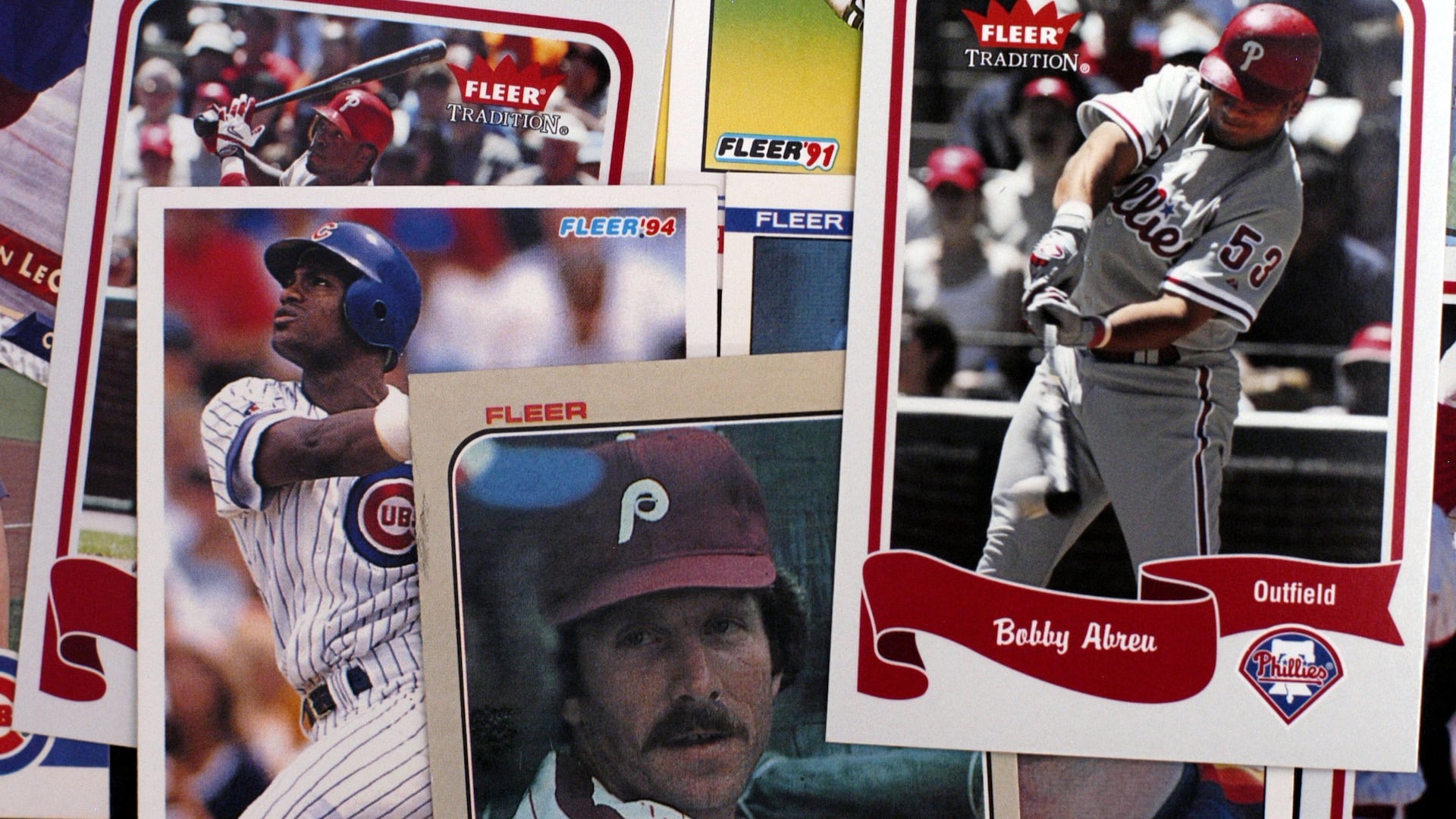
When Fleer was king — and like currency
The inside job began sometime after midnight at the factory in Olney where the work never stopped.
The trading card industry boomed in the early 1990s, so the cards produced by Fleer at 10th and Somerville may as well have been currency. A night-shift worker would grab a box of cards and toss it out the window as a cop waiting outside provided safe-keeping until the worker’s shift ended.
“I think the cops were being cut in on the profit,” said Ted Taylor, who was Fleer’s vice president of hobby sales and marketing.
Fleer was founded in Philadelphia in 1885, and an accountant named Walter Diemer is credited with inventing bubble gum in 1928 at the factory at 10th and Diamond.
Fleer printed its first baseball cards in 1923 and moved in the 1930s to Olney, where the company made its gum and cut its cards until 1996.
The Philadelphia area was once a hub for baseball cards, as Bowman was on Stenton Avenue and Philadelphia Chewing Gum was in Havertown. Fleer, which backed up to a railroad bridge, was the last to go when it left Philly 30 years ago.
Michael Jordan’s 1986 rookie card was cut and packaged in Olney. So was Cal Ripken’s 1982 rookie card and his younger brother Billy’s infamous 1989 card. The factory produced cards for multiple sports while also making candy like Double Bubble and Razzles.
The Olney factory — with a Fleer Fun Factory sign on the outside — was staffed with people from the neighborhood, many of them teenagers who worked in the summer when business picked up. Frank Diamond, a writer from Philadelphia who passed through Fleer, once wrote that “a stint at the factory was almost a rite of young adulthood for many who grew up in Olney, Logan, and North Philadelphia.”
And sometimes, the employee discount was hard to beat.
“There was an awful lot of Fleer product in the market that shouldn’t have been there,” said Taylor, 85. “They did break up a ring of guys who were doing this on a regular basis. That was pretty ugly. They caught them. It was crazy. It was a different world for about five or six years. Then when the bottom dropped out; it dropped out with a thud.”
A great job
John Meehan went to the Fleer factory in June of 1974, hoping to land a job after graduating from Cardinal Dougherty High. But the company told Meehan that it couldn’t hire him because he was only 17.
“I thought it was a joke and they were just blowing me off,” Meehan said. “But then on my 18th birthday, my mom wakes me up and says, ‘Someone is on the phone and wants to talk to you.’ It was Fleer.”
The neighborhoods around Olney were filled with spots where locals worked. Sears was on Roosevelt Boulevard. Goldenberg’s Candy was on Wyoming Avenue. Simkar Lighting was on Tioga Street, and Mrs. Smith’s Pies were baked at Seventh and Lindley. But only one place made bubble gum and baseball cards.
“They used to joke around that everyone from Incarnation, my parish, worked at Fleer,” said Frank Rigler, who grew up on Lindley Avenue and worked at Fleer in the summer of 1980.
Rigler used a sledgehammer to smash bubble gum after it cooled, worked a machine that made Bubble Burgers, and would see sheets of baseball cards waiting to be cut.
“They were stacked on these pallets,” Rigler said. “We would just walk by them and never realized what those things would be worth.”
Meehan, 69, worked at the factory for nearly four years, spending most of his time in candy production. A family friend helped him get a prime job after just a few months.
He never worked with the cards but knew people who did. And he was aware of the “employee discount.”
“Once you’re in the building, you’re in the building,” Meehan said. “The parking lot was in the back, and nobody ever really checked anything. You just walked out the back door with whatever you wanted.”
It was a great job. To this day, people will say, ‘I worked at Fleer.’ And I’ll say, ‘Oh yeah? What did you do?’ Everyone knew someone who worked there.
The guys dressed in all white outfits, wore hair nets, carried union cards, and spent their paychecks down the shore each weekend.
“It was a great job. To this day, people will say, ‘I worked at Fleer,’” said Rigler, 65. “And I’ll say, ‘Oh yeah? What did you do?’ Everyone knew someone who worked there.”
Meehan’s last job at Fleer was making boxes with a buddy from the neighborhood. They had a quota of boxes to make per day and would hustle to finish their work in four hours. They clocked out for lunch, headed to the bar around the corner, and made a deal with someone to clock them back in.
“But in the meantime, some of the guys in the next shift who were supposed to start at 2 o’clock didn’t show up, so they were looking for us,” Meehan said. “We came back and they were like, ‘Where were you?’ We weren’t saying anything and they just said, ‘You two are fired.’”
‘I’d call them stolen’
Taylor was at a card show in the early 1990s when a vendor was selling uncut sheets of Fleer cards.
“I walked up and they asked, ‘What would I call them?’” Taylor said. “I said, ‘I’d call them stolen because you have no business having them.’ I handed him my business card and the guy almost had a stroke.”
Taylor opened his first pack of baseball cards as a 7-year-old in the summer of 1948, pulled out a card of Phillies second baseman Emil “The Antelope” Verban, and was hooked.
“There was just something about it,” Taylor said. “I connected with it. From that point on, I loved baseball cards. There was something fascinating about it. ‘Wow, these are my heroes.’”
He worked as an athletic director at area colleges but his passion was always collecting. He wrote a column in Sports Collectors Digest, organized an annual baseball card show, and even testified in an antitrust case between Fleer and Topps.
Fleer hired him in the late 1980s in hopes of revitalizing its brand. He had an office in Olney. The company made strides to compete and business spiked.
“1992 and 1993 was like printing money,” Taylor said. “It was like gold. You couldn’t make enough, the dealers couldn’t get enough, and the distributors couldn’t get enough. Anything you printed sold. We were printing multiple different kinds of series and it didn’t matter. It all sold.”
But then the bubble burst. Fleer — which was owned by Marvel Comics — blamed the downturn on the 1994 Major League Baseball strike. Cards that were marked sold were returned to the factory.
The guys who threw cards out the window once derailed a train when they piled boxes on the tracks behind the factory, Taylor said. But there was nothing worth throwing out the window anymore. The end was near.
“There was just product coming back from everywhere,” Taylor said. “It doesn’t have a lot of value when there’s truckloads of it. That’s why it’s called junk wax. It was a thud.”
Fleer — which moved corporate offices in 1992 to Mount Laurel — announced in November 1995 that it would outsource its card production and move candy operations from Olney to Mississippi. It was Taylor’s job to tell the workers that the factory was closing.
As someone who loved cards, it was really cool. After they emptied the plant out. I went back over there and roamed around.
“There were a lot of unhappy folks,” Taylor said. “They went home for Thanksgiving, came back, and didn’t have a job. It was really done in a bad way.”
The work stopped immediately in Olney, but the factory didn’t close for 60 days because of federal labor laws. Employees sat in a cafeteria, played cards, and read the newspaper until January 1996. Fleer was sold nine years later to Upper Deck, which stopped making Fleer-branded cards in 2007. It was a badge of honor for people in the neighborhood to have a job at Fleer. But then it was gone.
“It was crazy. It was like nothing you dreamed of and nothing you expected,” Taylor said. “As someone who loved cards, it was really cool. After they emptied the plant out, I went back over there and roamed around. I found stuff in there that they had forgotten they even had, like uncut sheets of the Michael Jordan rookie, which my boss took for himself. All kinds of crazy stuff was still in there, stuck in filing cabinets.”

- Working at Olney’s Fleer factory was a ‘rite’ and the baseball cards flew out the window
- They weren’t seriously house hunting until a Mount Airy mansion came back on the market with a $50,000 price cut | How I Bought This House
- Is my boyfriend worth the gas money to Jersey?
- The playoff rivalry got so petty they removed Philly from the cheesesteak | Weekly Report Card
- See it, hear it, feel it: All the Philly art we loved this week
- Lancaster is basically Philly’s cool country cousin | Field Trip
- Citywide Quest: Do you know where these mother-themed photos were taken?
- How to have a Perfect Philly Day, according to author Jennifer Weiner
- The best things we ate this week
- A galaxy not so far away lands in New Hope