‘Phillies Extra’ Q&A: Aaron Nola on evolving as a pitcher, the importance of J.T. Realmuto, and more
Nola, who will make his first start on Saturday, talked with The Inquirer's baseball show about several topics, including the value of his WBC run, and why he’s confident he can bounce back in 2026.
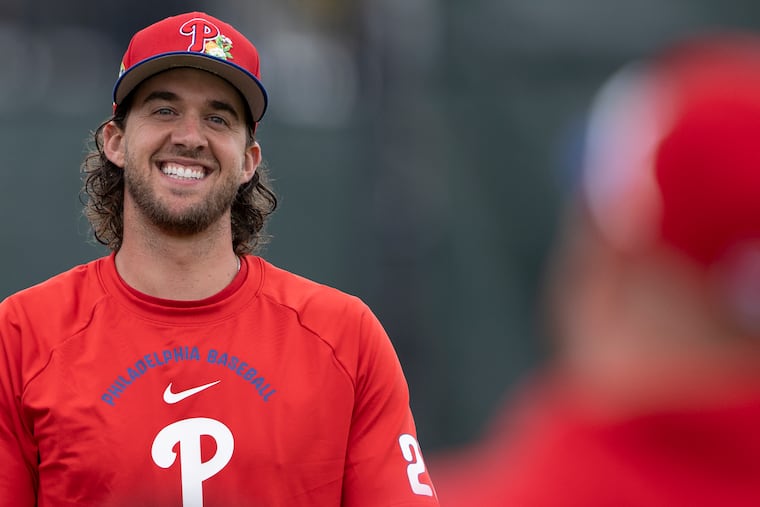
Aaron Nola will scale the mound Saturday and begin his 12th major league season in a familiar place: the Phillies’ starting rotation.
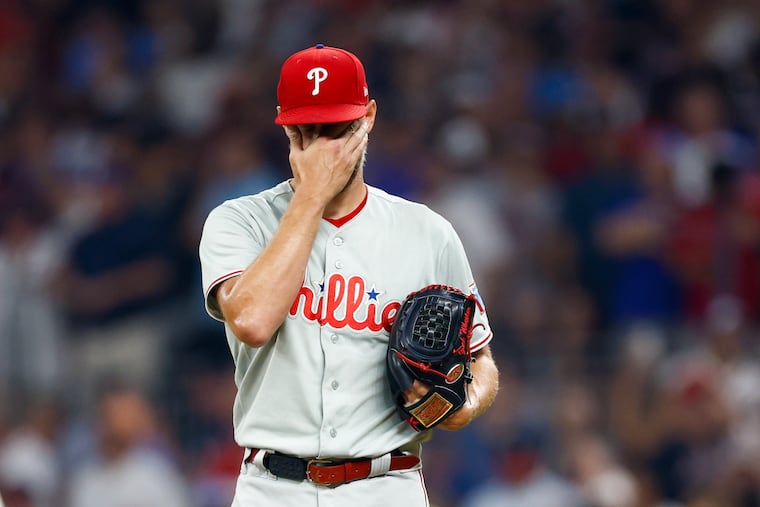
This time, though, Nola is coming off the worst season of his career. Not only did he miss nearly three months with ankle and rib injuries, but he also posted a 6.01 ERA and 1.346 walks/hits per inning — career-worst marks in both categories.
None of it sat well with Nola, who made changes to his offseason training. Specifically, he reinstated a rigorous long-toss program that he had scaled back in recent years to offset the toll of the Phillies’ extended postseason runs. He threw more often and from longer distances to help improve the movement on his pitches.
» READ MORE: Starting pitchers say the Phillies ‘just make us better.’ And it starts with ‘next generation’ coach Caleb Cotham.
Recently, Nola sat down with Phillies Extra, The Inquirer’s baseball podcast, to discuss those changes, why it was important for him to use his two starts for Italy in the World Baseball Classic as a test lab, and why he’s confident he can bounce back this season.
Here are a few excerpts from the conversation. Watch the full interview below and subscribe to the Phillies Extra podcast on Spotify or Apple Podcasts.
Q: What were your expectations going into the WBC? And is it fair to say that it exceeded all of them?
A: Yeah, I think it was everything I expected going in. Just from talking to a lot of the guys that have played in the WBC before, the atmosphere, the way fans travel, in some games, exceeded my expectations.
I never would have thought Miami [in the semifinals] would have felt something like that. I pitched in Miami a lot of times, and never felt anything close to an atmosphere like that. The loudness of that stadium, it was just really cool. I’m really glad I participated in it and they called me. Obviously would have loved to have my brother [Austin, who withdrew after getting hired as the Mariners’ bullpen coach] on that team, but I wanted to stick with those guys and experience what a lot of other guys on the Phillies experienced. And I think what made it a lot more special, too, was that nobody really thought we were going to make it out of pool play, and that was the expectation of everybody else looking into Team Italy.
» READ MORE: Aaron Nola: Team Italy’s surprising run in World Baseball Classic was ‘some of the best times I’ve ever had’
We had a good team led by [manager] Francisco Cervelli, and he put together a really good squad, a lot of young, scrappy players that just love to play baseball and played well. Didn’t take at-bats off, pitches off. Just wanted to win. And we won pool play and made it to Miami, and that was pretty awesome. And I still think a lot of us Italian Americans, a lot of the Americans on the team, don’t really understand what we did for Italy. Just from [Italy general manager] Ned Colletti and others talking to us after the games [about] how many people were watching the quarterfinals in Houston, how many people were watching the semifinals out there in Italy, and what we did for that country was pretty amazing.
Q: For years, the Phillies rotation always started with Zack Wheeler and Aaron Nola. You’re very much still a part of this rotation, but a lot of the talk is Cristopher Sánchez and Jesús Luzardo. Is there a point in your career when you think about reinventing yourself as a pitcher to achieve longevity at a really high level?
A: Yeah, I don’t think there’s really reinventing it. I think it’s just staying sharp and adjusting to the league and adjusting to things that don’t come as easy to me as they used to. My body doesn’t move in certain ways like it used to when I was 22, 23, 24 years old. I think that’s just the reality of baseball players and athletes and pitchers, especially. I know some pitchers may be different, but I think overall [with] a lot of innings under my belt and a lot of games, I think my body changes over time. All the pitchers’ [bodies change] over time.
I think if you talk to Wheeler, he’d maybe say the same thing, too. He’s not the same as he was when he was in his 20s, even his late 20s, so he’s evolved. And I think, honestly, he’s better now than ever. But I just think that’s kind of the way pitching goes. That’s kind of what we want to do. We want to throw a lot, we want to pitch a lot of innings, and that’s what we train for just to sharpen it up. I tried to learn as much as about myself as possible over these last few years, especially getting hurt.
» READ MORE: Starting pitchers say the Phillies ‘just make us better.’ And it starts with ‘next generation’ coach Caleb Cotham.
I think things get more detailed. The game’s getting better. I think players get better. Things are changing. The strike zone is getting smaller. So I think you’ve got to be a little bit more precise. And everything we do pretty much [has] got to be more precise in the strike zone. I don’t have the 97 to 100 [mph] with unbelievable stuff, so sometimes I can’t really sit in the strike zone and make the ball move like some of these other guys. So I’ve got to focus on command. And I think the preparation with that starts in the outfield in between starts, and then in the bullpen, just to try to keep everything sharp.
Q: What has J.T. Realmuto meant to you as you go into your eighth year together?
A: Yeah, it’s gone by quick. But I think there’s something to say about a pitcher throwing to pretty much the same catcher for a long time. We’re not on Adam Wainwright and Yadier Molina’s level. They had hundreds and hundreds of games together. But J.T. is such a big part of our team, and he’s such a big part of our pitching staff, because he knows the game well. He studies it. He knows the league, both leagues, really well, obviously the National League better. But he knows what each one of our starting pitchers and relief pitchers can do, and what our strengths are and what we need to get better at, and what is not our strengths.
» READ MORE: Winning a World Series ‘changes everything.’ And the Phillies legacies for this veteran core are riding on it.
So, the way that we can communicate during a game, and especially in a time where the pitching is on a pitch clock, it makes it a lot easier when you got a guy like him behind the plate. And one of the most athletic catchers in the league, too. So everybody was pumped to have him back in [after he re-signed with a three-year, $45 million contract in January]. We needed him back. He’s one of the leaders on the team and one of the best catchers in baseball. So it’s still going to help us out tremendously.

Phillies Extra is your deep dive into all things Phillies on Gameday Central! Hosted by Scott Lauber, each episode brings you insider analysis, exclusive interviews with players and experts, reader emails, and more to cover the hottest topics with the Phillies and across Major League Baseball. Don’t miss it — the conversation starts here!
You can also subscribe to the podcast version of Phillies Extra on Spotify or Apple Podcasts.