Robot umpires are here: What to know about the pitch challenge system, and how the Phillies will use it
The Phillies and MLB have test driven the automated ball-strike challenge system the past two springs. Now it’s coming to the regular season. “I think it’s going to help overall,” says J.T. Realmuto.
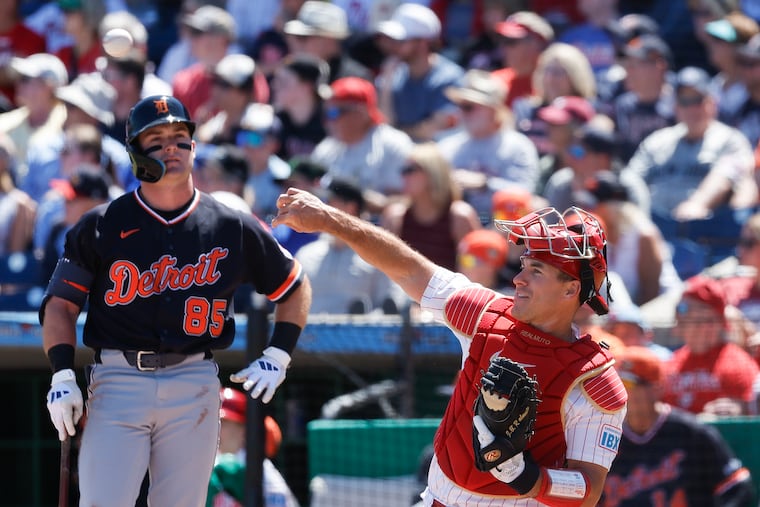
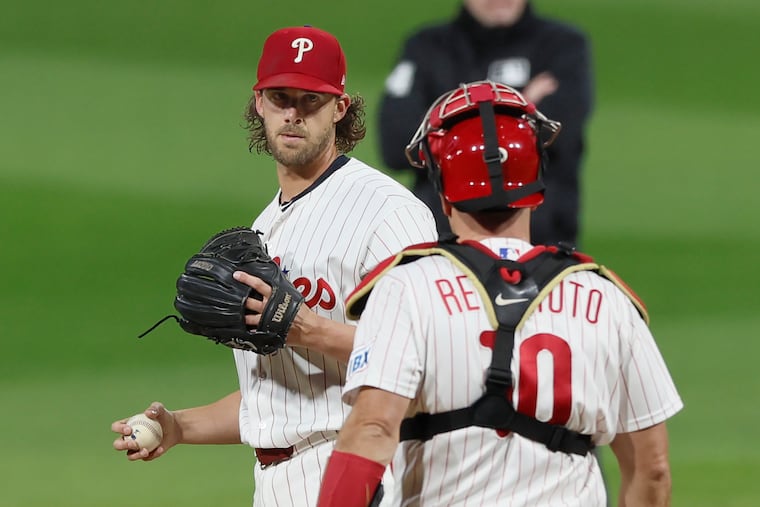
Phillies catcher J.T. Realmuto has another task added to his to-do list before every game this year.
In addition to his normal scouting reports on each opposing hitter that he uses to devise a game plan, he also now receives a new packet of information that includes a diagram of each opponent’s individual strike zone, compared to how it used to be.
Because now, after the implementation of the automated ball-strike challenge system, some are very different.
» READ MORE: Phillies catcher Garrett Stubbs has lots of experience with robot umpires. Here’s what he says to expect.
The ABS system, which the Phillies test drove during spring training the last two years, will be officially implemented in Major League Baseball this season. Human umpires still will call every pitch a ball or strike, but players will now have the power to challenge if they disagree.
Realmuto’s added work has been paying off. He finished the spring 6-for-6 in challenges behind the plate. Backup catcher Rafael Marchán, who has experience with the system from the minor leagues, won 10 out of 17 challenges. Neither attempted a challenge as a hitter.
Phillies hitters won 61% of their challenges, and Phillies fielders won 63%. The league average this spring was 45% for hitters and 60% for fielders, entering Tuesday.
Here’s what to know about ABS this season:
The rules
A system of cameras monitors the exact location of each pitch, relative to each player’s personal strike zone.
Each team begins with two challenges, which can be used by the pitcher, catcher, or batter to compare the umpire’s call to the tracked location of the pitch.
If a challenge is unsuccessful, the team loses it. If it is successful, it retains it.
A challenge is initiated by a player tapping the top of his head.
The challenge must occur immediately following the pitch, with no input from the bench, coaching staff, or teammates allowed.
If a game goes to extra innings, teams get one new challenge at the beginning of any inning in which they have zero left. If they still have challenges remaining in extra innings, they do not receive an extra one.
When a position player is pitching, challenges are not allowed.
Umpires have discretion with how they place baserunners if an overturned ball or strike call impacts a play on the bases.
An ABS challenge and video replay challenge can occur on the same play, and the ABS challenge will be settled first.
Note: The ABS system will not be in use during the Phillies’ Field of Dreams game against the Twins on Aug. 13, as the ballpark in Dyersville, Iowa, does not have the necessary infrastructure.
Major league players were measured this spring to determine the size of their personal strike zones. The width of the ABS box is 17 inches across for everybody, the same width of home plate. The top of the zone is 53.5% of a player’s height without cleats, while the bottom is 27% of his height.
» READ MORE: 20 things to know about the Phillies for the 2026 season
Since umpires typically judge a strike zone based on the player’s stance, standardizing based strictly on height will lead to changes. For example, a player who crouches low in his stance will find his ABS zone to be larger than he is used to.
One other wrinkle: All pitch location data will be delayed by MLB to deter misuse of that information. The strike zone box on game broadcasts also will not identify each pitch as a ball or a strike on screen.
“It’s hard to say,” manager Rob Thomson said about how much ABS will impact the game. “You only get two challenges. Somebody was asking me about catchers framing, and I think, well, once you lose your challenge, the framing is back on. So I’m not really sure. But I think it will help hitters. This is just my first thought.”
Pitchers’ point of view
The Phillies pitcher with the most strikes incorrectly called balls last year was Jesús Luzardo. He had 68, or 2.3% out of all pitches he threw.
“That’s not surprising,” Luzardo said.
From his point of view behind the plate, Realmuto has found that pitches with high velocity, on the outside corner, or in the upper half of the zone are most often missed by umpires.
“I’ve noticed that if you’re going away from, say, a righty or a lefty, usually the outside part of the plate, they miss more, just because they’re set up on the plate,” Realmuto said. “Whereas, when you’re going inside, on either batter, usually their eyes are over the inside corner, so they see that side of the plate a little better.”
» READ MORE: Hope for a new Phillies offense lies with Aidan Miller, Otto Kemp, Justin Crawford
He expects the ABS system to especially help Luzardo, but also reliever José Alvarado.
“Because the velocity, and just, location-wise, Alvy’s not a guy who’s necessarily trying to hit pinpoint location,” Realmuto said. “So he’ll miss sides of the plate pretty big at times. And those are the ones, if I’m set up middle in and he throws it up and away, with how hard he’s throwing, they’re not going to call that a strike very often because they just don’t see it well.”
The Phillies had no restrictions on who could challenge and when this spring, as Thomson wanted to give all his players the chance to get to know the system. But most teams generally discourage their pitchers from initiating challenges, since their vantage point of the zone isn’t as good as the catcher’s.
Luzardo and Cristopher Sánchez tapped their heads to challenge a pitch call during spring training and happened to do so at the same time as Realmuto. Both challenges were successful.
Sánchez doesn’t plan on making it a habit.
“J.T’s one of the best that there is. I’m never going to go against him. … Whatever he wants to do, I’ll go and back him up,” he said through a team interpreter. “If there’s anything to highlight on what we do in a great way here is that we have a great communication between the pitchers and the catchers, and that’s a very important thing to have, that kind of chemistry.”
Luzardo said he is going to try not to challenge.
» READ MORE: The Showman returned for a ‘huge’ WBC moment. And it could be big for Bryce Harper and the Phillies, too.
“I fought my hand going up a couple times already,” he said.
But he can see instances when he would, such as if a baserunner is attempting to steal and Realmuto or Marchán is popping out of his crouch to make the throw and may not be focused on the location of the pitch.
Even if a pitcher never plans on challenging, he now has to be careful not to inadvertently adjust his hat at the wrong time. Luzardo said he often unconsciously touches his hat while on the mound, so he plans to warn umpires of that tendency and tell them that if he is challenging, he will make it obvious.
Strategizing
In addition to learning opponents’ new strike zones, Realmuto has also seen his own, and it has changed a lot.
Because he stands so tall in his stance, his ABS strike zone will shrink about five inches from the top compared to how umpires have called it in the past.
“For me, it’s going to be an adjustment not swinging at pitches in the upper third of the zone because I usually like high fastballs,” he said. “It’s going to be hard for me to get used to that being a ball now, as opposed to a strike.”
» READ MORE: Why has Dave Dombrowski invested even more in the Phillies’ starting pitching? Check his record: ‘It’s worked’
Technology helps. The Phillies can program any player’s new strike zone on their Trajekt pitching machines, so they can get accustomed to what they look like.
Realmuto thinks that overall, the system will benefit hitters more than pitchers by making the zone more standard. On the 2025 Phillies, Trea Turner was the hitter with the most balls incorrectly called strikes with 44, which was 1.8% out of all pitches thrown to him. Behind Turner in the top three were Bryson Stott (37) and Realmuto (35).
There will be a learning curve. The bulk of the 23 challenges by Phillies hitters this spring were initiated by players with recent experience in the minor leagues, who have more familiarity with the system. Christian Cairo, who spent 2025 on Cleveland’s triple A affiliate, won all four of his challenges.
The members of the Phillies’ opening day roster who challenged a pitch were Dylan Moore (2-for-3), Otto Kemp (1-for-2), Adolis García (1-for-2), Brandon Marsh (1-for-1), and Bryce Harper (0-for-2).
Thomson declined to get into specifics of the Phillies’ strategy for ABS in the regular season, although he did say that they will have a plan on an individual level — certain players will have a green light to challenge, while others will not — and on a situational level.
The Phillies have had meetings this spring about what constitutes a high-leverage opportunity for challenges. There have been occasions when Realmuto has thought a call might be incorrect, but he held off on challenging considering the situation. For example, on a pitch early in the game, with the Phillies leading and nobody on base, he would have to be absolutely certain before challenging.
In a case like that, the cost of potentially burning a challenge would outweigh the benefit of a potential overturned call.
ABS may be more work, especially for catchers, but Realmuto still sees it as a positive development overall.
“I’ve already noticed the spring training umpire zones have gotten so much better, just from the immediate feedback,” Realmuto said. “I think it’s going to help overall. The zone is just going to be better.”

Let's talk about the Phillies' bullpen. Larry Andersen happens to be an expert on the subject. The popular Phillies radio analyst had a 17-year major-league career in which he appeared in 699 games – all but one in relief. He joins Phillies Extra to break down the biggest question standing between the Phillies and a long run through October: How will they bridge the gap to closer Jhoan Duran? Watch here.
You can also subscribe to the podcast version of Phillies Extra on Spotify or Apple Podcasts.
Previous episodes: Matt Klentak | Jeff Francoeur | Luke Murton | Mike Hazen | Tony Gwynn Jr. | Kevin Stocker | Bobby Dickerson | Jim Bowden | John Middleton | Ryan Howard