Hitting coach Kevin Long and manager Rob Thomson take too much heat for the Phillies’ shortcomings
The team led the NL in hitting last season and won its most games in 14 years, but after another playoff collapse, the fans wanted blood. Fortunately, they didn't get any of K-Long's or Topper's.
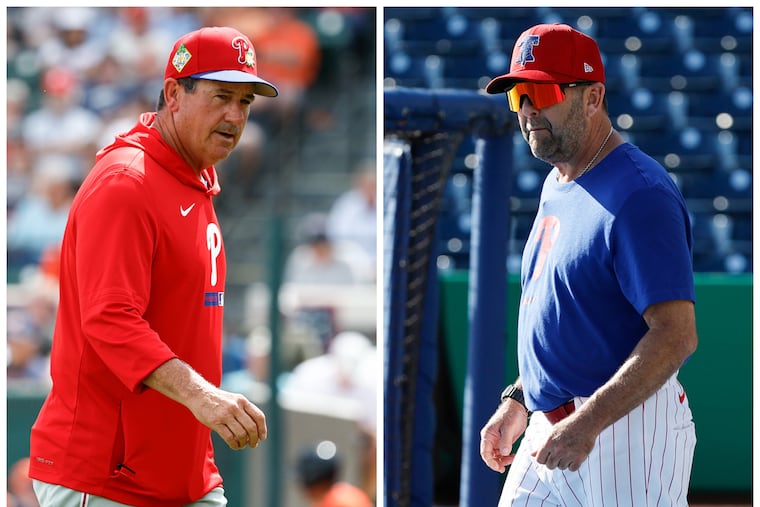
To listen to public opinion after the Phillies fizzled again in October, the job done in 2025 by manager Rob Thomson and hitting coach Kevin Long was, in general, subpar. The burning question: Should they be fired?
It would have been an awkward conversation for president Dave Dombrowski:
“Rob, you’ve won your second straight division title, more games than the previous season for the fourth year in a row, and the most since 2011.”
Turns.
“Kevin, the team led the National League in hitting, you had the NL batting champion and the home run and RBI champion.”
Sigh.
“I’m afraid I’m going to have to let you go.”
» READ MORE: Hope for a new Phillies offense lies with Aidan Miller, Otto Kemp, Justin Crawford
In all sports, repeated postseason failures usually result in scapegoats. Football is the worst, but baseball isn’t far behind, and only occasionally does the problem lie with the head coach or with the top assistants.
Thankfully for the Phillies, Dombrowski can see through the scapegoat fallacy.
In his October postmortem, Dombrowski created a controversy when he said Bryce Harper’s 2025 season was not “elite.” The other news of the day: Dombrowski said that Thomson not only would not be fired but soon would get a contract extension. These bombshells obscured Dombrowski’s review of Long and his staff.
“Kevin Long’s an exceptionally good hitting coach,” Dombrowski said of Long and his assistants, Rafael Pena and Dustin Lind. “Can always get better, right? Nobody’s perfect, by any means, but I think they’re very good.”
How good?
Good enough that, while at spring training, a top executive from another team told me, “Yeah, let them fire him. He’d be hired by somebody else in 15 minutes.”
How good?
Good enough that Dustin Lind was hired as the Orioles’ hitting coach. That is, Dr. Dustin Lind. Unlike the preponderance of his critics, Lind has a Ph.D.
Maybe the hitting staff wasn’t smart enough to beat the Dodgers, who muted the Phillies’ bats in the National League Division Series, but then, the Dodgers’ pitching staff included Shohei Ohtani, Blake Snell, and Yoshinobu Yamamoto, and they’d stashed 100-mph Roki Sasaki in the bullpen. The Dodgers won their second consecutive World Series last year.
Maybe they weren’t good enough in 2024, when the Phillies flailed against the Mets in another, more painful four-game NLDS loss.
» READ MORE: 20 things to know about the Phillies for the 2026 season
But they were very good in getting there, and, frankly, there’s very little the hitting staff and the manager can do in a playoff series to affect the performance of a group of hitters after 162 games. It’s like asking an NBA team of bricklayers to suddenly start dropping three-pointers.
Critics can point at the steady decline of Nick Castellanos, the two-year stagnation of Bryson Stott, or the 2024 All-Star mirage of Alec Bohm.
Fine.
Counterpoint: Castellanos is a stubborn and selfish hitter (and person) whose unprofessionalism got him released last month. If Stott and Bohm suddenly have cases of slider-itis, it’s not because Long & Co. didn’t identify and address it.
On the flip side, it was Thomson who directed Long to turn Trea Turner into more of a pure contact hitter and to do so at the age of 31. The result: Turner’s second career batting title.
Long helped him win the first one, too, in 2021, the year that ended their astoundingly productive, four-year cotenancy in Washington.
“He kind of changed my career in ’18,” Turner said. “I kind of struggled. Was trying to find more power but kind of doing it incorrectly. And then in ’19, I kind of figured out how to drive the ball the other way. That helped me out a lot to not kind of leak and cheat and all that.”
Come 2025, as Thomson penciled Turner into the leadoff spot more often, Turner hit a two-month slide that began in early June. He needed recalibration. Long was there.
“I felt more consistent making adjustments, and those are conversations that we had each and every day. You know, nothing drastic,” Turner said. “We just did a better job of not overreacting, trying too many different things, just keeping it simple. That definitely helped me be more consistent last year. And that’s always what I want.”
» READ MORE: Phillies prospect Aidan Miller’s back blocks his path; was Daniel Robert’s heart issue a false alarm?
The secret, said Schwarber, is that Long understands his audience. Some hitters need input that purely addresses mechanics; some need to concentrate on anticipating how pitchers will attack them.
“Half the battle is, you have to be a mental coach. You have to know your players,” Schwarber said. “You have to know what makes them click, what makes them turn on.”
Sometimes, when you’re feeling lost, you just need a coach to break the tension.
“He makes you laugh, and you rocket off and get three hits or whatever. Get out of your own way a little bit,” Schwarber said. “I feel like that’s what he’s really good at — knowing his guys and knowing what makes them click.”
Long knows what makes Schwarber tick. Schwarber hit 121 home runs and had an .816 OPS in six seasons with the Cubs before he met Long in Washington. He’s hit 219 home runs with an .867 OPS in the five seasons since, he’s won two NL home run titles, and has signed two contracts with the Phillies worth a total of $249 million.
“He changed my career,” Schwarber said. “When I got with him in 2021, there were a lot of things that we tried to change, adjust, knowing that it would be a process. We were able to start with the extreme, then got to a place that I felt very comfortable. That’s what got me here to Philadelphia.”
It wasn’t Long who switched Turner and Schwarber in the lineup, which was riskier than it seemed.
Schwarber was 32 and hadn’t regularly hit No. 2 since his rookie season in 2015. The result: Schwarber led the league with a career-high 56 home runs, led all of baseball with a career-high 132 RBIs, and finished second to Ohtani in MVP voting (remember, Ohtani also is a starting pitcher).
» READ MORE: Phillies daycare cornerstones Bryson Stott and Alec Bohm grow up a little bit more at spring training
Thomson hinted over the winter that he might move Harper to No. 2 and protect him with Schwarber at No. 3. That won’t happen any time soon.
“We had a lot of success with it last year,” said Thomson, who acknowledged that Harper and Schwarber told him they would rather stay in their current lineup spots. But, as with last season, nothing is promised: “We’re open to making some moves.”
None of the moves will matter if the Phillies don’t start winning again in October. Schwarber understands that the hitting coach and the manager are going to feel some heat when, over the last three years, your team scores three or fewer runs in eight of its last 10 playoff games, all of which the Phillies lost.
“I’m not making excuses,” Schwarber said, “but I’m a realist. You’re going to face the best pitchers in baseball in postseason. It’s hard.”
It’s hard to win division titles, too. It’s harder when two of the best players in franchise history are absent, diminished, or both.
Thomson won 96 games last season and did so even though staff ace Zack Wheeler’s second straight All-Star season ended in mid-August when he was diagnosed with thoracic outlet syndrome.
Harper wasn’t himself, either. He started the season with a wrist issue that began in May 2024 and never improved. It finally landed him on the injured list in early June 2025, cost him about a month of play, and, logically, cost him some strength and his sense of the strike zone. He returned healthy, but his chase rate of 35.6% sabotaged his season. It was the second-worst chase rate of his career.
His worst came in 2022, at 35.7%. Not coincidentally, Harper was injured in 2022.
You can’t very well blame K-Long and Topper for Harper’s injuries.
Can you?
You blame them for everything else.

Let's talk about the Phillies' bullpen. Larry Andersen happens to be an expert on the subject. The popular Phillies radio analyst had a 17-year major-league career in which he appeared in 699 games – all but one in relief. He joins Phillies Extra to break down the biggest question standing between the Phillies and a long run through October: How will they bridge the gap to closer Jhoan Duran? Watch here.
You can also subscribe to the podcast version of Phillies Extra on Spotify or Apple Podcasts.
Previous episodes: Matt Klentak | Jeff Francoeur | Luke Murton | Mike Hazen | Tony Gwynn Jr. | Kevin Stocker | Bobby Dickerson | Jim Bowden | John Middleton | Ryan Howard