PowerYourVote.com's Jon Lubert: What political money can't buy
Rich donor's lament: Pols just want our cash
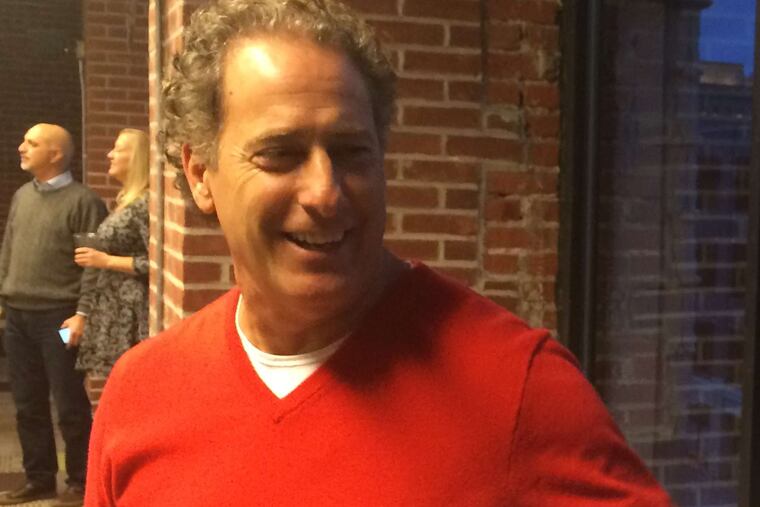
Philadelphian Jon Lubert, 35, a businesslike Republican who believes in democracy and the transforming power of the Internet, has set up the new political watch, policy debate and crowd-thinking site, http://www.poweryourvote.com. Says he wants people to "join and debate ideas and candidates on a non-partisan basis. They'll agree to vote site-wide, a few weeks before an election, then vote in that election as a bloc, the way the majority of the site agrees." A lobby for thoughtful people to back effective and efficient government, against more specialized interests.
Lubert, founder of the $350 million-asset alt.investment firm JL Squared Group and a member of one of Philadelphia's best-known investor families (his father, Ira Lubert, runs the Independence Capital group of funds, based like JL in the Cira tower), is "becoming very frustrated with the direction of the country," he told me in his firm's offices facing the Art Museum across the Schuylkill. And "it's very hard to have any influence."
Don't rich guys like him already rule American politics with their money? He tested that: As Bloomberg noted here, Jon was one of the 250 "well-connected Republicans" who met with Presidential hopefuls Mitt Romney and Sens. Lindsey Graham and Marco Rubio over rifles at a Spring fundraiser in Utah. Jon and his wife also donated to Carley Fiorina, Ben Carson and Chris Christie.
Lubert concludes most campaigns just want guys like him for their cash: "Every time I try to get involved, they want me to be a donor and a fundraiser. It's very hard to have any policy influence." So Lubert started http://www.poweryourvote.com, which he hopes will bring thoughtful voters deeper into the process -- and create a broad, common-sense citizens' lobby to vet policies, act in common to push well-balanced candidates, and compete with the teachers' unions, the National Rifle Association and other narrow-interest groups for kingmakers' and elected officials' attention..
How'd he decide to organize around a Website? "I though, Who tends to have the most influence on politics?" Media companies (like the Inquirer's owners) play a role, as do contributors "obviously"; but "I think there is even more power in the labor unions, and the large blocs like the NRA, AARP. These groups have power because they represent a large number of voters." Narrow, single-issue voters.
What about the rest of us? "What if you are more of a grassroots-type person, who wants their vote heard, but isn't very partisan? Would you be willing to sign up for a Web site that uses technology to debate all the election issues? We'll look at where the polticians stand, and vote on our site, and by majority determine who we suport."
The site offers snappy summaries and links to mainstream reporting on the Presidential and Pennsylvania state Senate and House races. The hope is to add other states. Lubert has broad shared principles he hopes voters will share: "that compassion should be s springboard to self-reliance; fiscal soundness; privacy." He hopes in time to attract enough voters in key house districts to influence candidates and elections.
I asked if he knew Richard Vague, the Dallas and Wilmington marketing mogul turned Philadelphia philanthropist and policy financier for campaigns against gratuitous war and for private-debt relief. "He's a friend. He's put together a great platform," Lubert told me. "We're probably not politically aligned in our views."
Lubert is more grass-roots-focused? "Yeah. There's a lot of things on the Web asking you to contribue through ads. That model of raising $100 million [for a Political Action Committee PAC] so you can get your thoughts out there, is all over the place. no one's done, 'How do you team up with people to use the technology to leverage your vote so you create actual influence?' You have no value unless you have scale." So he's signing up voters.
Does he really expect to raise masses of people without more defined positions? "This is the first iteration. We'll have ads running on Google and Facebook: 'Do you feel like your views aren't heard?' There's power in numbers. We have discussion boards, candidate boards, a mainstream mix." The goal: "to give people a real view of where candidates are. Not 'this guy kills babies' or 'that guy is a right-wing whacko.' We purposely leave out social issues. They create such a passion it clouds everything else. They are the most divisive part of politics. And they have mostly been decided at the Supreme Court. Why ruin all our potential agreement over that stuff?"
The goal: "If we can focus in a couple of important districts and get members in a competitive House race, it only takes a few thousand to have real influence. From there you can influence a few House races and influence policy at the national level."