Yogurt, the old way
Our daughter refers to my childhood as "the olden days," so when I told her that the first time I tasted yogurt was in college, she acted as though I had said I didn't have shoes until I was 18 years old.
Our daughter refers to my childhood as "the olden days," so when I told her that the first time I tasted yogurt was in college, she acted as though I had said I didn't have shoes until I was 18 years old.
"No way!" she said.
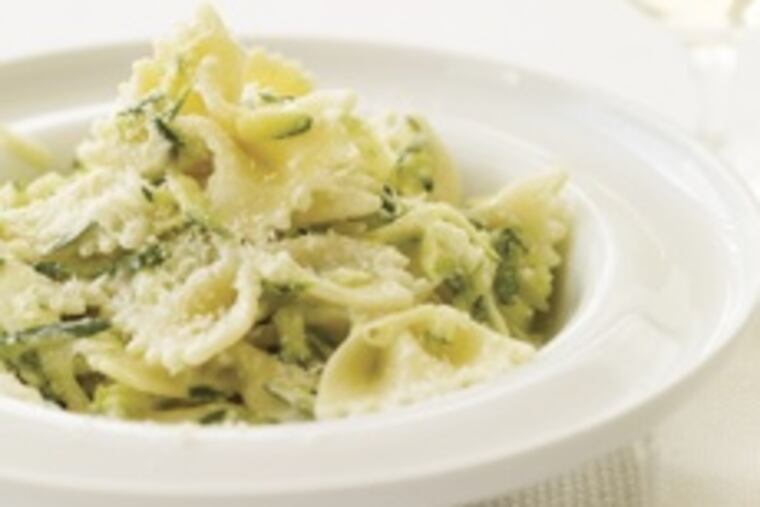
Funny she should say that, because "no-whey" yogurt - the unflavored version drained for a minimum of four hours - is a key component of one of her favorite pasta dishes.
To millions of American children, yogurt is a fact of life - and dessert. Rather than knowing it as an ingredient, they think it edible only if it contains added sugar in the form of flavorings, fruit, cereal, or even bits of candy.
In the olden days, before the American marketplace pumped it full of such things, yogurt was a happy, healthy, calcium-rich union of certain bacteria and milk that originated in the truly olden days of the Neolithic period in Central Asia. It then was popular in ancient Greece, Rome and Egypt - and still is. (Tzatziki, the yogurt-garlic-dill dip, has a widespread modern following, for example.)
In the United States, though, yogurt began to infiltrate the refrigerators of everyday Americans only in the 1970s. Before that it was identified with immigrants, then with hippies living off the grid in California.
But even before yogurt was groovy, enterprising new Americans Sarkis Colombosian and his wife, the former Rose Krikorian, saw that it could be profitable.
In 1929, the couple began what is now our robust yogurt culture by founding the nation's first yogurt manufacturing plant, Colombo & Sons Creamery, at their small farm in Andover, Mass.
Their product, full-fat and non-flavored, was based on Rose's traditional recipe from Turkish Armenia, the immigrants' home country. At first, it sold only to European transplants familiar with its taste and virtues. But by 1940, according to the Massachusetts Historical Society, it was selling well throughout New England.
Over the years the company grew, expanded its offerings, and soon had to compete with the product of another immigrant, Daniel Carcasso from Portugal, whose company, Danone (now Dannon), pioneered fruit-flavored yogurt in 1947. (Dannon is the world's top-selling brand. The Colombosian family sold its company in 1993 to the General Mills conglomerate.)
Now yogurt is as ubiquitous a refrigerator item as milk - be it plain, laced with fruit jam and/or cereal and/or candy, frozen like ice cream, packed into tubes, carbonated to attract more tweens, and, just recently for baby boomers, marketed as a "probiotic" aid to digestion and the immune system. There are pet snacks covered in it, skin conditioners and make-up containing what purports to be yogurt; it's an ingredient in toothpaste and cereal.
All of which is why U.S yogurt sales doubled to $5 billion from 1998 to 2006, according to the market tracking company Euromonitor.
Shopping for yogurt requires a glossary: Swiss or custard style is mixed with fruit; sundae-style has fruit on the bottom; probiotic means it contains bacteria friendly to the digestive system.
But my favorite type of yogurt is the triple-strained, thick, unflavored Greek style, which, happily, is also becoming more available. (Look for the Chobani, Fage and Oikos brands.)
However, since purchasing a yogurt strainer, a strange-looking, conical footed contraption made of white plastic and fine plastic mesh, I discovered that supermarket brands (but not the type that contain gelatin) can be drained to produce similar yogurt - sweet and creamy with consistencies ranging from thicker to cheeselike.
As many people of Middle Eastern descent know, it is delicious eaten cold, perhaps with a drizzle of honey and figs in season, among other ways.
It is also an excellent ingredient, but remember:
Bring it to room temperature before including it in a hot dish so that it does not separate.
Don't boil anything containing yogurt. Heat the mixture gently just until it is warm or it will curdle nastily.
Don't heat it to more than 120 degrees if you want to preserve its beneficial bacteria. Stirring it in at the end of a cooking process is best.
Don't go stir-crazy unless you want the yogurt to be thinner.
Cook with thick yogurt. If you don't buy it this way and don't own an official strainer, place a coffee filter or a double layer of cheesecloth in a sieve. Place the sieve in a bowl with at least 4 inches of room at the bottom to allow the yogurt to drain. Pour the yogurt into the sieve, cover it, and refrigerate for at least 4 hours. The longer the yogurt drains, the thicker it will become. The liquid in the bottom of the container is whey, which is chock-full of vitamins, minerals and proteins. It can be added to soup or used to make ricotta cheese.
Chicken Do-Piaza
Makes 4 servings
EndTextStartText
1 cup plain whole-milk
yogurt
2 large white or yellow onions (about 1 pound)
1/2 cup freshly squeezed orange juice
1/4 cup water
1 tablespoon grated fresh ginger
3 garlic cloves, coarsely chopped
2 teaspoons coriander seeds, lightly toasted and ground
1 teaspoon ground turmeric
1/4 teaspoon cayenne, or to taste, or 1 small dried red chile
Coarse salt
8 bone-in, skinless chicken thighs (about 2 pounds total) or bone-in skinless chicken breasts.
2 teaspoons ghee (clarified butter, see note) or vegetable oil
EndTextStartText
1. Drain the yogurt 4 to 6 hours in advance by setting a small mesh sieve over a tall medium bowl so that the bottom of the sieve sits at least 1 1/2 inches above the bottom of the bowl. Line the strainer with cheesecloth, paper towels or a paper coffee filter. Pour the yogurt into the sieve and refrigerate for 4 to 6 hours. Discard the liquid in the bowl and use the soft, thick cheese that is in the sieve.
2. Prepare the onions and braising liquid by thinly slicing one onion, placing the slices in a strainer or colander, and rinsing them thoroughly with cold water. Set aside to drain.
3. Coarsely chop the other onion and place it in a blender. Add the orange juice, water, ginger, garlic, coriander, turmeric, cayenne or chile and one teaspoon salt. Blend on high speed until it becomes a smooth puree. (You can also do this in a food processor, but the texture of the sauce will be coarser.)
4. Rinse the chicken thighs with cold water and thoroughly dry them with paper towels to enable them to brown well. Season the chicken with salt.
5. Heat the ghee in a heavy-based 12-to 14-inch shallow braising pan over medium-high heat. When the fat is almost shimmering, add the chicken in batches so that the pan is not crowded. Lightly brown on both sides, turning with tongs, 6 to 8 minutes total per batch. Transfer to a large plate to catch the drips. When all the chicken is browned, pour off all but a tablespoon of fat from the pan, retaining any browned bits on the bottom of the skillet.
6. Return the pan to medium-high heat. Gradually pour in the orange-onion puree. (Stand back; it will sputter.) Simmer about 5 minutes, scraping the bottom and stirring with a wooden spoon.
7. Add the chicken to the sauce along with any juices that pool under it. Turn the pieces to coat them with the sauce. Return to a simmer. Cover, reduce the heat to low, and simmer gently. Check after 10 minutes to make sure that the simmer is quiet and not turbulent. If the latter, lower the heat. After 20 minutes, turn the chicken pieces with tongs. Continue braising the thighs for 40 to 45 minutes, or breasts for 30 to 35 minutes, until the chicken is fork-tender.
8. With tongs, transfer the chicken to a platter. Cover loosely with foil.
9. Add the reserved onion slices to the pan and stir. Replace the cover and set off the heat undisturbed for 5 minutes. The onions will be crisp and mildly pungent. Stir in the drained yogurt with a wooden spoon, working the onions into the sauce. Heat the sauce very gently over medium heat until the yogurt is warmed through. Don't let the sauce boil or it will look curdled. Taste and adjust with salt and cayenne.
10. Return the chicken to the pan, turning to coat. Serve, spooning the sauce and onions over the chicken.
Per serving: 316 calories, 34 grams protein, 21 grams carbohydrates, 11 grams sugar, 11 grams fat, 134 milligrams cholesterol, 167 milligrams sodium, 3 grams dietary fiber.
EndText
Raspberry Fool
Makes 4 servings
EndTextStartText
1 1/2 cups vanilla nonfat yogurt
One 10-ounce package frozen unsweetened raspberries, thawed
1/3 cup confectioners' sugar
1/4 cup well-chilled heavy cream
4 ladyfinger cookies
EndTextStartText
1. Place the yogurt in a strainer lined with a paper towel and let it drain and thicken in the refrigerator for at least four hours and up to one day. Discard the liquid and set the thickened yogurt aside.
2. Process half the raspberries in a food processor until smooth. Transfer the puree to a fine mesh strainer and strain it into a large bowl, pressing the liquid out with a rubber spatula. Discard the seeds. Whisk in the confectioners' sugar. Stir in the remaining raspberries.
3. In a chilled medium bowl, whip the cream with an electric mixer until soft peaks are formed. Gently fold in the yogurt. Fold in the raspberry mixture.
4. Spoon the fool into cocktail glasses and chill, covered with plastic wrap, for at least one hour and up to one day. Serve with ladyfinger cookies.
- From The Food You Crave by Ellie Krieger (Taunton, 2008)
Per serving:
241 calories, 6 grams protein, 40 grams carbohydrates, 26 grams sugar, 7 grams fat, 61 milligrams cholesterol, 77 milligrams sodium, 4 grams dietary fiber.
EndText
Baked Peas With Tarragon, Yogurt and Pistachios
Makes 4-5 servings
EndTextStartText
1 pound frozen baby peas
1/2 cup loosely packed fresh tarragon leaves
2 scallions, white and green parts, chopped
2 tablespoons extra virgin olive oil
1/4 cup Greek yogurt
1/2 cup chopped pistachios
EndTextStartText
1. Preheat the oven to 500 degrees.
2. Put the peas in a clay pot or small Dutch oven and gently heat them on the stove until they thaw, stirring occasionally.
3. Meanwhile, put the tarragon, scallions, olive oil, yogurt and 1/4 cup of the pistachios into a blender and puree.
4. Gently mix in the peas, sprinkle the top with extra chopped pistachios, and bake about 15 minutes. The top will begin to brown.
5. Remove and serve in your best serving bowl.
Per serving (based on 5):
208 calories, 9 grams protein, 18 grams carbohydrates, 6 grams sugar, 12 grams fat, 2 milligrams cholesterol, 211 milligrams sodium, 6 grams dietary fiber.
EndText
Farfalle With Yogurt and Zucchini
Makes 4 to 6 servings
EndTextStartText
1 pound farfalle
4 medium zucchini (about 1 1/2 pounds), coarsely shredded
4 tablespoons unsalted butter
1 cup plain whole-milk Greek yogurt
1 cup freshly grated Parmigiano-Reggiano cheese, plus more for serving
Freshly grated nutmeg
Kosher salt and freshly ground black pepper to taste
EndTextStartText
1. In a large pot of boiling, salted water, cook the farfalle until al dente. About one minute before the farfalle is done, add the shredded zucchini to the pot. Drain the farfalle and zucchini, reserving 1/4 cup of the pasta cooking water.
2. Meanwhile in a large, deep skillet, melt the butter. Remove from the heat. Stir in the Greek yogurt and the one cup of grated Parmigiano-Reggiano and season the yogurt sauce with freshly grated nutmeg, salt and black pepper.
3. Add the farfalle, zucchini and reserved pasta water to the skillet and cook over low heat, tossing, until the sauce coats the pasta.
4. Transfer to warmed bowls and serve with the extra cheese.
Per serving (based on 6):
460 calories, 18 grams protein, 64 grams carbohydrates, 6 grams sugar, 15 grams fat, 39 milligrams cholesterol, 242 milligrams sodium, 4 grams dietary fiber.
EndText