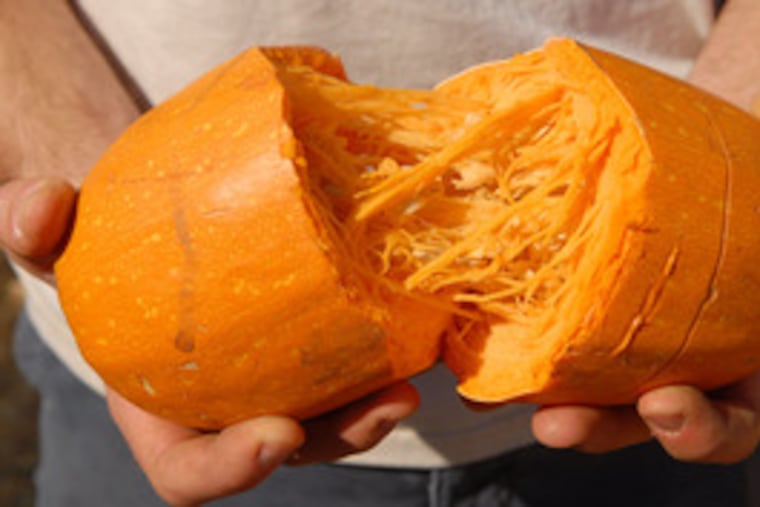
Don't let that pumpkin on your front step go to waste after Halloween. You may be able to use it for Sunday supper.
Depending on how long the pumpkin's been outside, you could use the inside "meat" to make soup, or just serve a stew in the shell.
Ed Farace, produce manager and resident pumpkin-cooking expert at Linvilla Orchards in Media, says more varieties of pumpkins are available these days, especially heirloom types. They're rich in beta-carotene, and he's got suggestions for picking a pumpkin or squash that's just right for cooking.
Small (not miniature) round pumpkins, often labeled sugar pie pumpkins, are plentiful at farm stands and supermarkets - and so are recipes for using them in cakes and pies. But we're focusing here on savory pumpkin dishes.
In general, the pumpkins we see at farm markets and stores are bred for size, color and shape. They're meant to be decorative, with meat that is stringy and not very flavorful and seeds that may be too dry even for roasting as a snack.
That said, those pumpkins still make impressive tureens for serving soup or stew at the dinner table.
A pumpkin that's been sitting in the sun on your front porch for the last several weeks, when temperatures inched into the unseasonable 80s, may have started to "cook" internally, so don't use it. By the same token, a pumpkin that has frosted over isn't good for cooking, either.
But if your pumpkin still has its heft and color, start by washing and drying the outside. Then cut off the top of the pumpkin to make a lid. Use a high-quality, sharp chef's knife and cut on a stable surface. A flimsy or dull knife is dangerous.
Remove the seeds and set them aside if you'd like to roast them later. (Wash and dry, then roast in a single layer on a flat pan at 350 degrees for 20 to 30 minutes and sprinkle with salt.)
Remove and dispose of the pulp from inside the pumpkin. Use a spoon to scrape the interior surface clean. Rinse and dry the inside, sprinkle with salt, and brush with melted butter.
Brush the outside with oil. Place the pumpkin shell on a sturdy, flat baking pan (cover the pan with foil if desired) and set it aside while you prepare the soup or stew to be served in the pumpkin.
We're featuring two stew recipes in today's food section.
One is a beef version made on the stove top and, when nearly finished, ladled into the pumpkin shell and roasted in the oven for an additional 25 to 30 minutes.
The other is for a vegetarian stew that is both prepared and cooked in the pumpkin shell.
Either way, you'll note that pumpkin is not listed as an ingredient in the stew. Instead, you are expected to scrape some of the pumpkin from the inside of the shell while serving the stew.
You can even use your favorite recipe for stew, make it ahead of time in a crock pot, and finish it off in the pumpkin shell for a presentation that will not only dazzle your kids, but also demonstrate where real food comes from.
Small pumpkins also make great serving vessels, even if they don't have much meat. Prepare as with a larger whole pumpkin, but stuff with hot applesauce, bread pudding, turkey or chicken stuffing or cranberry relish.
If you are determined not to use canned pumpkin in a recipe, here are some tips for using the real thing, from
A Harvest of Pumpkins and Squash
by Lou Deibert Pappas (Chronicle Books, Sept. 2008).
Start with a pumpkin that is solid and hefty for its type and blemish-free. Wash the dirt from the exterior. After that, you have a choice of cooking techniques:
Leave the pumpkin whole, but pierce the skin with a fork. Then place it in a roasting dish with about two inches of water, and bake at 350 degrees for about 30 minutes or until fork-tender.
Cut into the pumpkin to remove the seeds and pulp. Then either cut it into manageable pieces and boil it on the stovetop or roast the pieces in the oven.
Cut the pumpkin along its equator, remove the seeds and pulp, and then place the two halves face down on a baking pan and roast at 350 degrees for about 45 minutes, until fork-tender. Or, microwave in a covered dish with a tablespoon or two of water for 7 to 10 minutes per pound.
With any of these techniques, you'll be able to remove the exterior rind easily after cooking and cooling. Then either puree or cut into chunks, depending on how you plan to use the pumpkin in your recipe.
Cooked pumpkin or squash can be pureed in a blender or food processor and used in soups or baked dishes. You can refrigerate a puree for up to two days, or freeze in an airtight container for one month.
And if all that still seems like too much work, simply scoop out a fresh pumpkin and use it on the dinner table as an organic, single-use vase, filled with autumn flowers.
Argentine Stew in a Pumpkin Shell
Makes 6-8 servings
2 pounds beef stew meat, cut in 11/2 inch cubes
1 large onion, chopped
2 cloves garlic, minced
3 tablespoons oil
2 large tomatoes, chopped
1 large green pepper, chopped
2 teaspoons salt
1/2 teaspoon sugar
1 cup dried apricots
3 white potatoes, peeled and diced
2 sweet potatoes, peeled and diced
2 cups beef broth
1 medium pumpkin
Butter, melted
1/4 cup dry sherry, optional
1 16-ounce can whole-kernel corn
1.
Cook beef with onion and garlic in oil until browned.
Add the tomatoes, pepper, salt, sugar, apricots, potatoes and broth. Cover and simmer for 11/2 hours.
2.
Meanwhile, preheat the oven to 325 degrees. Cut off the pumpkin top and discard. Scoop out the seeds and stringy membrane. Brush the inside of the pumpkin with melted butter and sprinkle lightly with salt and pepper.
3.
Stir the sherry and corn into the stew and spoon into the pumpkin shell.
4.
Place the pumpkin shell in a shallow pan and bake at 325 degrees for 1 hour or until fork-tender. Place the pumpkin in a large bowl and ladle out the stew, scooping out some of the pumpkin with each serving.
Per serving (based on 8):
459 calories, 28 grams protein, 51 grams carbohydrates, 13 grams sugar, 17 grams fat, 76 milligrams cholesterol, 1,071 milligrams sodium, 7 grams dietary fiber
Vegetarian Pumpkin Stew
Makes 6 to 8 servings
2 tablespoons olive oil
1 cup chopped onions
4 cloves garlic, minced
2 large tomatoes, cut into
1/2-inch cubes
1 red bell pepper, coarsely chopped
1 russet potato (about 10 ounces), peeled and cut into 1/2-inch cubes
1 orange-fleshed sweet
potato (about 12 ounces) peeled and cut into 1/2-inch cubes
1 cup dried apple slices
2 cups vegetable stock, plus more as needed
1 sugar pie pumpkin (8 to 10 pounds)
2 tablespoons unsalted
butter, melted
Salt for sprinkling, plus 1/2 teaspoon freshly ground pepper for sprinkling
1 15-ounce can black beans, drained and rinsed
1/4 cup dry sherry
1.
Heat the oil in a dutch oven over medium heat. Add the onions and garlic, cook, stirring occasionally, until the onions are translucent, about 5 minutes. Add the tomatoes, bell pepper, potatoes, apples and 2 cups vegetable stock. Increase the heat and bring to a boil. Reduce heat, cover and simmer, stirring occasionally, until the vegetables are tender, about 20 minutes.
2.
Meanwhile, preheat the oven to 325 degrees. Lightly oil a shallow baking pan large enough to accommodate the pumpkin. Slice off the top of the pumpkin, leaving about a 6-inch opening, and discard. Scoop out the seeds and stringy membranes, leaving the pumpkin flesh intact. Brush the inside and top edge with melted butter and sprinkle lightly with salt and pepper. Place the shell in the prepared baking pan.
3.
Stir the stew and add the black beans, sherry, 1/2 teaspoon salt and 1/2 teaspoon pepper. Pour the mixture into the pumpkin shell. Bake for about 1 hour and 15 minutes, or until the pumpkin flesh is fork-tender.
4.
Carefully transfer the pumpkin to a large bowl. The shell may be soft in places, so take care. If the stew has become too thick to suit you, gentle stir in some hot vegetable stock.
5.
For each serving, use a large spoon to scoop out a wedge of cooked pumpkin; place in the bottom of a soup bowl. Top with the stew.
Tips/variations:
This stew can also be baked and served in six individual-size pumpkins (about 2 pounds each). Ladle 11/3 cups of the stew into each pumpkin and bake for about 1 hour. Or it can also be made in one pumpkin, as described above, and then served in roasted acorn squash bowls.
To prepare roasted acorn squash bowls:
1.
Preheat the oven to 375 degrees. Cut the acorn squash in half horizontally. Scoop out the seeds and discard. Use a spoon to remove strings and smooth out the inside. Cut a very thin slice off the bottoms to make a stable base. Brush the insides and tops with oil and sprinkle lightly with salt.
2.
Place the squash halves, cut side down, in a lightly oiled baking pan. Pierce the skin in several places with a fork. Bake for about 45 minutes, or until the flesh is fork-tender.
3.
Place the roasted squash on a plate, or set in a soup bowl. Fill with warm stew and serve immediately.
Per serving (based on 8):
207 calories, 5 grams protein, 31 grams carbohydrates, 8 grams sugar, 7 grams fat, 8 milligrams cholesterol, 576 milligrams sodium, 6 grams dietary fiber
Small Stuffed Pumpkins
One miniature pumpkin per serving
Several fresh pumpkins about 5 to 6 inches in diameter, one for each serving.
Ingredients for stuffing: applesauce, turkey or chicken stuffing, cranberry sauce.
(The pumpkins become novelty serving dishes when roasted and stuffed.)
1.
Preheat the oven to 250 degrees.
2.
Wash the pumpkins; cut off and discard the tops.
3.
Scoop out the seeds and stringy membranes.
4.
Place the pumpkins on a cookie sheet covered with parchment paper or aluminum foil. Brush inside and out with oil.
5.
Bake 15 to 20 minutes or until the insides begin to soften.
6.
Allow to cool (for use with cold foods). Otherwise, fill with stuffing and serve on a saucer.
Cheese Soup in Little Pumpkin Shells
Makes 6 servings
6 mini pumpkins or
carnival, sweet dumpling, or acorn squash (3/4 to 1
pound each)
3 tablespoons olive oil
1 large onion, finely chopped
2 large carrots, peeled and
shredded
2 stalks celery, finely
chopped
1 quart homemade or
canned low-sodium
chicken broth
1 clove garlic, minced
1/4 teaspoon salt
1/4 teaspoon freshly ground
black pepper
1/4 teaspoon freshly grated
nutmeg
3/4 cup whole milk or half- and-half
1 cup shredded extra-sharp
cheddar or Gruyere
cheese
1/3 cup dry white wine
1/2 cup garlic sourdough
croutons (see note)
1.
Preheat the oven to 375 degrees.
2.
With a small, sharp knife, cut wide tops out of the pumpkins to make bowls. Scrape out and discard the seeds and fibers. Replace the tops and arrange the pumpkins on a parchment-lined baking sheet. Bake until tender when pierced with a knife, but still firm, 40 to 45 minutes. Let cool slightly. Trim all but 1/4 inch of flesh from the tops, reserving the trimmed flesh. Cut and scrape out some of the flesh of each pumpkin to make shells with about a 3/4 cup capacity. Dice the trimmed flesh and set aside.
3.
Meanwhile, heat two tablespoons of the oil in a large saucepan over medium heat. Add the onions, carrots and celery, and saute about 8 to 10 minutes. Add the broth, garlic, salt, pepper and nutmeg. Cover and simmer for 20 minutes, or until the vegetables are tender. Let cool slightly.
4.
Working in two or three batches, in a blender or food processor fitted with a metal blade, process the vegetable mixture to a puree. Return the puree to the saucepan. Stir in the milk and cook until heated through. Add the cheese and wine and cook, stirring until the cheese melts. Taste and adjust the seasoning.
5.
Heat the remaining tablespoon of oil over medium heat. Add the cooked squash pieces and toss and stir just to heat through.
6.
Place the hot pumpkin tureens on dinner plates and ladle in the soup. Sprinkle with the croutons. Serve immediately, with the sauteed pumpkin alongside to spoon over the soup.
Note:
To make the garlic sourdough croutons, in a small baking dish, combine one clove of minced garlic and one tablespoon of olive oil. Stir to coat, and let steep for a few minutes. Add two slices of sourdough French bread cut into 1/2-inch cubes and toss to coat. Bake for five minutes or until lightly toasted.
Per serving:
261 calories, 9 grams protein, 17 grams carbohydrates, 5 grams sugar, 17 grams fat, 23 milligrams cholesterol, 558 milligrams sodium, 2 grams dietary fiber.