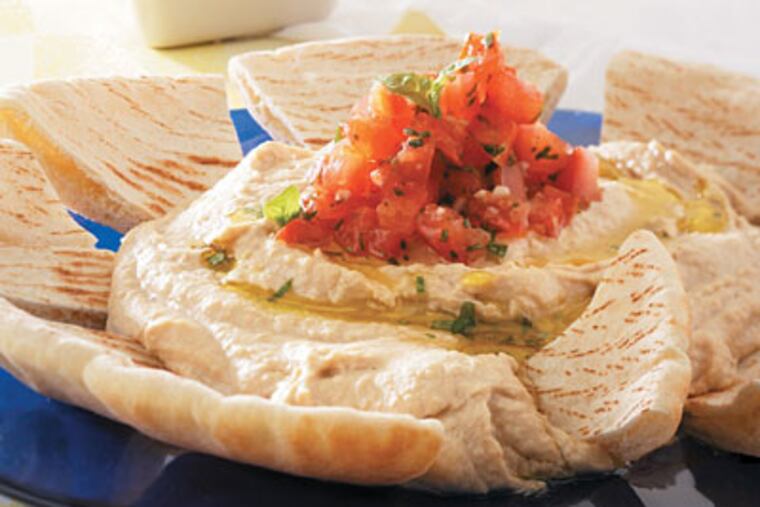
Imagine an evolutionary timeline of party spreads and dips.
It would show salsa eventually replacing the 1970s sour-cream-and-onion mix called California Dip and then morphing into hummus, which is now omnipresent.
But "hummus" made of pureed vegetables is positioning itself to take over when the ancient Middle Eastern spread, which is made of chickpeas and tahini (sesame paste), wears out its welcome.
This is not to say that the popular pita-bread accompaniment is stepping down any time soon.
Ten years ago, hummus sales in the United States totaled about $5 million, according to the tracking firm A.C. Nielsen. By 2007, that figure had risen to about $192 million, and some marketing companies predict that sales will reach $250 million within four years.
In New York City and other cities, parlors that serve only hummus are popping up in attempts to replicate the hummusiot, the hummus parlors of Israel. There and in other Middle Eastern countries, it is decidedly not an ancillary part of a meal, but the main event.
Still, the new global popularity of hummus as a spread or dip reflects an acceptance and promotion of such concoctions that are quite different from the classics that graced coffee tables and buffets over the last several decades. This is a difference that can be generally summarized as "fat content" vs. "vegetable matter."
Perhaps we have the popularization of the food processor to thank for this revolution. Without it, all party or "cocktail" nibbles might still be mixed by hand and based on sour cream, mayonnaise and cream cheese.
Then again, optimists might say that we are increasingly turning to vegetable spreads because we've finally heeded warnings about the empty calories and saturated fat contained in the nibbles of yore.
Hummus also appeals as a popular party food, since it meets the dietary restrictions of many guests, vegetarians, vegans, celiacs, and diabetics alike.
A delicious yet (some would say) horrifying trip down the Memory Lane of Cocktail Party favorites confirms where we've been:
The "Burning Bush." According to Sylvia Lovgren in Fashionable Food, this post-Prohibition (in the late 1930s) appetizer consisted of chipped, dried beef mixed with cream cheese and formed into balls. The balls were placed on toothpicks and stuck into an eggplant to resemble a "bush in autumn foliage, too attractive not to be noticed."
California Dip. The simple, enduring sour-cream-and-onion-soup dip (usually made with Lipton dry mix) induces flashbacks to parties in the 1970s.
Crab (or Clam) Dip. Made of artificial crab or canned clams, a block of cream cheese, a bit of mustard, and dash of sherry, it is melted together in a fondue pot. Circa 1950s.
The "Caviar Pie." This is a layered affair consisting of cheap jarred "caviar," hard-boiled eggs, onions, cream cheese and mayonnaise and sour cream and is a cousin to:
Seven-Layer Dip. The popularity of this spread peaked in the 1980s but is still going strong. It is fashioned of strata of the Mexican combo of guacamole, sour cream, refried beans, salsa, black olives, green onions, and cheese. Sometimes, sauteed ground beef is added for another layer.
This brings us up to what looks like the Age of Reason in comparison. It is the era of hummus and recipes pretending to be its children.
Even though it packs a caloric punch (about 425 calories in a cup), hummus is lower in fat than sour cream or cream cheese and contains dietary fiber, folate, calcium, Vitamin C, and iron. The best commercial varieties, like homemade, contain no trans fats.
Similarly healthier are pureed vegetables transformed into spreads and dips by the addition of herbs and, perhaps, olive oil.
To the dismay of purists, many restaurant menus and cookbook recipes dub these spreads "hummus" to piggyback on the fad. The word is evolving into a synonym for a vegetable puree that can be applied to bread, crackers or vegetables.
Take, for example, a recipe for an Asian-style eggplant spread (below) that I've made for years. I have always called it "Chinese Eggplant Dip." It does not contain the tahini (sesame paste) integral to true hummus.
I included its recipe in a neighborhood cookbook about five years ago. Just last month I saw the identical formula pop up in another local collection of recipes, this time bearing the moniker "Eggplant Hummus."
And, even though putting edamame in a blender results in, well, a pale green paste, I've seen a half-dozen variations of "Edamame Hummus." One is included here.
Hummus has even been co-opted to now and then become an alternate name for toppings on bruschetta - which is technically Italian toasted bread rubbed with garlic cloves and olive oil.
What next? Strawberry "hummus"? While we wait for that, here are a few examples of the next generation of pseudo-hummus.
Eggplant Hummus With Asian Flavors
Makes 3 cups or about 20 servings
EndTextStartText
2 eggplants, each about 1 1/2 pounds
2 tablespoons minced garlic
1 tablespoon finely minced fresh ginger
1/4 cup thinly sliced green onions
1/2 teaspoon cayenne pepper
1 tablespoon hoisin sauce
3 tablespoons soy sauce
2 teaspoons brown sugar
2 tablespoons rice vinegar
EndTextStartText
1. Heat oven to 500 degrees. Pierce eggplants in several places with a fork and place them on a baking sheet.
2. Bake for about 1 hour, turning once, until tender and collapsed. Remove them from the oven, slit them lengthwise and allow them to cool.
3. When just warm to the touch, scrape pulp into a medium-size bowl and mash gently so that no big strands or pieces remain. Stir in the garlic, ginger, green onions, cayenne pepper, hoisin, soy, brown sugar, and rice vinegar. Serve on crackers or pita or with fresh vegetables.
Per serving: 23 calories, 1 gram protein, 5 grams carbohydrates, 2 grams sugar, trace fat, trace cholesterol, 73 milligrams sodium, 2 grams dietary fiber.
EndText
Edamame Hummus
Makes 10 servings
EndTextStartText
About 1 cup shelled, fresh or frozen (unthawed) edamame (soybeans), from 1 pound, shelled
2 large cloves garlic, peeled
1/2 teaspoon salt
1/2 cup fresh flat-leaf parsley leaves
1/4 cup canned chickpeas, drained
1/4 cup plain yogurt
2 tablespoons tahini (sesame paste)
3 tablespoons fresh lemon juice
Pinch of cayenne pepper
1 teaspoon ground cumin or 1 teaspoon whole cumin seeds, toasted in a dry skillet and ground
EndTextStartText
1. Bring a large pot of salted water to a boil over high heat. Add the edamame and cook until tender, 4 to 5 minutes. Drain the edamame in a colander and set aside to cool.
2. Place the garlic, salt, and parsley in a food processor and pulse the machine until the ingredients are finely chopped. Add the edamame and chickpeas and pulse 5 or 6 times until they are coarsely chopped. Add the yogurt, tahini, lemon juice, cayenne pepper, cumin, and ½ cup of water and process until smooth. The hummus can be refrigerated, covered, for up to 1 week. It can be served cold or at room temperature.
Per serving: 83 calories, 5 grams protein, 8 grams carbohydrates, 3 grams sugar, 4 grams fat, trace cholesterol, 128 milligrams sodium, 2 grams dietary fiber.
EndText
Parsnip Hummus With Parsley
Makes 8 appetizer servings
EndTextStartText
1 pound parsnips (about 6 medium or 4 large), peeled and cut into 1-inch chunks
1 tablespoon chopped garlic (about 3 large cloves)
1/4 cup freshly squeezed lemon juice
4 tablespoons butter, cut into small pieces
1/4 cup extra-virgin olive oil
2 teaspoons ground cumin
Salt and pepper to taste
1/2 recipe Tahini Sauce (recipe below)
2 tablespoons chopped fresh parsley
EndTextStartText
1. In a medium saucepan, cover the parsnips with water and bring them to a boil over high heat. Reduce the heat to medium and simmer the parsnips for about 20 minutes, until they are very tender when squeezed with a pair of tongs or pierced with a fork. Drain the parsnips in a colander, reserving 1 tablespoon of the cooking liquid or water.
2. Transfer the parsnips to the work bowl of a food processor fitted with a metal blade. Puree the parsnips with the reserved cooking liquid, garlic, lemon juice, butter, olive oil, and cumin until smooth and creamy, for about 3 minutes, stopping to scrape the sides of the bowl a couple of times. Season the puree with salt and pepper. Spoon the puree into a serving bowl and cool it to room temperature, about 1 hour.
3. Use the back of a large serving spoon to create a well in the center of the puree, big enough to hold about a half-cup. Spoon the Tahini Sauce into the center of the well. Garnish with parsley and serve.
Note: To make the Tahini Sauce, place ¼ cup tahini, ¼ cup extra-virgin olive oil, 3/4 teaspoon ground cumin, ¾ teaspoon chopped garlic (about 1 clove), and 1 teaspoon freshly squeezed lemon juice in a blender and blend until smooth. Season with salt and pepper to taste. Refrigerate up to 5 days.
Per serving: 213 calories, 2 grams protein, 12 grams carbohydrates, 3 grams sugar, 19 grams fat, 15 milligrams cholesterol, 50 milligrams sodium, 3 grams dietary fiber.
EndText
Creamy Hummus With Steeped Tomatoes
Makes 8 to 10 servings
EndTextStartText
1 (15-ounce) can small white beans or cannellini beans, drained and rinsed
1 (15-ounce) can chickpeas, drained and rinsed
3 cloves garlic
1/2 cup tahini
Juice of 2 lemons
1 1/2 tablespoons soy sauce
1 1/2 teaspoons fine sea salt
1 1/2 teaspoons ground cumin
1/2 teaspoon cayenne pepper
1/8 teaspoon ground white pepper
1/3 cup extra-virgin olive oil
1/4 cup cold water or more as needed.
For the steeped tomatoes:
2 plum tomatoes
1 clove fresh garlic, minced
1/4 cup fresh basil, minced
1/4 cup extra-virgin olive oil
8 to 10 large pita breads, warmed in the oven, cut into triangles
EndTextStartText
1. Place beans, chickpeas, garlic, tahini, lemon juice, soy sauce, salt, cumin, cayenne pepper, and white pepper into the bowl of a food processor fitted with a metal blade. Process for 1 minute. Drizzle in a third of a cup of olive oil and water. Process again. Add more water as needed to thin the hummus to desired consistency.
2. Transfer the hummus to a plastic or glass container; cover and chill in the refrigerator.
3. Cut each tomato in half and discard the seeds and juices. Chop the halves into small dice, place in a small bowl, and add the garlic, basil, and enough olive oil to cover. Cover the bowl and place it in the refrigerator to give the flavors a chance to steep.
4. To serve, top hummus with steeped tomatoes. Serve with warm pita bread.
Per serving (based on 10; with pita): 472 calories, 16 grams protein, 59 grams carbohydrates, 2 grams sugar, 21 grams fat, no cholesterol, 681 milligrams sodium, 7 grams dietary fiber.
EndText
Quick Crostini With Avocado and Green Pea Hummus
Makes 30 canapes.
EndTextStartText
1 ripe avocado
2 tablespoons lime juice
1/2 clove garlic
1 (10-ounce) package frozen green peas
1 teaspoon kosher salt or 1/2 teaspoon table salt
30 pumpernickel bread rounds
EndTextStartText
1. Place the flesh of the avocado, the lime juice, garlic, peas, and salt in a food processor and process until smooth.
2. Spoon onto pumpernickel bread and serve.
Per canape: 37 calories, 1 gram protein, 6 grams carbohydrates, 1 gram sugar, 1 gram fat, no cholesterol, 123 milligrams sodium, 1 gram dietary fiber.
EndText