Cooking classes a night-school staple
Peanuts are the problem. Tom Voravolya can't teach his popular Thai Cooking class at Lower Merion High School because so many Thai dishes contain peanuts, and so many schoolchildren today have serious food allergies.
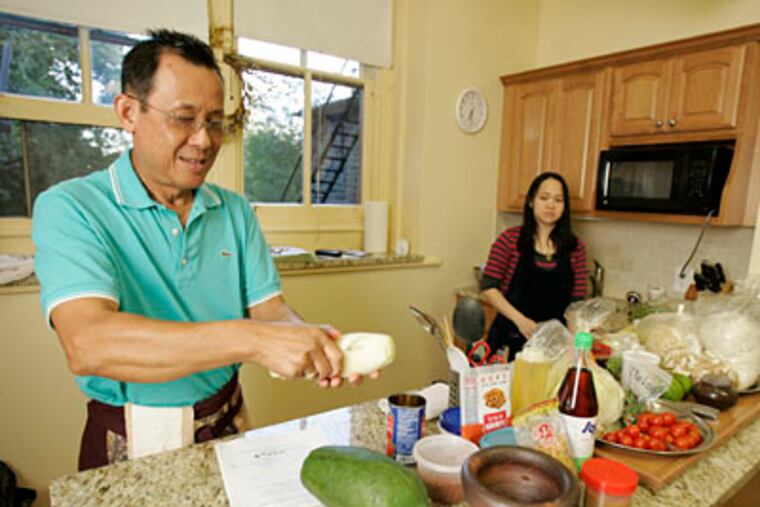
Peanuts are the problem.
Tom Voravolya can't teach his popular Thai Cooking class at Lower Merion High School because so many Thai dishes contain peanuts, and so many schoolchildren today have serious food allergies.
"They're allergic even to the scent," Voravolya says. "Our food has a very, very strong smell - and it stays around. If I cook something tonight, you'll still smell it in the room tomorrow."
The 20 adults enrolled in Voravolya's class at Main Line School Night didn't seem to mind last week. Without complaint, they settled into school desks in a room at the Creutzburg Center on Gulph Creek Road in Radnor, the magnificent Frank Furness-designed mansion where the night school has its offices and some classes.
At community night schools from the Main Line to Mount Airy (at the Mount Airy Learning Tree), thousands of people take classes in dance, literature, filmmaking, and yes, cooking, at reasonable prices right in their neighborhoods.
Main Line School Night, with a current fall catalog of 475 courses, lists six pages of cooking classes. Cooking classes have always been among the top five fan favorites, says Caroline Cuthbert, the nonprofit school's vice president for programming.
French cooking classes were long fashionable. But recently, enthusiasm for healthy eating and a taste for global ingredients converged, resulting in more demand for classes in Thai, Japanese, and Pan-Asian cuisines, Cuthbert said.
Vegetarian cooking is especially hot now.
"Five years ago, you could hardly sell any kind of healthy vegetarian cooking class," Cuthbert said. "Now we have a really good response to classes like that."
The Zen Vegetarian Clinic introduced three years ago is always a sellout.
Across the region and the country, night schools have a long tradition of educating newcomers to this country. In the 1800s, European immigrants worked long days and took classes at night, studying English, history, and cooking.
The tradition continues today, in some cases with immigrants sharing their culture and cooking, at the same time, drawing neighbors together to learn about the larger world and, in the process, about one another.
Voravolya, 63, is perhaps a perfect example.
He graduated from Chiangmai University in Thailand and immigrated to the United States in 1989 to open a restaurant. He did well - at one point owning three restaurants in his new hometown of Chicago.
But late one night after work, Voravolya was attacked and robbed. He cooperated with police, but only two of his attackers were caught and convicted. With the other three attackers at large - and aware of Voravolya's court testimony - he no longer felt safe on the streets of Chicago.
"I knew I cannot risk my life staying there," he said. "I moved here to Philadelphia about 12 years ago."
"Now I do my own business from home as a feng shui consultant, advising homeowners and business owners on how to place everything in the right position and direction, for luck."
With his wife, Jane, at his side, and daughter Nadia, 8, in the next room doing homework, Voravolya walks students through two recipes at each session of the five-week course.
Since time and space are at a premium, he preps his ingredients in advance and cooks on site in a restaurant-size, propane-fueled wok.
He displays each vegetable before and after it is sliced and diced and suggests where to shop and what to look for. The typed recipes he hands out show quantities that make four servings, but Voravolya cooks enough for the whole class and then some. So each session becomes a dinner party.
On the first night, Voravolya made Papaya Salad with Lime Sauce and Vegetarian Pad Thai (see recipes).
The salad uses a "young" or unripe papaya, but if that's not available, napa cabbage is a good substitute. (The lime sauce can be made days in advance, and any leftover sauce will keep in the refrigerator for several weeks.) He suggests controlling the heat of this dish by adding fewer or more fresh chile peppers.
For the pad Thai, perhaps the most popular Thai dish, start by soaking rice "sticks" overnight in warm water and save time by using prepackaged fried tofu. The tamarind called for in Voravolya's recipe can be purchased as a soft but solid block in a sealed plastic bag. (Cut off a hunk and soak it in warm water, using your hands to soften the tamarind. Then squeeze out the juice needed for the recipe, and save the rest in an airtight container.)
The recipes seemed simple enough to Brad and Lisa Leventhal of King of Prussia. With all three of their children in college, the Leventhals told the class, they are official empty-nesters.
"Now you can cook whatever you want!" someone in the back of the room exclaimed, and the others cheered.
Voravolya is in his fourth year at Main Line School Night. He teaches with infectious glee, proud that his food tastes good, and aware that his students come, as he says, "from all walks of life."
"When you finish this course, you can open your own Thai restaurants," he tells them with a sly smile, invoking the spirit of entrepreneurship.
"It will be a limited menu, with only 10 dishes, but it will be yours."
Thai Papaya Salad With Lime Sauce
Makes 4 servings
EndTextStartText
For the salad:
1 medium-size, fresh, green (not ripe) papaya (napa cabbage may be substituted)
12 cherry tomatoes, halved, or 4 plum tomatoes, quartered
2 carrots, julienned
20 regular green beans or 8 Thai string beans (long and thin)
2 tablespoons ground peanuts
For the sauce:
2 cloves garlic, diced
3 or more fresh small Thai chile peppers, red or green
2 tablespoons Thai palm sugar (or 3 tablespoons granulated sugar)
1 1/2 tablespoons lime juice
3 tablespoons Thai fish sauce (or 1 teaspoon salt)
EndTextStartText
1. To prep the papaya: peel and rinse; wipe off any milky liquid. Julienne using a knife, box grater, or mandoline; remove and discard seeds. Arrange slices on a towel to drain moisture.
2. Combine in large salad bowl: papaya, tomatoes, carrots, green beans and peanuts.
3. Prepare the sauce by crushing the following ingredients with a mortar and pestle, adding them one at a time: garlic, chile peppers, sugar. Put those crushed ingredients in a lidded storage container. Add the fish sauce and lime juice and shake.
4. Toss the salad with the sauce and serve immediately. Extra sauce may be refrigerated for a few weeks.
Per serving: 131 calories, 4 grams protein, 28 grams carbohydrates, 19 grams sugar, 2 grams fat, no cholesterol, 1,099 milligrams sodium, 4 grams dietary fiber. EndText
Vegetarian Pad Thai
Makes 4 servings
EndTextStartText
10-ounce bag dried rice sticks
1/3 cup canola oil
4 cloves garlic, diced
4 eggs
8 ounces fried tofu
4 tablespoons Thai fish sauce (or 1 teaspoon salt)
4 tablespoons ketchup or tomato paste
4 tablespoons sugar
2 tablespoons tamarind juice
6 scallions, green sections, cut in one-inch pieces
2 cups fresh bean sprouts
2 tablespoons ground peanuts
Optional: Thai dried chile powder (spicy) to taste
For garnish: lime wedges and bean sprouts
For nonvegetarians, sliced beef, pork or chicken may be added, or large uncooked shrimp
EndTextStartText
1. Prepare rice sticks by soaking them in water at room temperature (not hot or cold) at least 4 hours or overnight.
2. Have all other ingredients prepared and measured, as this dish will be cooked quickly in a wok.
3. Put oil in wok set at highest heat (electric wok or stove top may be used). Test temperature by putting a drop of water in the wok. If it sizzles, it's ready.
4. Working quickly and stirring as you go, add the garlic, then the eggs (break each one into the wok separately); when the eggs begin to scramble, add the tofu. If you are using any meat, add it at this point. If using shrimp, add it at this point but remove it once it is pink so that it does not overcook.
5. Add the rice sticks that have been soaked and drained.
6. Add tomato paste, Thai fish sauce, tamarind juice, and sugar.
7. Add scallions, bean sprouts, and peanuts. Return shrimp to wok if using.
8. Arrange on serving platter and garnish with lime and bean sprouts. Chile powder can be added at this point, if using.
Per serving: 684 calories, 23 grams protein, 66 grams carbohydrates, 21 grams sugar, 39 grams fat, 212 milligrams cholesterol, 1,682 milligrams sodium, 8 grams dietary fiber. EndText