Kugel meets quiche
Cookbook author Joan Nathan seeks out Jewish cooking in France, and finds a taste of compelling history.
Joan Nathan is the thinking person's cookbook author, known for bringing the past into the present and telling the stories of ordinary people whose histories remind us why food matters.
Primarily associated with Jewish cooking in the United States and Israel, Nathan was in town recently to speak about her latest book: Quiches, Kugels, and Couscous: My Search for Jewish Cooking in France, (Knopf Books, 2010).
France? The country where women don't get fat?
To many, Jewish and French cooking styles seem mutually exclusive. The difference in serving sizes at French restaurants and Jewish delis alone is striking.
Jewish dietary laws prohibit eating typically French delicacies such as eel or frogs' legs, or enjoying cream sauces and buttery tart crusts when the main dish is meat.
And then there is the problem of the fate of French Jews under Nazi occupation. Not good.
Mais oui, Nathan says.
France now has the third-largest Jewish population in the world (after Israel and the United States), she notes, and Jews traveled with the Romans into France when it was Gaul. So the recipes are there, she says, but prying them loose from people who would rather keep a low profile was not easy.
"That's why the title emphasizes my search," she says.
This is the 10th in Nathan's shelf of books that present up-to-date recipes in their cultural and historical contexts. At the First Person Arts Festival last month, Nathan spoke about her work as listeners munched on hummus with laffa from Zahav restaurant, and restaurant Argan couscous, a dish brought to France by Jews from North Africa.
Appropriately, Quiches, Kugels, and Couscous offers eight quiches and kugels, among them a pear and prune kugel from the Alsace region, where Jews cooked with goose fat they learned about in Poland, while their southern counterparts in Provence used oil and garlic they brought with them from the Mediterranean and North Africa.
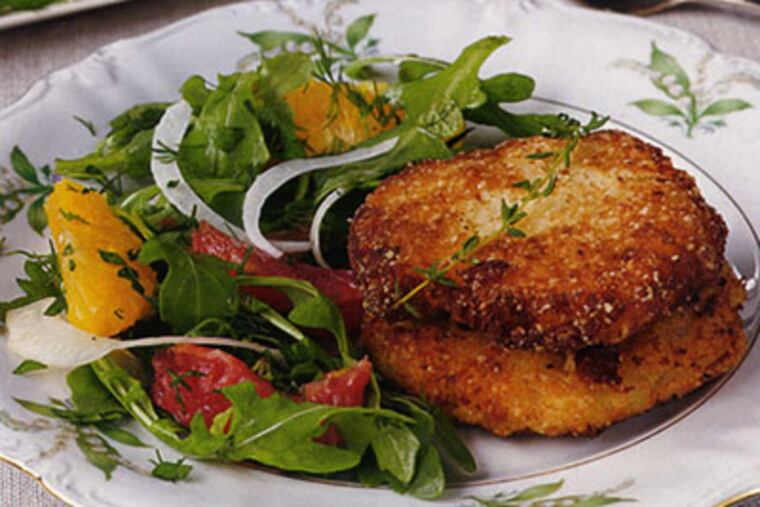
For Hanukkah, which began Wednesday evening, the book features four latke recipes. There's Potato Chremslach, made with mashed potatoes; Palets de Pommes de Terre, which start with raw russets; Gretchenes Latkes, with buckwheat groats; and Brandade potato latkes, a recipe from a young Parisian chef Nathan met, who adds fresh cod to the mix (see recipe).
What sets Nathan's cookbooks apart in the crowded field is the human touch she finds in food history.
"I wouldn't call myself a food historian necessarily," she says. "But I do look for hints of the background in what a chef cooks."
Nathan first saw France as a teenager. Between her junior and senior years of high school, she stayed with relatives in Annecy, a picturesque lake town in the Alps. And she returned for her junior year of college to study at the Sorbonne.
Her familiarity with the land and fluency in its language helped enormously, she says, to win the confidence of shopkeepers and home cooks she met along the way.
So, for example, Nathan retrieved a recipe for sweet meatballs called Faux Poisson or Fake Fish, from Danielle Fleischmann, an elderly woman in Montmartre who survived 1942-43 in the home of a Christian family.
Part of the recipe's backstory is that Fleischmann's mother had come to France from a village in Poland where she could not get carp in winter because the lake was frozen. And, since fish is a Sabbath delicacy, this "fake" was made with veal and ground beef, bound with matzo meal, and shaped to resemble gefilte fish.
Being Joan Nathan (no simple task), she also explains that potatoes actually came to France from the so-called New World, and notes that Jewish people were among those who traveled back and forth with Columbus.
As Jewish merchants traveled from France to the East, she notes, ingredients and recipes came and went with them. Truffles, salt cod, herring, and the art of making foie gras were all brought to France by Jews. Eggplant, often thought of as a quintessential French vegetable, was in fact brought there by traveling Jewish merchants who tasted it in India and returned with the seeds to Provence.
"A lot of people say certain ingredients came with the Crusades," Nathan notes. "But I think they were brought much earlier to France."
With some exception, Nathan says, French Jews eat like other French people. The more striking differences are between U.S. and French cooking.
Take apple cake, she offers: The French taste the apples first to make sure they are ripe. Then they add less flour and far less sugar.
As for getting fat, "people think of cream and eggs when they think of French cooking, but if you don't eat a lot of cream and eggs it's not so bad for you."
"I think it's true that French women don't get fat, even though they eat everything, and that's because they taste. They don't have seconds, they don't keep snack food in their pantries, and they don't eat between meals."
And portions are indeed small by American standards.
"They don't jump in the way my family does," she says with a laugh. "They admire the food, and discuss it. It's studied eating. To the French, the most important thing in life is food and they're always talking about it."
Still, can the French be forgiven?
In July 1942, French police rounded up 13,000 Jews in one 24-hour period and sent them to almost-certain death in Auschwitz, Nathan writes in the book.
But she also writes of meeting the grandson of one of those French police officers - a non-Jew who went into hiding rather than cooperate with the roundup. The grandson is today a police officer and a convert to Judaism who travels miles to buy kosher meat.
"Time and again in my travels in France, I interviewed people who told me they were saved as children from the Nazis by Christian housekeepers who begged the police to let them have the children."
And on her most recent trip to Paris, Nathan says, she was newly conscious of retracing the footsteps of Helene Berr, known as the French Anne Frank, who perished at Auschwitz but left behind a journal published in 2008.
"Throughout their history the Jewish people were expelled from one country after another and, sometimes, welcomed back again," she says.
Anti-Semitism didn't start with the Inquisition or end with World War II. Responding to hate with more hate, and clinging to it for centuries, is not the answer, Nathan says.
And she quotes Jean-Paul Sartre: "Freedom is what you do with what's been done to you."
Moroccan Tagine of Chicken With Prunes, Apricots, and Almonds
Makes 4-6 servings
EndTextStartText
1/4 cup vegetable oil
2 onions, peeled and sliced in thin rings
One 3 1/2- to 4-pound chicken, cut into 8 pieces
Salt and freshly ground black pepper to taste
1 teaspoon ground cinnamon
1 cup pitted prunes
1/4 cup raisins
1/2 cup dried apricots
A few saffron strands
1/2 teaspoon ground cumin
1/2 teaspoon hot paprika
1/2 cup blanched almonds
EndTextStartText
1. Heat the oil in a Dutch oven or other large, heavy frying pan with a cover. Add the onions and saute slowly until golden.
2. While the onions are cooking, season the chicken pieces with salt and pepper and sprinkle with cinnamon. Push aside the onions and tuck the chicken pieces into the pan. Brown them well on all sides. Add the prunes, raisins, and apricots to the chicken pieces, along with the saffron, cumin, paprika, and a cup of water. Simmer, covered, stirring occasionally, for about 40 minutes, or until the chicken is cooked and most of the liquid has evaporated (add more water if necessary).
3. Just before serving, toast the almonds in the microwave for 3 minutes, and sprinkle them over the chicken. Serve with rice.
Per serving (based on 6): 613 calories, 30 grams protein, 38 grams carbohydrates, 20 grams sugar, 39 grams fat, 110 milligrams cholesterol, 110 milligrams sodium, 5 grams dietary fiber.EndText
Brandade Potato Latkes
Makes 8 entree servings or 32 appetizer servings
EndTextStartText
2 pounds fresh cod, skin and bones removed
Sea salt to taste
1/2 cup olive oil
1 cup milk
5 sprigs fresh thyme, or 1 teaspoon dried thyme
8 cloves garlic, crushed
2 1/2 pounds russet potatoes, peeled and halved
1 large egg, well beaten
2 cups matzo meal or fine, dry bread crumbs, plus more if needed for batter
Freshly ground pepper to taste
Vegetable oil for frying
EndTextStartText
1. Preheat the oven to 300 degrees. Liberally coat each side of the cod with sea salt, about 3 tablespoons in all, and let rest for 15 minutes. Rinse the cod with cold water and pat dry with paper towels.
2. Place the cod in an 8-by-12-inch baking dish or rimmed jelly-roll pan. Pour the olive oil and the milk over it, and lay the thyme sprigs and garlic on top. Cover with aluminum foil and cook for 20 minutes, or until the fish is just cooked and begins to flake apart. When the fish has cooked, remove it, reserving the thyme and the cooking liquid. Discard the garlic.
3. Meanwhile, put the potatoes in a large pot of cold water and season with 2 tablespoons sea salt. Bring the water to a boil, and cook the potatoes until a knife passes effortlessly through them. Strain in a colander and return to the pot, cooking over very low heat for about 4 minutes to get rid of any excess moisture. Remove from the heat and mash in the pot until smooth.
4. Lightly beat the egg in a large bowl. Stir the mashed potatoes, little by little, into the egg. Add the leaves of the reserved thyme. Using a fork, flake the cod, and then fold it into the mashed potatoes. If the batter is too stiff, mix 1/4 cup to 1/2 cup of the reserved cod cooking liquid into the batter. On the other hand, if the batter does not hold together, add up to 1/4 cup matzo meal.
5. Season with salt and freshly ground pepper if needed. Cover and refrigerate for 30 minutes.
6. When ready to cook, heat about 1/4 inch of vegetable oil in a large skillet. Scoop 1/4 to 1/2 cup of the cod-potato mixture. Form into a 1/2-inch-thick disk and roll it in the matzo meal or bread crumbs. Fry in batches of two or three for about 2 minutes on each side, or until golden. Drain on paper towels. Repeat with the remaining cod-potato mixture. Reheat, if necessary, on a baking sheet in a 350-degree oven.
Per serving (based on 32): 133 calories, 8 grams protein, 14 grams carbohydrates, 1 gram sugar, 5 grams fat, 20 milligrams cholesterol, 23 milligrams sodium, 1 gram dietary fiber.EndText
Alsatian Pear Kugel With Prunes
Makes 6 to 8 servings
EndTextStartText
5 tablespoons vegetable oil, divided
2 pounds ripe Bosc pears
2 small onions, peeled and cut into 1-inch dice
1/2 teaspoon salt
1/2 loaf white bread
3/4 cup sugar, divided
6 tablespoons butter or pareve margarine, melted
3 large eggs
1 1/2 cups pitted prunes
1 teaspoon ground cinnamon
Juice of 1 lemon
EndTextStartText
1. Preheat the oven to 350 degrees and grease a 9-inch springform pan with 2 tablespoons of the oil. Peel the pears, and cut all but one of them into 1-inch cubes
2. Heat the remaining 3 tablespoons of the oil over medium-high heat in a skillet. Lightly saute the onions until they are translucent. Remove from the heat, salt lightly, and allow them to cool slightly.
3. Soak the bread for a few seconds in lukewarm water and squeeze dry. Put in a large bowl and, using a wooden spoon or spatula, mix with 1/4 cup of the sugar and the butter or pareve margarine. Stir in the eggs, the onions, and half of the diced pears, setting aside the remaining pears for the sauce.
4. Pour the batter into the springform pan and bake for 1 1/2 to 13/4 hours.
5. While the kugel is cooking, make the sauce. In a heavy saucepan set over medium-high heat, put 1 cup water, the remaining 1/2 cup sugar, the prunes, cinnamon, lemon juice, and the remaining diced pears. Cook this compote mixture uncovered for 30 minutes.
6. Finely grate the reserved whole pear and stir it into the cooked compote.
7. When the kugel is done, remove from the oven and set on a rack to cool for about 20 minutes. Unmold from the pan onto a serving platter and spoon half of the compote over it. Serve the remaining compote on the side.
Note: You can make this kugel using only prunes or plums in place of the pears, and use them in the sauce as well.
Per serving (based on 8): 471 calories, 6 grams protein, 71 grams carbohydrates, 44 grams sugar, 21 grams fat, 102 milligrams cholesterol, 405 milligrams sodium, 6 grams dietary fiber.EndText
Frozen Souffle Rothschild
Makes 8 to 10 servings
1/2 cup candied orange or ginger, finely chopped
3 tablespoons plus 1/2 cup Grand Marnier or other orange liqueur
6 large egg whites, plus 9 large egg yolks
1 teaspoon lemon juice
9 tablespoons sugar, divided
1 1/2 cups heavy cream
5 ounces almond cookies (or any other kind of flavorful crunch cookies), cut up into bite-sized pieces
1 cup nougatine (see note) or other crackly caramel-based candy
1. Put the candied fruit in a small bowl and cover with 3 tablespoons of Grand Marnier or other orange liqueur.
2. Cut a strip of parchment paper the full circumference of a 10-cup souffle dish. Ring the inside edge of the dish all the way to the bottom with the paper, creating a collar that extends a few inches above the rim, and secure the end of the paper with tape.
3. Whip the egg whites with the lemon juice in the bowl of an electric mixer until foamy. Gradually add 3 tablespoons of the sugar, and whip until stiff peaks are formed. Remove to a large bowl, and fold in the remaining 1/2 cup of Grand Marnier.
4. Clean the mixer bowl and beaters and whip the cream until it holds soft peaks. Fold the cream into the egg whites.
5. Clean the bowl again, and, using the mixer, beat the egg yolks and the remaining 6 tablespoons sugar until very thick and pale yellow. Then fold into the whipped cream and egg whites.
6. Fill a third of the souffle dish with the batter. Drain the candied fruit and sprinkle half of it, along with the cookie pieces, over the surface of the batter. Pour in the rest of the batter and top with the remaining candied fruit.
7. Cover tightly with plastic wrap and freeze for at least 3 hours and up to 8 days. Before serving, remove to the refrigerator, and when half frozen, sprinkle the nougatine over the souffle. Remove the paper collar before serving.
Note: To make the nougatine, coat an 18-by-13-inch rimmed jelly-roll pan with vegetable oil. Have a pastry brush ready, along with a cup of cold water. Put 1 1/4 cups sugar, 1/4 cup water, 1 teaspoon vanilla extract, and 1 tablespoon light corn syrup in a heavy medium-size saucepan and stir over low heat until the sugar melts. Then raise the heat to medium, and cook, stirring constantly, until the sugar comes to a boil. Dipping a pastry brush in cold water, quickly wash down the side of the pan to rinse away any sugar that is still crystallized.
Continue to boil, without stirring, but gently agitate the pan to distribute the heat. When small puffs of smoke begin coming from the sugar, which should be a rich dark brown but not burned, remove the pan from the heat. Quickly stir in 11/2 cups blanched almonds and spread the nougatine on the jelly-roll pan. Cool completely.
Break the nougatine into 4-inch pieces. Loosely wrap several pieces together in plastic wrap and store in an airtight container. When ready to use, leave the nougatine in the plastic wrap and hammer it into little pieces, being careful not to pulverize it.
Per serving (based on 10): 596 calories, 10 grams protein, 64 grams carbohydrates, 52 grams sugar, 31 grams fat, 236 milligrams cholesterol, 115 milligrams sodium, 3 grams dietary fiber.