Close at hand and delicious
When a Kensington couple buys food from regional purveyors, it's not so much to make a point as it is the luscious taste.
Dinner at the Kensington home of John Vick and Amanda Jaffe is as simple as roast chicken, mashed potatoes, salad, and biscuits - and as complicated as farm-raised, sustainably grown, homemade, and locally sourced.
Jaffe uses chicken from Griggstown Quail Farm outside Princeton, unaltered by hormones or antibiotics.
Vick mashes the All Blue potatoes, a variety that produces colorful flesh as well as skin, from Tuscarora Organic Growers in Hustontown, Pa., adding butter from Hometown Provisions in Lancaster County and whole milk from Trickling Springs Creamery in Chambersburg, Pa.
For his biscuits, Vick blends heirloom cornmeal from Rineer Family Farms in Lancaster and buttermilk from Maplehofe Dairy in Quarryville, Pa.
The salad greens, baby arugula, and baby spinach were grown hydroponically at Woodland Produce in Fairton, N.J., by a farmer who recently got a grant from the USDA to install photovoltaic cells in order to run his greenhouses on solar energy.
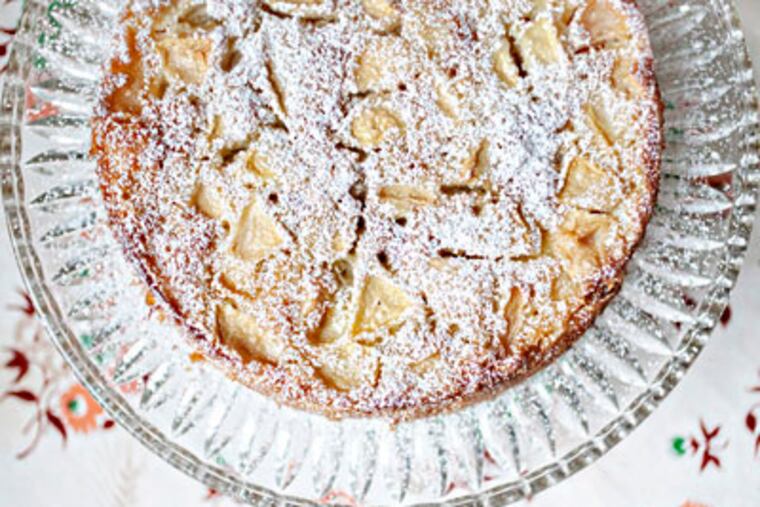
For dessert, Jaffe made an apple cake with two Mutsus and two Ida Reds from Beechwood Orchards in Biglerville, Pa. Even the beer, Flying Fish Amber Ale, is brewed in Cherry Hill.
Get the picture?
For Vick and Jaffe, who bike to work at the Philadelphia Museum of Art, where he is in special exhibitions and she's a photographer, eating is all about the sourcing.
This couple and their cohorts put a premium on knowing who grew it, how, and what distance it traveled.
"Five years ago, this wasn't on my radar," Vick says, "but now, eating this way makes me feel I am supporting the local community I am part of."
They eat this way for the pleasure it brings them, not from a zealot's sense of responsibility.
"Local food is just really delicious. There is nothing like good fresh butter," Vick says. "When we make our grocery lists we write down good butter and 'bad butter' because sometimes we need bad butter - unsalted - for baking."
Vick and Jaffe often share dinners with like-minded friends. Emily Gunther, produce manager at the Fair Food Farmstand in the Reading Terminal Market, and her partner, Charlie Kaier, a WHYY engineer, shared the chicken, blue potatoes, salad, and biscuits meal, for example.
At the Farmstand, Gunther stocks only produce grown within 150 miles of Philadelphia, which leaves out blood oranges, grapefruit, bananas, avocados, olive oil, and myriad foods that start elsewhere and are "finished" locally, such as chocolate, tea, and coffee.
But Vick and Jaffe make their own adaptations to eating locally and in season.
The couple share a trinity - with one room per floor - on a narrow, treeless street in a neighborhood once rich in factories and jobs.
Here, Jaffe is far afield from her South Carolina and Massachusetts childhood homes, where mom shopped at Publix or Piggly Wiggly markets that offered meat encased in cellophane and Styrofoam, and asparagus year-round.
Dinner is different now.
Boris, an English bulldog, and Olive, a calico cat, crowd the floor beneath the wooden table for which Vick recently made extensions.
The table is set with a vintage cloth from a flea market as Jaffe plates Chicken in Milk from Jamie Oliver's cookbook Happy Days With the Naked Chef. The pieces are crispy outside, moist inside, and Vick declares this is favorite way to eat chicken (see recipe).
"I was a picky eater as a kid. I wouldn't eat any fruit or tomatoes. But my parents didn't push me. I think they figured there were other battles to fight."
What changed?
"Cooking," he says, "became a creative pursuit."
Beyond eating for survival, cooking offers a chance to explore geography, politics, chemistry, and community. And with savory results.
Now, living in what could be an inner-city food desert, Jaffe and Vick get fresh ingredients from Greensgrow urban farm, where they enjoy summer and winter shares in a Community Supported Agriculture program (details online at greensgrow.org).
"A lot of what we cook hinges on what we get at the CSA," Jaffe says.
In winter they may find rutabagas, carrots, spaghetti squash, sweet potatoes, apples, radishes, shallots, or onions in their CSA box. Occasionally there are surprises, like pierogies, sauerkraut, and garlic scapes, which look like scallions and taste like fiddleheads.
"Delicious," Vick says.
"In the winter they know they can't give you onions and potatoes every week and expect you to stay interested," he says, "so they may add some fresh pasta."
When the root vegetables are gone, Greensgrow still has greenhouse and hydroponically grown vegetables, as well as preserves, cheeses, eggs, meat, and poultry.
The rest of this couple's needs come from nearby Almanac Market, at Fourth and Poplar, where they know the owner can vouch for the source of the products he sells.
Eating this way could be more expensive than shopping exclusively at supermarkets, but not necessarily, Jaffe says.
For starters, they cook at home almost every night, rarely spending their food and beverage dollars in restaurants.
"And that means we have leftovers I can pack for lunch," she says.
Their winter CSA share comes to less than $34 a week. They entertain at home cooking with friends who are equally passionate about ingredients.
Keeping to the food-centric theme, Vick and Jaffe give each other gifts of cookbooks and utensils.
On a recent date night, they went on a tour in Brooklyn to see how a pig is butchered. And the highlight of a recent drive in the Poconos was an impromptu tour of the dairy that provides the cream they get from Greensgrow.
"We don't eat 100 percent locally," Vick says, "or totally organic because that label can be costly and deceiving."
Eating chemical-free food from a known source is more reliable, he says.
"Besides, food is the most important thing you spend money on."
Chicken in Milk
Makes 4-5 servings
EndTextStartText
3-3 1/2 pounds chicken
4 tablespoons of butter
A couple of glugs of olive oil
1/2 cup fresh sage leaves
Zest of 2 lemons
Cinnamon stick
8 to 10 garlic cloves, whole and skins on
1 pint whole milk
Salt and pepper
EndTextStartText
1. Preheat oven to 325 degrees. Melt 1/2 stick of butter and olive oil in a medium-sized cast iron pot.
2. Season the chicken generously with salt and pepper. Sear each side of the chicken in butter/olive oil until lightly browned.
3. Take the chicken out of the pot and dump oil/butter mixture. Don't clean out the pot, but return the chicken to it and add sage, lemon zest, cinnamon stick, garlic cloves, and milk. Place pot in the oven and cook for 11/2 hours, basting every once and a while.
4. Serve with a little bit of the sauce and curds in the pot.
Per serving (based on 5): 557 calories, 35 grams protein, 6 grams carbohydrates, 4 grams sugar, 43 grams fat, 160 milligrams cholesterol, 217 milligrams sodium, trace dietary fiber.
French Apple Cake
Makes 6-8 servings
EndTextStartText
3/4 cup all-purpose flour
3/4 teaspoon baking powder
Pinch of salt
4 large apples (2 Mutsu and 2 Ida Red from Beechwood Orchards, Biglerville, Pa.)
2 large eggs
3/4 cup sugar
3 tablespoons dark rum
1/2 teaspoon pure vanilla extract
1 stick unsalted butter, melted
EndTextStartText
1. Preheat oven to 350 degrees. Butter and flour an 81/2-inch springform pan and place a parchment circle on the bottom of the pan. Butter and flour the parchment as well. Place springform pan on a lined baking sheet (springform may leak some butter).
2. Sift flour, baking powder, and salt together into a medium bowl. Peel and cut apples into 1-inch chunks.
3. In a stand mixer with the whisk attachment, beat eggs until foamy. Add sugar, and whisk until combined. Add rum and vanilla, whisk until just combined. Alternate adding flour and melted butter in two batches. Remove bowl from the stand mixer and use a spatula to fold in the apples. Toss the apples in the batter until fully coated.
4. Add the batter to springform pan and even it out as best you can. Bake until top seems firm and golden brown, about 1 hour to 1 hour and 15 minutes.
5. Let cake cool for 10 minutes before removing sides of springform pan. Wait until cake is almost completely cool before removing bottom. Serve with fresh whipped cream.
Per serving (based on 8): 287 calories, 3 grams protein, 37 grams carbohydrates, 25 grams sugar, 14 grams fat, 85 milligrams cholesterol, 72 milligrams sodium, 2 grams dietary fiber.
John's Cornmeal Biscuits
Makes about 20 21/2-inch biscuits
EndTextStartText
2 cups flour, plus more for rolling out
1 cup cornmeal
2 teaspoons salt
2 tablespoons sugar
1 tablespoon baking powder
1 teaspoon baking soda
1/2 cup unsalted butter, cold and sliced thin
1 cup plus 2 tablespoons buttermilk
EndTextStartText
1. Combine 1 1/2 cups flour with remaining dry ingredients (cornmeal, salt, sugar, baking powder, baking soda). Cut in butter. Stir in 1 cup buttermilk and mix well. Add the remaining 1/2 cup flour.
2. On a floured surface, roll out dough to 1/2-inch thick. Cut out biscuits with a biscuit cutter (or a glass) and place them on a greased pan.
3. Brush the biscuit tops with remaining buttermilk. Bake for 15 minutes at 425 degrees, or until biscuits are a light gold color.
4. Serve hot with fresh salted butter.
Per biscuit: 104 calories, 2 grams protein, 19 grams carbohydrates, 2 grams sugar, 3 grams fat, 7 milligrams cholesterol, 347 milligrams sodium, trace dietary fiber.EndText