Next bar craze: Craft spirits?
PORTLAND, Ore. - Philadelphia has already staked its claim as a player in the national craft beer movement, with dozens of local brewers producing top-notch beer.
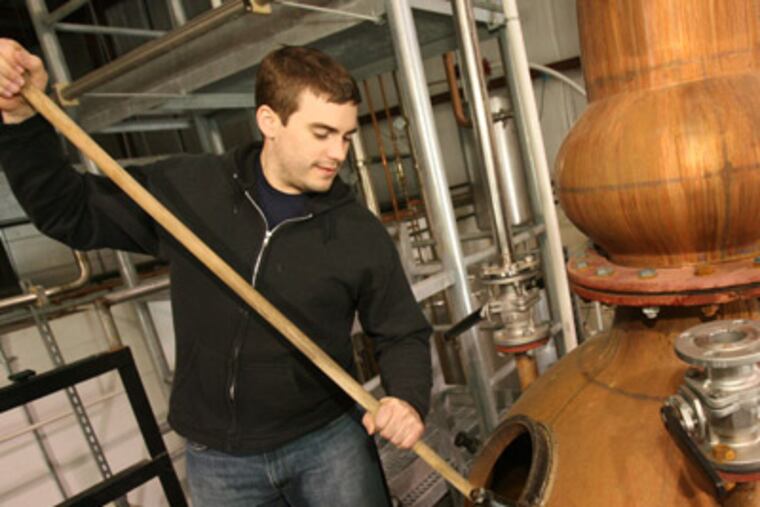
PORTLAND, Ore. - Philadelphia has already staked its claim as a player in the national craft beer movement, with dozens of local brewers producing top-notch beer.
Could the newest wave in artisan drink rolling our way from the West Coast - the craft spirit movement - be the next obsession to slake Philly's thirst with potent shots of white corn "Shine" and "Petty's Island Rum"?
It just might, if Rob Cassell of Philadelphia Distilling and James Yoakum of Cooper River Distillers realize their dreams.
They are among the few so far in our region to enter this relatively young industry, but they're hardly alone on the national stage. That was as clear as strong moonshine this week in Portland, where an annual conference organized by the American Distilling Institute (ADI) drew more than 500 people. They gathered to network and educate themselves on everything from Portland's thriving local spirit scene to the fine points of apple brandy, and to attend lectures like "The Magic of Enzymes."
"We're at the beginning of a national renaissance in artisan spirits," said ADI founder Bill Owens, who has watched the number of small craft distillers grow nationwide over the last eight years from 68 to 264 in 38 states, with 25 percent growth each year. Such companies produce fewer than 65,000 proof gallons a year, and, despite the uptick in distillers, they still account for less than 1 percent of the multibillion-dollar liquor industry.
"We've seen this craft movement happen already in wine, beer, bread, cheese, and coffee," Owens said. "We're the last frontier - and by far the most difficult."
Cassell and Yoakum, who both traveled to Portland for the conference, sit at opposite ends of the craft distilling universe.
Cassell is only 32 but is already a local pioneer. The Gilbertville native, who majored in nuclear medicine, left his brewing job at Victory in Downingtown to launch the critically acclaimed Bluecoat gin in 2005. He followed that with an absinthe (Vieux Carre), a rye vodka (Penn 1681), and an unaged "white" whiskey (Shine), set for release this month from Philadelphia Distilling's headquarters in an industrial park behind a National Guard armory in Northeast Philadelphia.
The 26-year-old Yoakum, meanwhile, is at just the beginning with his Cooper River Distillers, a long-steeped project he hopes will result this year in a distillery in downtown Camden. By day, the soft-spoken Wharton graduate sells residential and commercial real estate. But inspired by a small craft distillery near his Kentucky hometown, and confident after seeing Cassell on the move locally, he's determined to begin distilling. If all goes well in his search to secure financing - "and I'm ready to make something with my hands" - Yoakum hopes, like so many of his fellow conventioneers in Portland, that the off-hours persona of his spirits blog, the Whiskey Rambler, finally becomes his new life. Enter "Whiskey Jim."
High-end wonderland
As Cassell and Yoakum toured Portland's liquid highlights, it was obvious this modest-size city is a wonderland for high-end drinking where craft distilling followed an insatiable thirst for beer. Though only the nation's 30th-largest city, with just under 600,000 people, it's home to 37 breweries and eight craft distilleries. That puts it far ahead of the dozen or so breweries in Pennsylvania and the state's mere five distilleries, including Philadelphia Distilling and Boyd & Blair in Pittsburgh. And Portland's wine country nearby, of course, also produces some of America's best pinot noirs.
"There was already a whole group of beverage entrepreneurs," said Christian Krogstad of House Spirits Distillery, one of six innovative small distilleries in a neighborhood dubbed "Distillery Row" in Southeast Portland. "There's a real appreciation here for all things local, for the little guy doing something different, and the people rally behind it. The state liquor board also makes it easier for us."
Oregon, like Pennsylvania, controls sales of alcohol. But unlike Oregon, Pennsylvania and other states - many of which have not seen new distilleries since before Prohibition - challenge start-ups to rally for new legislation to make their business viable, a battle the craft beer industry is largely already winning. Cassell, for example, was just in Harrisburg last Monday arguing for House Bill 242, which would allow small distilleries to hold tastings on site and sell directly to visitors. It's a right the state's wineries already have, providing a significant revenue boost and a crucial spark for agri-tourism. A vote on the bill is expected Wednesday.
In New Jersey, meanwhile, where there are no small distilleries, there is pending legislation to allow licenses for craft distillers (S-2639) and two companion bills to allow wineries to produce spirits from grapes (A-2994; A-3798). If Yoakum does, indeed, become the Garden State's first, with plans for tomato-based vodka, blueberry eau de vie, and rum from North Jersey organic molasses, he won't be the only one cheering.
"Is James' project desirable? Absolutely," said David Foster, president of Cooper's Ferry Development Association and Greater Camden Partnership, which helps secure tax and rent incentives for new businesses. "Craft beer breweries and pubs have been the foundation of economic revitalization throughout the region. The kind of young, urban pioneer generation who would be customers of James' would also be pioneering residents of downtown Camden, which is also an entertainment-driven waterfront and a university city. For my money, a craft distillery really fits that story."
Liquor dreams
Literally hundreds of people from across the country with similar stories of locavore liquor dreams were walking the convention rooms in Portland. There were apple farmers hoping to turn their leftover fruit into brandy; brewers looking to Oregon icons like Rogue and McMenamins, who have given the mash base for their beers a twin life in a whiskey bottle. There were career-changing crude-oil traders, auto engineers, stockbrokers, pilots, doctors and free-lance journalists hoping to find their place beside a still. Colorado-based Peach Street Distillers, which recently launched TuB gin (exclusively available in New Jersey and Pennsylvania) with Philadelphia cable marketing firm Red Tettemer, swept numerous medals at the conference for their fruit brandies.
Yoakum came to soak up some basics, like details about federal licenses and fire codes. Cassell also got basic, drinking hard with old friends (they're distillers, after all) and networking with brokers and suppliers.
But for the many who come to it without a background in wine or beer, learning to open and run a new $450,000 distillery can be daunting - especially considering that, unlike beer, it is illegal to practice at home.
"There's no education or university classes for this," Owens says. "It's like getting the keys to a brand-new BMW, and you don't know how to open the door."
Karen Binder, who's partnering with two other women to open the Southern Sisters Spirits brandy distillery in Illinois, conceded that there was an aura of "the Wild West" to the movement right now, both in the rush to sink money into a hot trend and a lack of industry standards: "There are no rules, but it's exciting. It offers opportunities for creativity."
Small distilleries have been able to innovate new categories, often by necessity. There is the current boom in unaged "white dog" whiskey, also known as moonshine or "new make," because it provides instant cash flow from a product traditionally tied up in expensive barrel-aging for years. Large distillers such as Buffalo Trace and Maker's Mark have caught on with their own "new make" bottles, in turn lending cachet to artisanal renditions from Brooklyn (Kings County Distillery) or Cassell's Philly Shine. Wholesale executives - Chris Papariello from Majestic Wine & Spirits in Wayne, for one - have taken enthusiastic notice, with plans to bring back West Coast stars like Dry Fly Washington Wheat Whiskey or Aviation gin to Pennsylvania's state stores.
"I'm going to come to this conference every year," he gushed.
For Portland veterans such as Steve McCarthy of Clear Creek, who set the standard for labor-intensive fruit brandies in 1985, the gold rush to craft distilling comes with a mixed blessing. He applauds the "huge cultural change as we return to a nation that actually makes things."
But he also warns that the current lack of standards in labeling leaves the market open to bandwagon profiteers, who simply filter someone else's premade spirit into vodka, add mango extract, and "the only thing from Oregon in that bottle is the local water. For a lot of these so-called craft distillers, this is simply an exercise in brand-building."
Young purists in the room like Yoakum could only nod in agreement. But Cassell, now six years into the reality of competing as a little guy with local ingredients alongside products from billion-dollar corporate competitors, says there has to be "a fine balance between your business and your passion," where "marketing" is not a dirty word.
"You can put all your passion into the bottle," he said. "But if you can't get the consumer to have an interest in it, they're never going to know what that is."