At La Famiglia, fine lunch fare at 1976 prices
In 1976, as the city marked the Bicentennial mere blocks away, Carlo Sena and his family opened a posh Italian restaurant on Front Street in Old City.
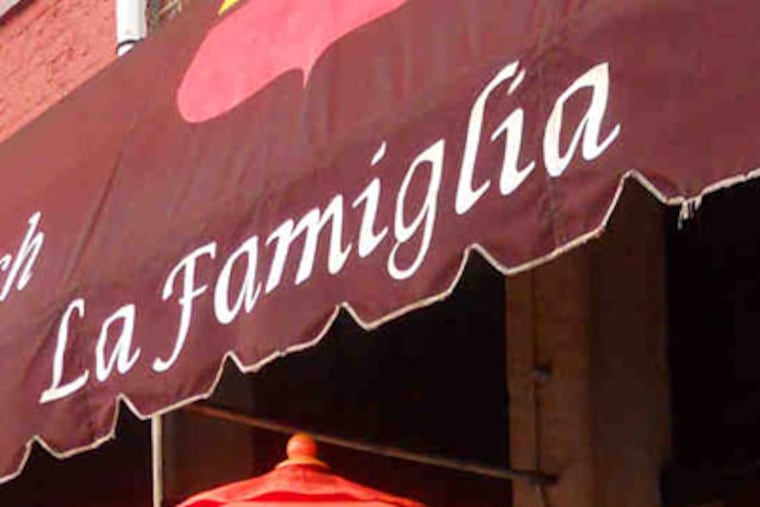
In 1976, as the city marked the Bicentennial mere blocks away, Carlo Sena and his family opened a posh Italian restaurant on Front Street in Old City.
La Famiglia was a revelation - a luxe dining room floored in pink marble, redolent of flowers, and bathed in candlelight. The fireplace mantel held dozens of bottles of potent grappa. An impressive wine cellar had been assembled in the basement - where construction workers had uncovered wells dug when the property was owned by Ben Franklin's daughter.
Thirty-five years later, Giuseppe Sena, one of the founder's four sons, is invoking if not the spirit of the 1976 La Famiglia, when Papa Sena strolled the dining room, then at least the lunch prices.
Sena, whose father died in January, is offering for the summer a lunch menu based on selections revived from 1976, classics such as Fegatino di Pollo (chicken livers sauteed with onions, mushrooms, and wine) and Sofficini Alla Papa Sena (fried croquettes stuffed with mozzarella, prosciutto, and anchovy). The menu, served Tuesdays to Fridays, is on the restaurant's website, www.lafamiglia.com.
The entrees are priced at $6.95 to $10.95 - a princely sum in 1976. By the Bureau of Labor Statistics' online calculator, $11 in 1976 is equivalent to $43.68 today.
Clearly, La Famiglia's prices have not risen in step with inflation. Before this promotion, the lunch menu offered a la carte entrees from $12 to $18, as well as a $26 prix-fixe. (Most dinner entrees are now $24 to $37, about double what they were 35 years ago.)
The old and new menus cannot be compared, as all the dishes are different. "The style then was Old World, traditional," Sena says. "We've modernized in some ways."
In other ways, though, La Famiglia has clung to tradition. A dessert cart still patrols the dining room. Waiters wear suits. Couples actually hold hands at the table.
The polished look is reminiscent of Sena's Le Castagne, on Chestnut Street near 21st. The Sena sons all work in the business, as do many cousins. Son Gino is co-owner of La Famiglia, where sister Rosa keeps the books and a cousin, Gianluca Forestiere, is chef. Another son, Luca, owns Ristorante Panorama and the Penn's View Inn at Front and Market Streets, as well as the new (and non-Italian) Revolution House at Second and Market Streets, where his son Luca is chef. And yet another son, Maurizio, owns a restaurant in Palm Beach, Fla. The matriarch, Giuseppina, died in 2008.
La Famiglia has endured myriad changes in its neighborhood, which itself was transformed in the 1960s by the construction of I-95 at its doorstep.
In 1976, "there was nothing here except for La Truffe and the Parson's Table," said Sena of two long-gone destination restaurants. "The '80s and '90s were very nice, very organized. People came down here [to Old City] to dine. The last five, 10 years, the lounges and bars started. Young people. Some trouble."
Which led to Sena's pragmatic reason for the lunch-price rollback, aside from the traditionally slow summer season. Business simply is not what it was; it's not easy for a white-tablecloth restaurant in the city to endure 35 years, given changing tastes and keen competition.
"My customers are getting older and I'm getting older," says Sena, who declines to discuss his age but is in his late 50s.
Closing is not an option. Sena has too much pride, too much invested both emotionally - there's a photo hanging over the door of his father as a young man - and physically.
Just ask, and he'll lead you downstairs. While brother Luca's Ristorante Panorama up the street has an unparalleled wine-by-the-glass selection, Giuseppe has arguably the finest assortment of bottles in the city. So many, even he doesn't know. More than 10,000, as has been reported? He shrugs.
The cellar runs along the walls the length of the property, with dimly lit and climate-controlled rooms and nooks, culminating in an intimate dining room.
Behind one glass door are eight bottles of 1964 Amarone Bertani, easily $300 per. Sena unlocks an iron door, scrambles over a steel grate covering an 18th-century brick-lined well, ducks behind a wooden case, and pulls out a 1955 Biondi-Santi, then a 1945. "Here's a Ruffino, 1958. Riserva."
Sena adores Barbarescos. One by one, he points out a 1961, a 1988, and a 1974. Then comes an Abacus cab from Napa. California, French, Italian. The Madeiras - an 1875 D'Oliveira. And an 1890.
"I have wine," Sena says, understatedly.
La Famiglia's wine list reflects the passion of a collector, not a restaurateur. Witness the many single bottles that he is loath to sell.
"Wine is art," he says. "When it's gone, it's gone forever."