Bee a good neighbor
Urban Apiaries' honey could hardly be more local, buzzing in from city rooftops and bottled by zip code.
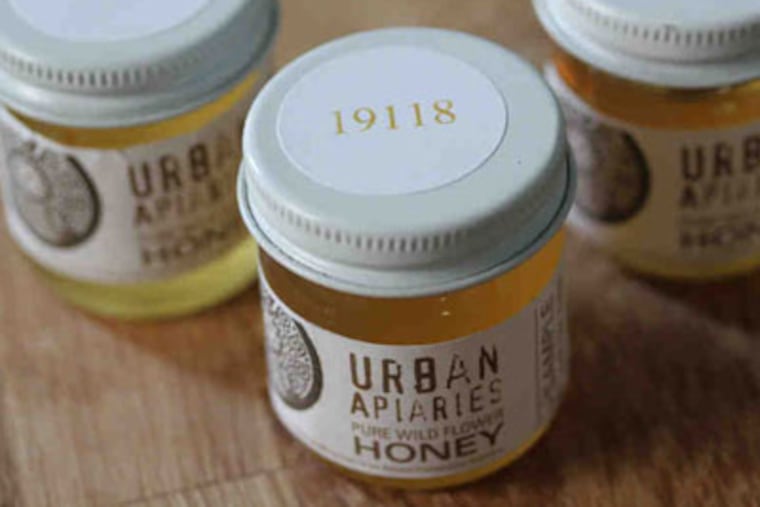
When Annie Baum-Stein opened Milk & Honey Market in West Philadelphia, the first thing she stocked was local honey from Berks County. Today, she's bottling her own, and the honey is more local than ever - from the rooftop hive above her store.
"It's herby and floral," she said, holding up a small jar of straw-colored nectar. "The flavor is much more complex than from other zip codes." Next month, she'll begin selling honey from zip codes across the city. "The range of flavors is unbelievable."
Urban Apiaries, which Baum-Stein runs with beekeeper Trey Flemming of Two Gander Farm, may have raised the bar for ultra-local honey. While beekeepers in other cities, including New York and Chicago, have launched rooftop apiaries to showcase urban gold, most producers combine the output of various hives to create a single product.
Bottling by zip code occurred to Baum-Stein and Flemming last year when piloting their project on a handful of rooftops. Their hives were so fruitful, and the flavor at each location was so distinct, that the duo decided not to create a city blend, but to sell each apiary's honey separately.
"Our 19118 honey from the rooftop of Weaver's Way Co-op is super-fruity," Baum-Stein marveled, "while our 19148 honey from above Restaurant Paradiso is very light and delicate."
Urban Apiaries honey will appear on shelves in early August. At Franklin Fountain, Old City's premium ice cream counter, a special Urban Apiaries flavor has already debuted: Candied Honeycomb - from 19143.
Hosting hives
On an overcast Wednesday morning, Baum-Stein and Flemming climbed through a window and onto the roof of Paradiso Restaurant and Wine Bar in South Philadelphia. "We're here for a status update," said Flemming, suited up in hazmat white. He fired up his smoker to sedate the bees so he could check their progress.
With Center City high-rises at his back, Flemming lifted the lid on one of three hives, then removed a frame to inspect waxy comb shivering with bees. "This first hive is putting on a lot of weight," he said. When conditions are ideal a hive can produce up to 20 pounds of honey per day, Flemming said.
Paradiso's chef, Corey Baver, appeared in his white coat. This summer, he and his wife and business partner, Lynn Rinaldi, built a roof garden here, hauling up two tons of dirt for nine raised beds. Already, tomatoes were looking plump. "Once we finished the garden, the first thing my wife said was, 'OK, now we need some bees,' " Baver said, laughing.
Since May, the hives have produced 40 pounds of honey. In exchange for hosting, Paradiso will receive a portion of the haul. Rinaldi has already developed a dessert to show off her prize: cinnamon Bombolini (Italian beignets) with homemade ricotta-honey dipping sauce.
"It's rooftop to table," Baver said. A few feet away, a single honeybee - one of about 120,000 up here - zigzagged over to a flowering pepper. Baver, who is allergic to bees, stepped back.
City vs. country honey
For Flemming, maintaining city hives is as much about ecology as gastronomy.
He began keeping bees in 2006, about the time that colony collapse disorder began decimating the American honeybee population. When he sited hives around corn and soybean fields treated with pesticides and fungicides, he noticed a pattern: "I had 90 percent losses in those colonies."
At the time, Flemming was in charge of 200 hives for a commercial producer in Chester County. The hives closest to the city were healthy and productive. "This is anecdotal evidence, but it really struck me. When you have fungicides and pesticides laced into the pollen, it affects the health of honeybees."
Today, Flemming maintains about 75 hives. A little more than half of those are in the country, near his home in Oley (he bottles this honey under his own Two Gander label); the rest are in the city. He estimates that his city hives are "among hundreds" in Philadelphia, citing apiaries in Woodland Cemetery and at Greensgrow Farm, which markets Honey From the 'Hood.
Flemming travels between seven sites every two weeks to check his hives. He starts his route on the roof of a food-pantry warehouse in North Philadelphia and ends in West Philly, making stops at a Queen Village art gallery and the Pennsylvania Horticultural Society Pop-Up Garden at 20th and Market in between.
When the honey is ready, he collects it and drives it back to the country for bottling. He favors a cold method of extraction over pasteurization, in order to keep beneficial enzymes intact.
Tasting terroir
Does city honey really taste different from country honey? That question arises during a local cheese, beer, and honey pairing class at Biba Wine Bar, 3131 Walnut St., on a recent Saturday.
"Like wine, honey has terroir - a sense of place," says Sean Faeth, Biba's manager and fromager. Then he defers to Baum-Stein, of Urban Apiaries, who provided samples.
"People say urban honey is much more complex - the bees have a more varied diet," Baum-Stein said. "In the country, bees draw from monocultures, so the honey is sweet, but it's often one-note."
The two dozen participants at Biba plunge spoons into spool-sized jars of glistening amber from three zip codes in Philadelphia. Two of the jars, from Chestnut Hill (19118) and Passyunk (19148), are slightly cloudy, flecked with wax bits. "They're raw, unfiltered honey," Baum-Stein explains. The third, from the hives above Milk & Honey Market (19143), has been strained; it's clear but richer in color.
"My favorite is 19148," says Emily Kohlhas. "It tastes complex and not at all like you'd expect honey to taste." Several participants described this particular variety as "minty." She concurred.
Aaliyah Pinkerton shared the same enthusiasm for 19148. "I usually just buy honey bears from the grocery, but my boyfriend and I are talking about buying a case." Her boyfriend has already pulled up the Urban Apiaries website on his iPhone.
"The amazing thing about city honey is how much the bees produce," said Baum-Stein. "The whole reason Trey and I are bottling by zip code is because each hive began producing so much. We're raising healthy, productive bees, and we're doing it in Philadelphia."
In 19118, the bees have the run of the Wissahickon. In 19143, their primary nectar comes from locust trees. In 19148, the bees above Paradiso comb angled streets in search of window planters and hanging flower baskets.
Despite traffic and pollution, the bees prevail.
And from May through November, Flemming and Baum-Stein will continue to gather and bottle, one golden zip code at a time.
Honey and Ricotta Panini
Makes 1 serving
EndTextStartText
1 croissant (we use Au Fournil)
3 tablespoons Claudio's ricotta or Apple Tree chevre
1/4 of a firm, fresh peach, sliced thin
Generous drizzle of 19143 Urban Apiaries honey
Thin slice of prosciutto
EndTextStartText
1. Slice open the croissant and layer the ingredients in the order in which they appear; serve cold or press on a panini press until crisped.
Per serving: 272 calories, 11 grams protein, 35 grams carbohydrates, 23 grams sugar, 10 grams fat, 41 milligrams cholesterol, 438 milligrams sodium, 1 grams dietary fiber.
Honey-Glazed Peaches With Homemade Ricotta
Makes 8 servings
EndTextStartText
To make the ricotta:
2 quarts whole milk (preferably raw cow's milk)
1 pint heavy cream
Generous pinch kosher salt
¼ cup strained fresh lemon juice
To prepare the peaches:
8 medium peaches (cut in half, pits removed)
¼ cup plus 2 tablespoons local honey
1 cup Moscato wine
5 tablespoons sugar
EndTextStartText
1. Make the ricotta: Combine milk, heavy cream, and salt in saucepan and bring to full boil, stirring occasionally.
2. Remove from heat, add lemon juice, and stir until mixture has separated into curds.
3. Set a sieve over a large bowl lined with a double layer of cheesecloth. Pour curds and whey into sieve and allow to drain for 30 minutes. Scrape ricotta into bowl. Can be served immediately or refrigerated overnight.
4. Prepare the peaches: Preheat oven to 400 degrees.
5. Place peaches cut side up in roasting pan. Pour all remaining ingredients except 2 tablespoons of sugar and 2 tablespoons of honey over peaches.
6. Roast for 20 minutes, sprinkle remaining sugar on peaches, and turn cut side down on roasting pan.
7. Continue to roast for 20 to 30 minutes until caramelized.
8. Top peaches with ricotta and remaining honey and serve.
Per serving: 496 calories, 10 grams protein, 44 grams carbohydrates, 42 grams sugar, 30 grams fat, 107 milligrams cholesterol, 196 milligrams sodium, 2 grams dietary fiber.
EndText