Food finders
A master forager leads seekers through fields and gardens, here in "the epicenter" of foraging, to pluck fresh, nutritious edibles hiding in plain sight.
Food is everywhere, says Tama Matsuoka Wong. Case in point: the small cluster of yellow wood sorrel growing out of a forgotten corner of the floor in the restaurant where we are standing.
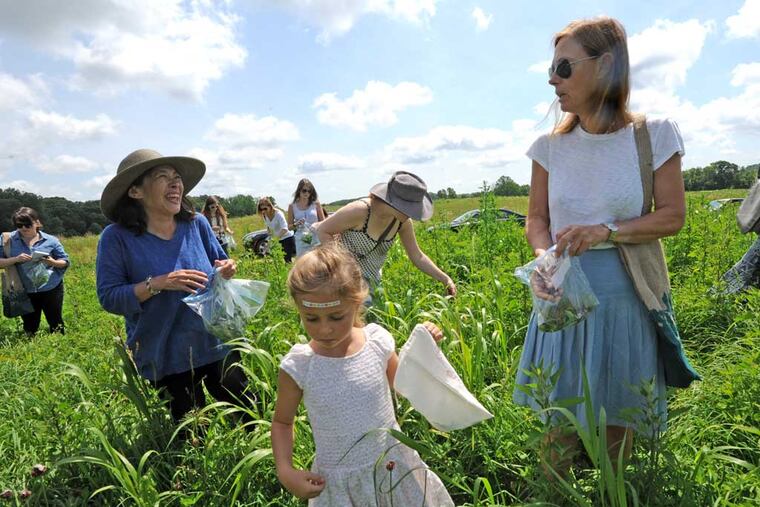
On a June Saturday, a small crowd has gathered at Terrain at Styer's in Glen Mills for a tour with Wong, the James Beard Award-winning author of Foraged Flavor (Clarkson Potter, 2012).
"The Philadelphia area is the epicenter for foragers," Wong says. "With so many gardens, and so many people interested in food and the Mid-Atlantic climate, it's really the best of all worlds." The group that has paid to forage with her - chefs, naturalists, foodies, a farmer - includes locals and Canadians, all eager to hear the gospel of greens-gathering.
Bubbly and vivacious, Wong, a former financial services lawyer who still occasionally consults for clients, sports loose-fitting clothes, a wide-brimmed hat she sourced at Terrain, and knee-high Hunter boots. Her eyes flash with excitement as she talks plants.
The tour is on "common ground" for a reason, Wong explains. "People can find these hidden ingredients in their own garden - it doesn't have to be a conservancy or deep in the woods."
There are no orientation skills necessary here, in fact. The group piles into cars and travels by caravan to the Happy Cat farmlands of Winterthur, set between a rolling meadow jumping with butterflies and a strip of wooded land. Along the way Wong notes a patch of orange daylilies growing outside a private cottage. "I would love some of those, but I don't think the residents would appreciate it," she says. Central to her ethos is collaboration with landowners or managers, so the foraging is less like stealing and more like assistance with weeding.
Indeed, many of the plants she shows us are considered nuisances to farmers and gardeners. In the meadow, there's wild garlic, the little spiky purple bulbettes hairy with chivelike strands. Wong pops one off its stem and shows us how the little cloves separate, explaining how its flavor is milder than conventional garlic, less biting. Interspersed is tall and regal lamb's-quarter, a spinachlike green that has diamond-shaped leaves dusted with a white powder that comes off only in cooking.
Though many people associate foraging with mushrooms, Wong focuses on greens, which tend to be more sustainable for picking and safer for human consumption. (With at least 250 varieties of toxic mushrooms in North America, a gathering expedition is more like munchable Russian roulette for novices.) In Foraged Flavor, Wong has focused on common, easily identifiable plants, and they're also the ones she most enjoys using in her kitchen. "They're not just edibles - they have to be delicious. And today is a delicious tour."
Her own personal education in wild eats began when her family moved to a 28-acre property in Hunterdon County, New Jersey. As she explored the land and inventoried its 250 plant species, she found that even for plants that have been eaten in traditional cultures, most guides offered only scant advice on how to prepare them - typically along the lines of "munch raw" or "boil until flavor is obliterated." She decided to take some anise hyssop to a chef, a serious chef, and see what could be done. Thus began her collaboration with Eddy Leroux, chef de cuisine of Daniel in Manhattan. "I said, 'If he can't make it good, I don't know who can,' " she says.
The trade-off that ensued - bags of gathered plants for recipes - was the foundation for Foraged Flavor. Wong is now chief forager for Daniel and several other restaurants in New York, gathering pounds of lamb's-quarter and stinging nettle for chef customers. Still, she considers herself more than just a supplier, mostly working on a customized basis, and forming close relationships rather than simply purveying her finds by the bushel.
As public interest in local/organic/wild foods grows, Wong's role is expanding. The cookbook is just an offshoot of her greater mission, she says, which is to educate people about the overlooked meals underfoot. She's now devoting attention to developing cocktails with bartender Darryl Chan. And she has also been working with a certain Philadelphia-based Iron Chef on ingredients for his new restaurant in the Kimmel Center.
In between the rows of Happy Cat's tomatoes are some of the yellow wood sorrel plants we spotted at Terrain. Their heart-shaped leaves lend a citrusy piquancy to seafood. Wong and Leroux cook them with scallops and a white wine shallot sauce, but only briefly, so as not to disturb the delicate flavor. Bitter dandelion greens (best picked young) can be served both poached and raw for a riff on salade Lyonnaise. Wong likes to make tempura with the flowers. And here, too, is the first evidence of purslane, sprawling little clusters of succulent ovals with a lemony taste, which Wong likes to add to Mediterranean-style dishes.
"In the farmer's markets now we're seeing more and more of this," Wong says. "It's catching on because it tastes great."
On the edge of the woods are invasive wineberry plants, their thickets of reddish leaves not yet bearing the fruit that she says looks like rubies.
Why would someone choose to eat foraged food? It's abundant, and almost always free for the taking. These plants are especially nutritious, with purslane topping the list for its rich antioxidant content. And then there's their vast, untapped culinary potential.
The tour winds down with a very civilized lunch at Terrain's Garden Cafe, where chef Keith Rudolf and Darryl Chan have showcased what can be done with these ingredients. There's a green juniper-infused prosecco cocktail to start, a snowy mound of grapefruit granita melting in the bottom of a mason jar to reveal the little berries. Then an appetizer of salmon cured with yellow wood sorrel, laced with ribbons of shaved vegetables. Thin slices of smoked duck breast are set over a pillow of sauteed lamb's-quarter, paired with a savory yet fragrant rose-petal jam. Finally, there's a delicate trio of sorbets: anise hyssop, lemon balm, and wild mint.
Wong opens up her magical cooler to show guests bags of other foraged items from her own land. There's creeping jenny, wild spearmint, and some of those coveted daylily buds. We've only just been grazing the surface of all the uncultivated food out there, she says.
"All you have to do is look more closely," she concludes, "and you will find good things to eat."
Purslane Eggplant Caponata
Makes 6 servings
EndTextStartText
¼ cup olive oil
2 small to medium thin eggplants, cut into
¼- to ½-inch dice
1 medium red onion, cut into ½-inch dice
2 tablespoons honey
2 teaspoons salt
2 teaspoons cayenne
pepper
6 ounces (4 cups)
tender purslane tips and small leaves, plus more for serving
(you can substitute spinach)
2 tomatoes, diced
¼ cup toasted pine
nuts
½ cup balsamic
vinegar
EndTextStartText
1. In a medium skillet over medium heat, heat the olive oil and add the eggplant. Cook, stirring occasionally, for 2 to 3 minutes, until softened.
2. Add the onion, honey, salt and cayenne. Reduce the heat to low and add the purslane, tomatoes, pine nuts, and vinegar.
3. Simmer for 2 to 3 minutes, or until it reaches the consistency of a stew. Decorate with fresh purslane.
Per serving: 197 calories, 3.2 grams protein, 20.8 grams carbohydrates, 12.1 grams sugar, 12.9 grams fat, 0 milligrams cholesterol, 783 milligrams sodium, 7.5 grams dietary fiber.EndText
Dandelion Leaves, Poached Eggs, and Bacon Bits
Makes 4 servings
EndTextStartText
1 pound small to
medium Yukon
Gold potatoes
Salt and freshly ground
black pepper
2 tablespoons distilled
white vinegar
8 slices bacon
2 tablespoons chopped
shallots
1 tablespoon red wine
(or sherry) vinegar
2 ounces (1½ cups)
young dandelion
leaves, torn into
bite-size pieces
(you can substitute
broccoli rabe)
¼ cup grapeseed or
olive oil
4 large eggs
EndTextStartText
1. In a medium pot, cover the potatoes with cold salted water, bring to a boil, and cook for about 20 minutes, or until a fork will pass through a potato. Drain and let cool slightly. Peel the potatoes while still warm and then cut into chunks.
2. In a large skillet, cook the bacon until crisp. Remove the bacon, drain on paper towels, and tear or cut into smaller pieces. Reserve 1 to 2 tablespoons of the drippings in the skillet. Return the bacon to the pan, add the shallots, and cook for 1 minute over medium-high heat, or until the shallots are softened. Add the red wine vinegar and cook for 2 minutes, or until the liquid has reduced. Add half of the dandelion leaves and the potato and cook, stirring for less than 1 minute, just until the leaves have wilted.
3. Meanwhile, put 4 cups water into a large saucepan and add 1 tablespoon salt and the distilled vinegar. Bring to a boil over high heat, then reduce the heat so the water simmers gently.
4. Remove the bacon/shallot/potatoes from the heat and transfer to a large bowl. Add the remaining raw dandelion leaves, toss with the oil, and season with salt and pepper. Divide among individual bowls.
5. Crack one egg into a ramekin or teacup without breaking the yolk. Gently pour the egg into the simmering water and quickly repeat for the other eggs. Simmer the eggs for 4 to 5 minutes, or until the white of each egg is set but the yolk is still runny. With a large slotted spoon, remove each egg from the water and transfer to the top of a salad. Serve immediately.
Per serving: 417 calories, 23.2 grams protein, 22.9 grams carbohydrates, 1.3 grams sugar, 26.8 grams fat, 216 milligrams cholesterol, 633 milligrams sodium, 2.2 grams dietary fiber.
EndText
Wild Berry Popsicles
Makes 14 popsiclesEndTextStartText
1 cup sugar
½ teaspoon pure
vanilla extract
3 cups mixed wild
berries (blueberries,
raspberries,
blackberries, etc.)
EndTextStartText
1. In a medium saucepan, bring 2 cups water, the sugar, and vanilla to a boil. Remove from the heat.
2. In a blender, puree the berries and then pour in the sugar syrup. Blend continuously for about 2 minutes, or until completely smooth. Pass through a fine-meshed strainer or several layers of cheesecloth, discarding the solids. Spoon into molds and freeze for at least 4 hours, until solid.
Per serving: 73 calories, 0.2 gram protein, 18.8 grams carbohydrates, 17.4 grams sugar, 0.1 gram fat, 0 milligrams cholesterol, 0 milligrams sodium, 0.8 gram dietary fiber.EndText