How November’s pivotal Supreme Court retention race could shape voting rights in Pa.
Republicans have long argued that Pennsylvania’s Supreme Court has played too large of a role in shaping the state’s elections. Their effort to oust three justices could reverberate in 2026 and 2028.

In a Philadelphia courtroom last month, an attorney for the Republican National Committee warned the Pennsylvania Supreme Court against opening “the floodgates” to election law challenges.
If the court found it unconstitutional for local election officials to set aside mail ballots that lacked an accurate date, attorney John Gore argued, “This court would stand as a legislative super power.”
Voting rights advocates have fought against the date requirement, arguing it results in the discarding of thousands of votes each year even though election officials don’t use the handwritten date. But, as three of the seven justices on the state’s highest court seek a second 10-year term this November, Gore’s argument included elements of the GOP argument against retaining them.
Republicans have long argued that Pennsylvania’s Supreme Court has played too large of a role in shaping the state’s elections, especially regarding mail voting and decisions made ahead of the 2020 election when President Donald Trump falsely attacked mail voting as fraudulent.
Now, that argument is central to the GOP effort to oust three Pennsylvania Supreme Court justices who are standing for retention this year in a race that could hold major consequences for election law in the critical swing state, which could decide the presidency in 2028.
The justices — Kevin Dougherty, Christine Donohue, and David Wecht — were all initially elected as Democrats in 2015. In November they are asking voters to give them another 10-year term in a nonpartisan retention race. The justices have highlighted their work to protect voting rights in campaign ads, and the Pennsylvania Democratic Party has emphasized voting rights in its own campaign to support retention.
“We protected access to abortion and your right to vote, even when the powerful came after it,” Donohue and Wecht say in a campaign ad that hammers the stakes of the retention vote.
Ousting the trio offers Republicans their best chance at securing what they believe could be a more favorable court before the next presidential election and redistricting cycle.
Liberals currently hold a 5-2 majority on the Pennsylvania Supreme Court. If Republicans successfully oust Dougherty, Donohue, and Wecht, the result will likely be a split 2-2 court until new justices are elected in 2027. Donohue’s seat will be on the ballot in 2027, regardless when she reaches 75, the state’s mandatory retirement age for justices.
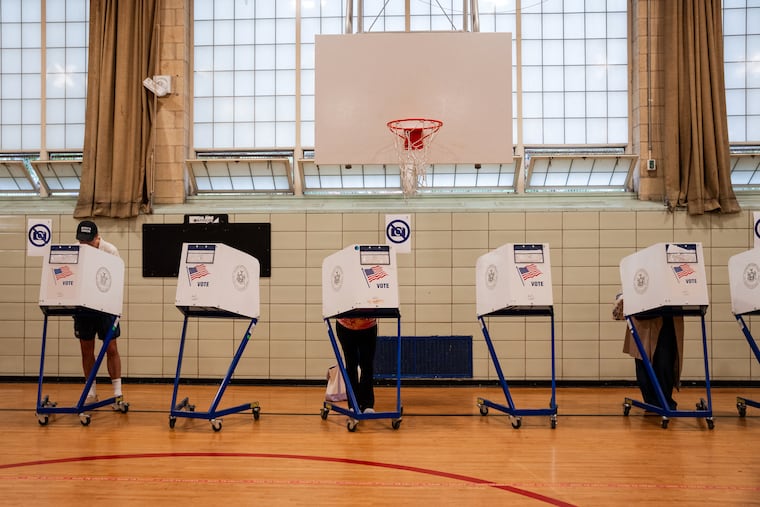
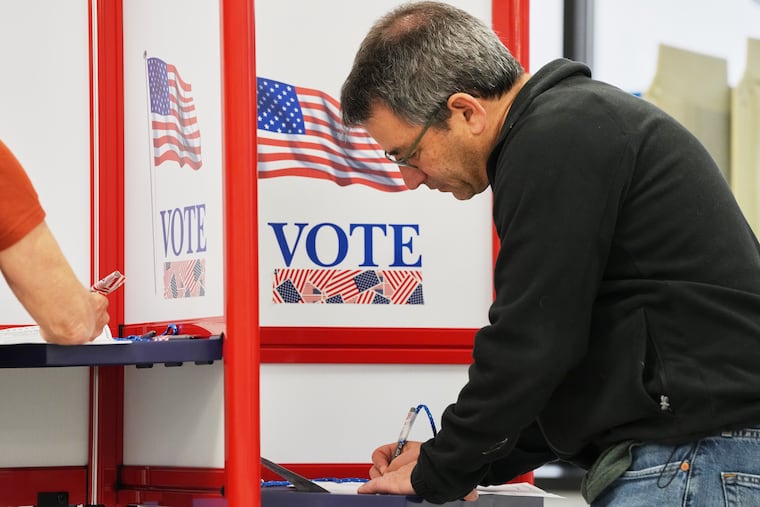
The race has drawn intense attention locally and nationally in part because the decisions the court makes in the next three years will set the rules for critical elections for governor and president, deciding whose ballots are counted and how Pennsylvanians vote.
“It is going to make a difference when we get to 2028 and a lot of those decisions are going to be in place for what a lot of people may be looking at as a monumental American election,” said Salewa Ogunmefun, executive director of Pennsylvania Voice, a nonpartisan civic engagement organization.
The role of voting rights in the race
Litigation over elections is a given in Pennsylvania and other swing states.
In 2018, the justices rejected a GOP-drawn congressional map as unconstitutionally gerrymandered. The court allowed a grace period for mail ballots to arrive in 2020 and upheld the requirement that ballots be placed in a secrecy envelope to be counted. Just last month, the court mandated that county election offices alert voters if their mail ballots will not be counted.
The court is currently considering whether counties must count mail ballots that are submitted without an accurate date on the outer envelope, and the justices are likely to play a key role assessing future congressional maps and deciding who will draw future General Assembly maps. Earlier this year, the court rejected a bid from independent voters to throw out the state’s closed primary system, but litigants say they’re prepared to try again in the coming months.
It is all but certain that when Democratic Gov. Josh Shapiro stands for reelection next year (likely facing Pennsylvania Treasurer Stacy Garrity, a Republican who is backing the anti-retention campaign) and when Americans elect their next president in 2028, that the Pennsylvania Supreme Court will play a role — as it has each cycle since 2020.
“Litigation after an election is being institutionalized,” said Matt Haverstick, an election law attorney who frequently represents Republican candidates.
Cases could span a variety of issues including mail voting, provisional ballots, and independent candidates. And they could include issues that haven’t been considered yet. Regardless, Haverstick said, they’ll quickly make it to the high court.
“To the extent there’s a perception the court will lean one way or another, some litigants will work to get cases straight to the Supreme Court,” Haverstick added, arguing that the court isn’t as political as many believe.
That inevitability, and perception of partisanship, has been a driving force in the GOP effort to oust the three justices.
Mailers from the right-leaning Commonwealth Partners urge voters to deny the justices an additional term in order to defend democracy and prevent gerrymandering.
As of September, the Commonwealth Leaders Fund, which is tied to Commonwealth Partners and funded by billionaire Jeff Yass, had already spent more than $100,000 on the race.
The American Civil Liberties Union of Pennsylvania, which does not endorse candidates but has litigated in front of the court on election issues repeatedly, plans to spend $800,000 on a voter education campaign this year.
The justices aren’t allowed to speak about possible future cases or rulings in their campaigning. But they’ve defended their decisions as nonpartisan interpretations of the law.
“Oftentimes we don’t like the outcomes of cases either, that’s just the fact of the matter, but they are based upon the rules that we follow deciding cases,” Donohue said last month during an event at a Philadelphia high school.
What issues could the court rule on?
The court’s decision in 2020 to allow voters three additional days to return their mail ballots remains a key example Republicans point to as overreach — although just two of the three justices standing for retention joined the majority opinion.
“That was to me a clear cut and wholesale rewriting of the code,” said Linda Kerns, an election attorney who represented the Republican National Committee in 2020, 2022, and 2024. “It was in black and white when the ballots had to be in and to say that we can accept them three days later, I think that was the most offensive.”
Marian Schneider, a former voting rights attorney at the ACLU of Pennsylvania who teaches an election law class at Villanova University, dismissed the idea that the justices ruled with a political agenda. Arguing in front of the court, Schneider won some of her cases with the ACLU but lost others.
Those cases, Schneider said, and the justices’ penchant for disagreeing even with members elected under the same party, undercut the argument that the court is acting politically.
The central issues of election cases, she argued, aren’t likely to change in the next 10 years.
“There certainly seems to be a significant movement trying to prevent certain categories of voters from voting,” Schneider said. “The opposite side of that is people working so that everybody who is eligible to vote who wants to vote can vote in a fair and free environment.”
As the Pennsylvania General Assembly continues to contemplate changes to election law — including a GOP push for voter identification laws and an effort from Democrats to approve early in-person voting — any new laws could go before the court.
Thad Hall, the election director in Mercer County, worried that as long as litigants were able to obtain changes to election law through the court — including a recent decision mandating counties tell voters if their ballot won’t be counted — that lawmakers would be unmotivated to reform the state’s law. GOP lawmakers, he said, won’t compromise with Democrats if they believe the ACLU will sue to remove pieces of that compromise.
The result, he said, is a continuing dynamic where election officials navigate changing rules year after year.
“It creates this environment that’s really toxic to election reform,” he said.
And in the absence of meaningful election reform in Pennsylvania, the court will continue to play a key role interpreting an election code that remains full of outdated provisions.
“As long as we have this election code with these same problems we could see some of the same issues,” Kerns said.

In November, voters will be asked whether three Pennsylvania Supreme Court justices should be retained for another 10-year term. Read The Inquirer’s coverage of the races before heading to the polls:
- Republicans are attempting to boot three Democratic justices from the Pa. Supreme Court — and for the first time, Dems are worried
- A ‘brazen’ Jeffrey Yass-backed mailer suggests the Pa. Supreme Court created the congressional map it actually threw out
- At Philly event, Pa. Supreme Court justices ask for 10 more years amid GOP campaign to oust them
- More than $7 million has poured into the Pa. Supreme Court judicial retention election so far
- The future of redistricting in Pa. could be at stake in November’s Supreme Court race