Sen. Dave McCormick says Chester County proves the need for national election rules. But the GOP proposal wouldn’t have solved the county’s problems.
McCormick said Chester County voters were turned away from the polls and unverified voters cast ballots on Election Day. The county says there's no evidence either claim is true.

When Sen. Dave McCormick stood on the Senate floor to call for nationwide rules mandating proof of citizenship and photo identification for voters, he invoked a drama that had played out three months earlier in Chester County.
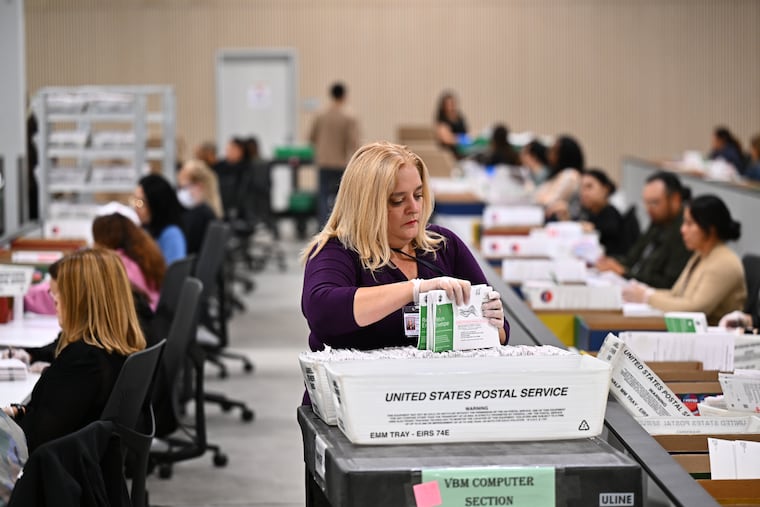
The county had mistakenly left all third-party and unaffiliated voters off the Election Day voter rolls, creating a chaotic scene in which more than 12,000 voters were forced to cast provisional ballots, which take more time to count as officials must verify the eligibility of each voter. A subsequent investigation by a law firm hired by the county attributed the issue to human error and insufficient oversight.
“Every time Americans hear about election problems like Chester County’s, they rightly question the integrity of our electoral process,” McCormick said.
But in his recounting of events, the Pennsylvania Republican gave incomplete and inaccurate information about Chester County’s election error.
What did McCormick say about Chester County?
Americans, he said, overwhelmingly believe there are problems with U.S. elections, and he argued that has been demonstrated for them on multiple occasions, including in November when Chester County omitted more than 70,000 third-party and unaffiliated voters from its Election Day pollbooks.
“Registered voters were turned away at the polls. And an unknown number of unverified voters cast regular ballots,” McCormick claimed.
But there is no evidence that voters were turned away or that ineligible voters cast ballots. McCormick’s office did not respond to questions.
Were voters turned away?
According to county officials, no voter who wanted to vote was turned away.
Instead, for most of the day voters were offered the opportunity to vote by provisional ballot while county and state officials worked to get supplemental pollbooks distributed to polling places across the county.
Some voters did testify at county election board meetings that they voluntarily left their polling place when their name was not in the pollbook but that they returned later in the day when they could vote on machines.
Did unverified voters cast ballots?
There is no evidence that ineligible voters cast ballots. The identity and eligibility of all voters who cast ballots were verified, county officials said.
When the pollbook issue was discovered on Election Day, Chester County officials initially recommended that poll workers ask voters not included in the pollbook to sign the pollbook manually and vote as normal, according to the independent investigation of the incident.
To ensure those voters were eligible to vote, county officials said, poll workers were instructed to follow a detailed process that included verifying voters’ eligibility in the full voter list and verifying their identity with photo identification.
The Chester County Republican Committee has disputed the county’s version of events, contending that photo ID was not checked for all voters who wrote their names into pollbooks and that poll workers were unable to verify voters’ identities using signature matching.
Around 7:40 a.m., less than an hour after polls opened, Pennsylvania Department of State officials recommended the county shift to asking voters to cast provisional ballots to eliminate the risk of an ineligible voter casting a ballot, thereby invalidating the election.
A county spokesperson said there is no evidence that ineligible voters cast ballots during November’s election.
Whether voters wrote their names into a pollbook or cast a provisional ballot, “the identity and eligibility of each individual was verified by the poll workers,” said Chester County spokesperson Andrew Kreider.
Would the SAVE Act have changed anything?
The SAVE Act is a collection of election policies proposed by congressional Republicans that would require proof of citizenship to register to vote and mandate all voters show photo ID at the polls.
Such requirements would not have prevented Chester County’s error, which investigators determined was a clerical error resulting from inexperienced staff with insufficient training and oversight.
“Sen. McCormick was ignoring the facts and feeding into this larger narrative that our elections can’t be trusted and just feeding into the president’s narrative that there’s something wrong with Pennsylvania elections,” said Lauren Cristella, the CEO of the Committee of Seventy, a Philadelphia-based civic engagement and good-government organization.
In addition to Chester County, McCormick pointed to his own experience in close elections — both his 2022 primary loss and his 2024 general election win — as a reason he supports the bill’s proof of citizenship and voter ID requirements.
The policy, which passed the Republican-led U.S. House, still faces an uphill battle in the U.S. Senate, where it would need 60 votes to advance. It has faced significant opposition from Democrats who say it would needlessly make it harder for people to vote.
The proof of citizenship requirement, critics say, would place a higher burden on married people whose last names no longer match their birth certificates.
Speaking to reporters last week, Democratic Gov. Josh Shapiro said he was “vehemently opposed” to the policy, arguing it would nationalize elections.
“We are not going to turn our elections over to Donald Trump,” he said.

Want to get Inquirer Chester County straight to your inbox every week? Sign up here for our guide to the news, stories, and events shaping life in your community.