Mikie Sherrill’s N.J. governor primary results show strengths and where she has work to do
Sherrill underperformed in heavily Black and Latino parts of New Jersey, though general election polling shows her leading with those voters ahead of November.
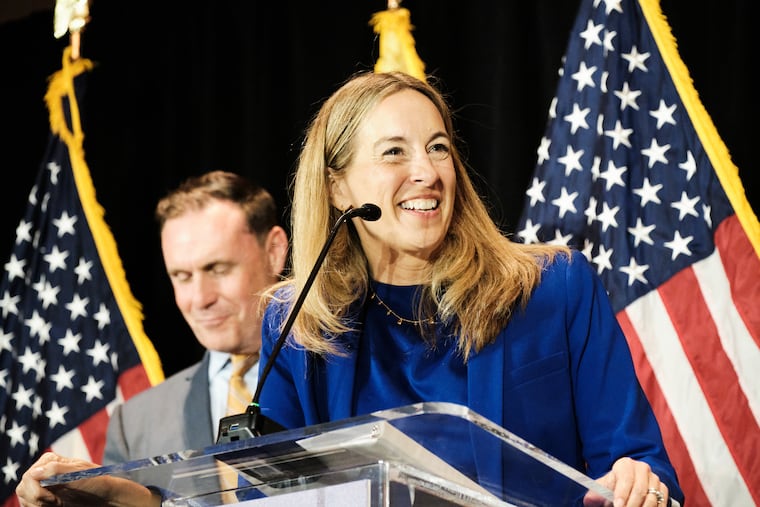
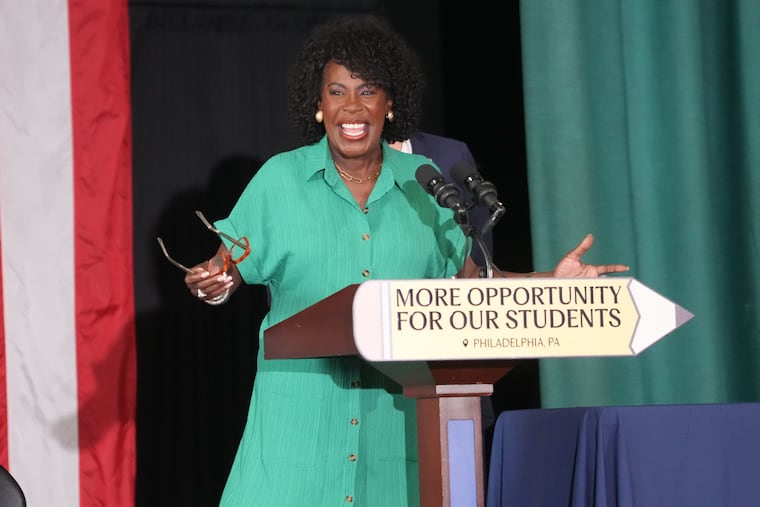
U.S. Rep. Mikie Sherrill dominated the New Jersey gubernatorial primary, but she trailed in some heavily Black and Hispanic areas, where there were also signs that once-mighty Democratic Party machines could be losing their grip.
Taken together, that raises some question of how effectively Democrats can turn out voters for her in an off-year election, even in a state where Democrats have the registration advantage and disapproval with President Donald Trump should give her an edge.
“That could be a vulnerability if she fails to energize those voters,” said Alyssa Maurice, head of research and polling at Stockton University’s Center for Public Policy. “We already know Republicans have been peeling away at Hispanic and Black voters. That’s something her campaign will have to watch. She didn’t win Camden, Newark, some of those urban centers.”
Primary results don’t tell much about general elections, as the pool of people voting changes and expands, and a Rutgers poll released last week shows Sherrill strongly leading GOP nominee Jack Ciattarelli among the very groups she trailed with in the primary election. Independent voters who cannot vote in the primary become a key target and are not reflected in the primary results.
But as attention shifts to the general election matchup with Ciattarelli, who cruised to the nomination in the GOP primary, the results offer some clues for what she might need to do to secure a win in November.
An Inquirer analysis of municipal-level primary results shows that Sherrill tended to perform best in older and more heavily white and Asian parts of New Jersey. She also performed best in wealthier areas in the state.
Her performance was weaker in boroughs, towns, and cities with higher shares of Black and Hispanic, lower-income, and younger residents.
Sherrill’s campaign said in a statement that she is building “the coalition it takes to win in November.”
“Throughout the campaign, Mikie has partnered directly with Black and Latino communities, listening to their concerns and bringing future legislative partners into these conversations to ensure productive work begins immediately,” said campaign spokesperson Sean Higgins.
In a six-way race, Sherrill won 34% of the vote and bested her nearest opponent, Newark Mayor Ras Baraka, by nearly 13 points.
But she struggled in many of the state’s vote-rich urban centers, losing six of its 10 largest cities, though in two, Newark and Jersey City, Democrats voted for their hometown mayors, Baraka and Steve Fulop.
The higher the percentage of Black or Hispanic residents was in a municipality, the worse she performed, securing 16% and 25.5%, respectively, in towns where most residents identified as one of those races.
In a moment when Democrats are trying to reengage some of these voters who skipped the 2024 presidential election or voted in larger numbers for Republicans, it’s a group for her to make up some ground with.
“I think Mikie has a harder road to hoe because she’s gotta come up to the urban core of North Jersey, Newark and Paterson, where turnout has just been abysmal lately, and get those voters to vote for her, and that’s really tough,” said Fairleigh Dickinson University pollster Dan Cassino.
Sherrill took just 20.5% of the vote in Paterson and 11.6% in Newark, placing second after Baraka.
Her campaign, in a memo after the primary, noted that she won in several counties with significant Black populations — including Camden, Mercer, and Burlington Counties. She also won in townships with large Latino populations, including Belleville, Dover, Vineland, and Union City.
The campaign has focused on Black and Latino areas, hiring Black and Latino media consultants, issuing materials in both English and Spanish, and attending community events to connect with those voters.
In a recent Rutgers poll, she led Ciatarelli with Latino voters, 56% to 22%.
The primary also showed a further weakening of some local party machines in populous urban areas.
Despite a Camden County party endorsement for Steve Sweeney, Sherrill won the county. Baraka won Essex, his home county, despite her endorsement there. That could also be a warning sign for how adept those party machines are at turning out voters, several strategists said.
“The other signal from these results is that the influence of the Democratic machine has really weakened,” Maurice, of Stockton, said. “It remains an open question if the party can rally the base behind Sherrill and turn out the votes in this part of the state, because the political machine down here seems to be struggling a bit.”
Still, Sherrill was endorsed by the most county parties, and won most of them. And her campaign, along with the New Jersey Democratic State Committee’s coordinated campaign, is leading the charge on her election, not the local parties.
Consolidating the base
Despite some fractured support among demographic groups in the primary, recent polling indicates Sherrill is consolidating the Democratic base.
“Progressives and Democrats are seeing this race in national terms, so they’re going to vote for the Democrat no matter who it is,” Cassino, of Fairleigh Dickinson, said. “They’re not insisting on loyalty tests.”
Bill Hyers, a campaign manager for Baraka, agreed and said headwinds against Republicans and Trump offer her an opportunity to go on the offensive.
“We don’t need to play defensive basketball where you’re just running out the clock. She needs to get out there and really say … here are two, three bold ideas that I think would be good for us,” Hyers said.
Sherrill won older, wealthier, and better-educated parts of the state in the primary. That could bode well for her in November since New Jersey is a richer and better-educated state on average.
She did very well in predominantly white and Asian parts of the state, taking 37.9% and 32.4% of the vote, respectively, in towns where those races made up the largest single demographic.
And she won across the more heavily populous and Democratic northern part of the state while still putting up a strong but more varied performance in the south.
Ciattarelli will aim to capitalize on South Jersey and the Democratic nominee’s relative weakness among lower-income and less-well-educated primary voters as he aims to appeal to a more blue-collar base.
“In New Jersey, culture matters a great deal,” GOP consultant Chris Mottola said. “One of the advantages that Ciatarelli has over Sherrill is that I can see her eating at the Washington Inn in Cape May, but I could see him more readily having a pork roll and cheese on the boardwalk, and I think that her kind of suburban, upper-income, boxed-wine vibe does not help her in traditional Democratic strongholds.”
For his part, Ciattarelli, who was endorsed by Trump, won across the board in the GOP primary.
“It just shows the power of Donald Trump to consolidate the Republican base,” Democratic strategist Anthony Campisi said of Ciattarelli’s primary results.
Still, in a state where there are more than 860,000 more Democrats than Republicans, Campisi notes “the big question will be whether Ciattarelli will be able to extend his reach beyond MAGA to independents.”
Unaffiliated voters make up the second-largest group of registered voters, behind Democrats.
“There aren’t enough MAGA supporters alone,” he said.

The Inquirer started its analysis by compiling results from each of New Jersey’s 21 counties. Roughly half of New Jersey's counties use a Clarity Elections system to report their election results, which breaks down results by precinct. The rest of the counties released results in either PDF or Excel spreadsheet format. Precinct names are based on municipalities, and were combined to get results by municipality. Results from some precincts with very few voters were not made available due to New Jersey election privacy laws and are excluded here but were not enough to limit the analysis.
To perform the analysis, the Inquirer combined the municipal-level election results with data from the Census Bureau's 2019-2023 American Community Survey on age, income, educational attainment, and race. For age, the Inquirer used a location’s median age, for income, a location’s median household income, for educational attainment, the share of a place's residents 25 years or older with at least a bachelor's degree. For race, Hispanics may be of any race while Asian, Black, and white are non-Hispanic.
When analyzing results by age, income, and educational attainment, the Inquirer split New Jersey's 564 boroughs, towns, and cities into quartiles — four equal groups into which a population can be divided — of about 141 municipalities each. With age, for example, the Inquirer measured the share of the vote each candidate received in the 25% of towns with the youngest median ages, then the next youngest 25% of towns, and so on.
For race, the Inquirer measured the share of the vote each candidate received in towns where a particular demographic group constituted the largest share of the population.