Former Trump national security adviser H.R. McMaster says Americans should ‘have a say’ on strikes against Venezuelan boats
The retired lieutenant general and Philly native will be feted by the Museum of the American Revolution in January.
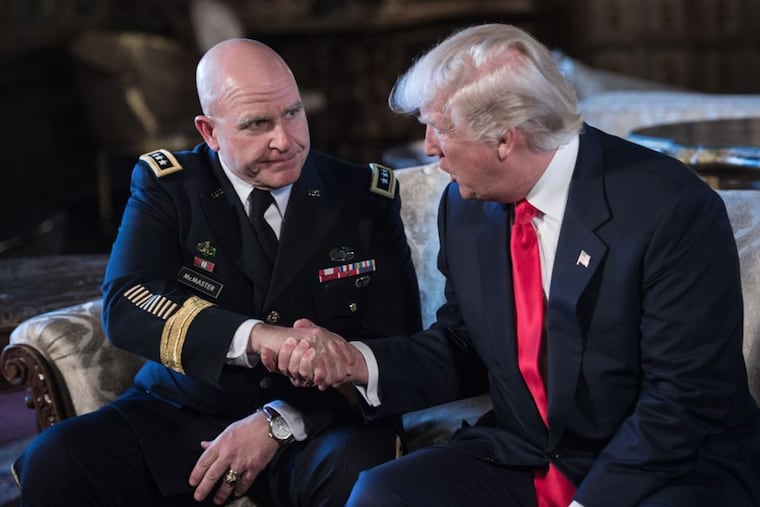
Americans should “have a say” in the Trump administration’s unilateral decision to use military force against Venezuelan boats, according to H.R. McMaster, former national security adviser during the first Trump administration, and a retired lieutenant general who grew up in Roxborough.
Being honored Jan. 16 at the Museum of the American Revolution’s 320th birthday celebration of Benjamin Franklin, McMaster was interviewed by The Inquirer last week. He offered a brief but wide-ranging discussion on foreign policy and military matters. McMaster will be named the 2026 Franklin Founder honoree during the annual Philadelphia event that celebrates the life and legacy of Franklin. McMaster is scheduled to speak about the role of the military in a democracy.
“A comprehensive explanation for bombing boats is lacking,” McMaster said in the interview, referencing the attacks on vessels allegedly carrying drugs that find their way to the United States, which have resulted in around 100 deaths since early September. “The American people should have a say through Congress.” The Trump administration has said it has complete authority to conduct the attacks.
McMaster said certain questions must be answered, such as whether the strikes are a “just cause,” and whether the right to conduct the missions is within the purview of presidential power under Article II of the U.S. Constitution.
McMaster didn’t discuss the ongoing controversy about whether U.S. forces were justified in killing two survivors of a Sept. 2 attack on a Venezuelan boat. Defense Secretary Pete Hegseth is refusing to release video showing the killing of two men clinging to wreckage in the Caribbean Sea.
McMaster, 63, is a historian and senior fellow at the conservative Hoover Institution at Stanford University who served 457 days in the Trump administration, from February 2017 to April 2018. He left after disagreements with Trump over foreign policy and internal dynamics.
Trump considered using force against drug smuggling during his first term, McMaster said, when the president asked his staff, “Why don’t we just bomb the drugs?” coming out of Mexico.
Military intervention was avoided, McMaster said, after he “huddled a team” and won “unprecedented cooperation” with the Mexican government to fight the flow of drugs.
Addressing other military matters, McMaster discussed the widely reported meeting of military commanders called by Hegseth in September.
One of Hegseth’s main messages was there’s no place for “wokeness” in the military, saying too many uniform leaders were being promoted “for the wrong reasons — based on their race … gender quotas [and] based on historic so-called firsts.” He added he wants “no more … DEI programs or dudes in dresses. No more climate change worship.”
While he agrees with much of what Hegseth said, McMaster explained, the secretary was speaking to the wrong people: “There are no woke generals and admirals,” McMaster said. “They had been following unwise directives from senior civilian officials pushing an extreme social agenda in the Biden administration.” Under Biden, McMaster concluded, the military had come to “valorize victimhood.”
Civilian guidance on so-called woke matters isn’t needed in a self-policing entity such as the military, McMaster said: “Yes, there have been criminals and sexists in the military, but hell, we threw them out ourselves.”
McMaster also said he doesn’t have a problem with the Trump administration deploying National Guard troops to U.S. cities such as Los Angeles; Chicago; Memphis; Washington, D.C.; and Portland, Ore. “It’s the president’s right to do so, allowing local law enforcement to enforce the law,” he said. “Regrettably,” he said, local authorities have resisted guard placement, especially in Oregon and California, where Democratic governors are in charge. “This is an example of how partisan politics can undermine our ability to work together,” he said.
As a former insider in a Trump-led administration, McMaster has said in previous writing that he’d witnessed the machinations of the White House, including “exercises in competitive sycophancy” among officials in Oval Office meetings. McMaster didn’t comment on the atypically blunt revelations by Trump chief of staff Susie Wiles in Vanity Fair.
He’s written that Trump is a “flawed commander in chief: mercurial, inconsistent, and easily distracted.” But, he added, Trump’s erratic course reversals can be helpful, because they make him unpredictable to our adversaries.
Despite his time in the inner sanctum of the Trump administration, McMaster would write in his book, At War With Ourselves: My Tour of Duty in the Trump White House, that he’d been unable to foresee Trump’s “persistent false claims of widespread election fraud [in 2020] and his encouragement of a mob [on Jan. 6] to conduct the most significant attack on the U.S. Capitol since August 1814,” when British troops set fire to the White House.
The partisanship that helped spur the attack is a continued threat to the republic, McMaster said in the interview with The Inquirer, referencing Franklin, “who feared factionalism.”
Each year, the Franklin celebration highlights a theme that connects Franklin’s work to current social issues and concerns. In receiving the Franklin Founder Award, McMaster joins company with others from a wide variety of fields:
John Mather, an astrophysicist who won a Nobel Prize, was the 2025 winner. He helped develop the James Webb Space Telescope, connecting with Franklin who uncovered important principles in electricity, marine oceanography, magnetism, and aeronautics.
In 2020, the centennial anniversary of Congress’ act to grant women the right to vote, awards went to Linda Greenhouse for her coverage of the Supreme Court for the New York Times, as well as to Cokie Roberts, political commentator and author.
The 2016 award went to pediatrician Paul Offit from Children’s Hospital of Philadelphia as well as the Perelman School of Medicine. Offit is the co-inventor of the rotavirus vaccine, and an author and public speaker. This topic was closely aligned with Franklin, whose civic involvement included creation of the first public hospital. Offit has frequently sparred with Health Secretary Robert Kennedy Jr. over the issue of vaccines.
McMaster is a graduate of Norwood-Fontbonne Academy (formerly Norwood Academy for Boys, and Fontbonne for girls), a private Catholic school in Chestnut Hill. He also graduated from Valley Forge Military Academy, which will be closed in the spring (it doesn’t affect Valley Forge Military College, which shares a campus with the academy in Wayne).
McMaster went on to the U.S. Military Academy at West Point, and was a U.S Army Officer for 34 years. His career included combat service in the Gulf War. Afterward, he returned to teach history at West Point and earned a Ph.D. in history from the University of North Carolina-Chapel Hill.