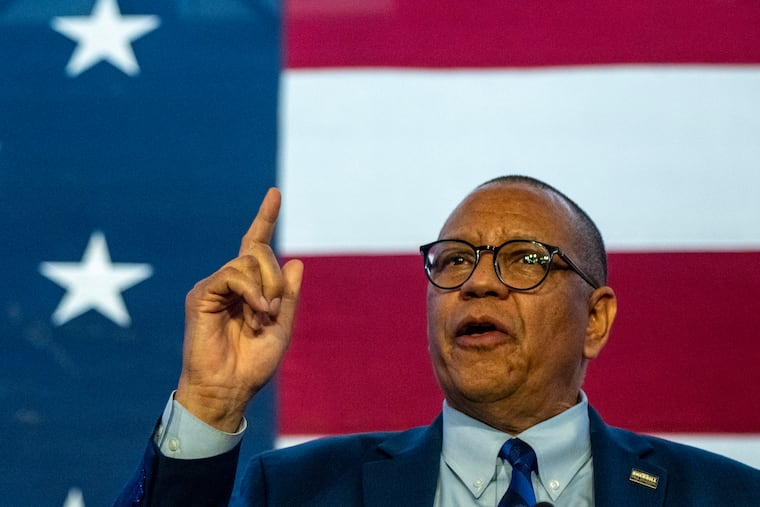
Bayly Winder has the most money in the race to face Jeff Van Drew. He also has the fewest connections to the South Jersey district.
Winder has roots in England and Princeton, and his parents have spent $64,000 to support his candidacy.

Bayly Winder has far more money than the other candidates running in the Democratic primary to take on South Jersey’s U.S. Rep. Jeff Van Drew, but he is also the one with the fewest ties to the district.
Winder, 34, repeatedly introduces himself as a “fourth-generation New Jerseyan” on the campaign trail.
But he was born in England and attended grade school there before moving to Princeton in Central Jersey, where he says he attended the local middle and high school. He moved back to the state just last year after stints abroad and in Washington. His candidacy is heavily funded by his parents, who live out of state.
Winder is competing for the Democratic nomination to face Van Drew against Cape May Mayor Zack Mullock, civil rights attorney and previous nominee Timothy Alexander, and grassroots candidate Terri Reese — all of whom have deep ties to the district.
Van Drew was elected as a Democrat in 2018 before switching to the Republican Party and declaring his “undying support” to President Donald Trump in December 2019. Ousting him is a tall order, but Democrats think this is their best chance yet in an anticipated blue wave this fall.
The sprawling 2nd Congressional District stretches from parts of Gloucester County in the Philadelphia suburbs through rural areas to the Jersey Shore.
Winder became a South Jersey resident when he moved to the district last May, according to his campaign manager, Andrew Sklansky, and launched his campaign the next month.
Winder registered to vote last June in Mays Landing — roughly 70 miles down U.S. Route 206 from where he spent his adolescence in Princeton. He said in an interview he is invested in the community and wanted “to be a part of this fight to take on Van Drew.”
After high school, Winder attended Johns Hopkins, the University of Oxford, and Georgetown University in Qatar, and did a Fulbright scholarship in Kuwait.
He worked on Iran policy at the State Department during the Obama and the first Trump administrations, consulted with Deloitte for the FBI under Trump, worked at a startup, and worked at USAID for the second half of President Joe Biden’s term.
Winder said he visited the Shore with his family as a kid, spending time in Cape May and Barnegat. When asked about his time there and how often he came to the district, he said his “memories are of intimate moments with family, friends, of cherishing the incredible nature that we have here.”
Bryan Thomas, a Lower Township resident, said Winder’s connections to the district are not sufficient to understand what life is like for residents.
“If I vacation somewhere, I’m not like, ‘I’m going to go run for Congress there.’ That don’t make sense. … Don’t pretend you’re one of us when you’re definitely not," he said.
Thomas and others have raised questions about Winder’s background, but the candidate said he does not “think most folks are too concerned about my childhood.”
His campaign logo features the Barnegat Lighthouse, which he says his father and grandfather “spent a tremendous amount of time around.” Winder’s great-grandfather, Philip Hitti, moved from Lebanon to work at Princeton University in 1926, and Winder said they have “been a New Jersey family since then.”
Hitti, a national leader in Arabic and Islamic studies, founded the university’s Near Eastern Studies program. And Sklansky said Winder’s grandmother and father were each raised in Princeton.
Support from Wyoming
Winder’s run has been supported by at least $64,000 from his parents, who reside in Wilson, Wyo., according to Federal Election Commission records, and are also based in Washington, according to Sklansky.
Wilson has 1,500 residents and was described by the Wall Street Journal in 2016 as a “ski town for America’s wealthy.”
Winder’s father, Philip, funneled $50,000 through a super PAC run by a North Jersey firm that is also funded by residents of D.C., Princeton, and Wilson. Winder’s parents also contributed $7,000 apiece directly to the campaign, the maximum amount. As of March 31, more than 20 other donors are Wilson residents.
Winder’s father, the CEO of Polygon Investment Management, lived in London for 14 years, according to his company website. Winder’s mother, Diane, worked in Mercer County before joining the family business, and previously worked in New York and London, the site says.
Through March, Winder received almost twice as much money from out-of-state donors as from New Jerseyans, with roughly $91,500 from Wyoming alone.
He raised more than three times as much as Mullock — whose contributions are mostly in-state — and the other candidates trailed further behind.
Winder said his geographical reach shows his broad support, and said he has “spent some time out in Wyoming” and has “some family connections.”
“We’re putting this district on the map,” he said.
Winder is the only candidate in the race who reported paying himself from his campaign. As of March 31, he pocketed more than $35,500 through 17 payments.
“I’m doing this full time and, frankly, I think that’s what’s required to do it in the right way,” Winder said.
“So many people who run and are successful are incredibly rich, are lawyers and surgeons or people who have made hundreds of millions of dollars in finance, and I don’t think running for office should be restricted to folks like that,” he added.
While it’s legal for nonincumbents to pay themselves, candidates “have to be very mindful of the perception that something like this would create,” said Anthony Campisi, a political strategist who works in the region but is not affiliated with any of the campaigns.
Embracing the Vineland data center fight, but not necessarily being embraced back
Winder has made fighting a controversial data center in Vineland a hallmark of his campaign. He has held town halls, circulated a petition, spoken at city council meetings, and released a plan for a federal data center moratorium.
He said at a Stockton University debate last Wednesday that he has “led the charge in this primary on fighting back on this issue.”
The super PAC supporting him disseminated a mailer falsely crediting Winder with stopping the data center altogether, but the center has already begun operating and a council vote on its expansion was only delayed. The mailer irked local activists who have grappled with Winder’s embrace of their cause.
“The claim that Vineland’s data center was stopped by him is inaccurate and misleading,” said Jenna Williams, a member of Sustain SJ, a local group opposing the data center. “This comes off as an attempt to gain credibility with voters at the expense of a community that is working tirelessly to organize against the project as construction continues.”
Winder touts rallying alongside local groups like Sustain SJ, but the group, which has remained neutral in the race, has distanced itself from him recently. Some local activists told The Inquirer that while they appreciate the attention to their cause, they feel Winder has used it opportunistically to bolster his campaign.
They note other candidates have also opposed the data center and said they are concerned about Winder’s campaign getting conflated with their cause.
In one example, local activists were met with an abundance of “Winder for Congress” signs at a rally meant to target the data center, said Adele Faust, a local opponent of the project.
“He definitely tried to turn it into a campaign stop,” Faust said. “He had people filming there for his social media, and it definitely felt like more of a production on his end than what all the other groups had been trying to make it. It reads very much to me like ‘I want attention for this,’ not ‘I care about this.’”
Sklansky said Winder “has always centered the community’s response to this issue.”
At the debate, Alexander accused Winder of investing in data centers, which Winder called “a silly exaggeration” in an interview.
In his financial disclosure, Winder, who is against stock trading in Congress, reported investments in tech companies like C3.ai, an artificial intelligence company, and Alphabet, Google’s parent company, which owns data centers. Winder said there are “a couple stocks that I bought a long time ago that are some of the most common in the country.”
A district outsider or a D.C. insider?
Mullock said on the debate stage that “people want South Jersey to be brought to D.C., not D.C. to South Jersey.”
But Winder and his supporters argue his experience in Washington is an asset.
“If serving our country makes me an outsider, then I think our definition of outsider is wrong,” he said in an interview. “And I think that going to Congress and delivering on day one without training wheels is going to take someone with the right kind of experience.”
Winder has endorsements from 18 individuals and groups from the local, state, and national levels, including Stockton University Democrats, New Jersey Citizen Action, and Samantha Power, his former boss at USAID.
Maura Collinsgru, director of policy and advocacy for New Jersey Citizen Action, rebuffed criticism that Winder is an outsider to the district.
“Like many younger people, when they go to school, they make a career,” said Collinsgru, a Burlington County resident. “They have worked outside of New Jersey. I mean, that’s how he got the experience he got at the federal level. I don’t think that’s a disconnect.”
Philip Swibinski, a North Jersey-based strategist who runs the super PAC supporting Winder, said that Winder’s background reminds him of successful candidates like Democratic Sen. Andy Kim, who also held roles at the Department of State and USAID.
Reese, Alexander, and Mullock said they would support one another in the general election. But they have all been critical of Winder, and Reese and Alexander said they would not support him if he is the nominee. (Winder said he would support the primary winner.)
Reese said in an email that Winder “exemplifies what I firmly believe is wrong with our government.”
At the end of the debate, Reese embraced Alexander and Mullock. Winder went in for a handshake, and she declined.