Why did Jack Ciattarelli do so much worse than everyone expected? These N.J. Republicans have some theories.
Democrat Mikie Sherrill won the New Jersey governor's race by more than 13 points.
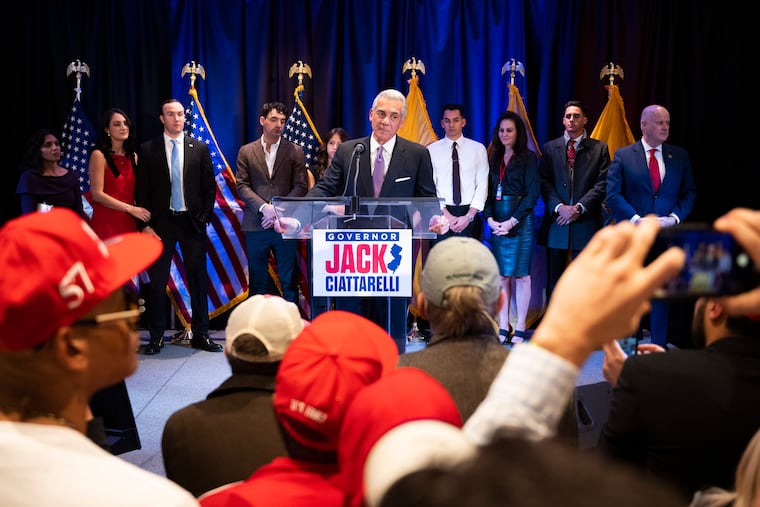
New Jersey Republicans really thought they had a shot.
After Jack Ciattarelli’s closer-than-expected loss in 2021, an optimistic base was convinced he would be sold as the change candidate this time around. He held high-energy rallies and was polling closely with Democrat Mikie Sherrill.
But with President Donald Trump in the White House and a federal government shutdown in progress, a candidate who embraced the president was not the change voters wanted — especially as Trump targeted the state for funding cuts.
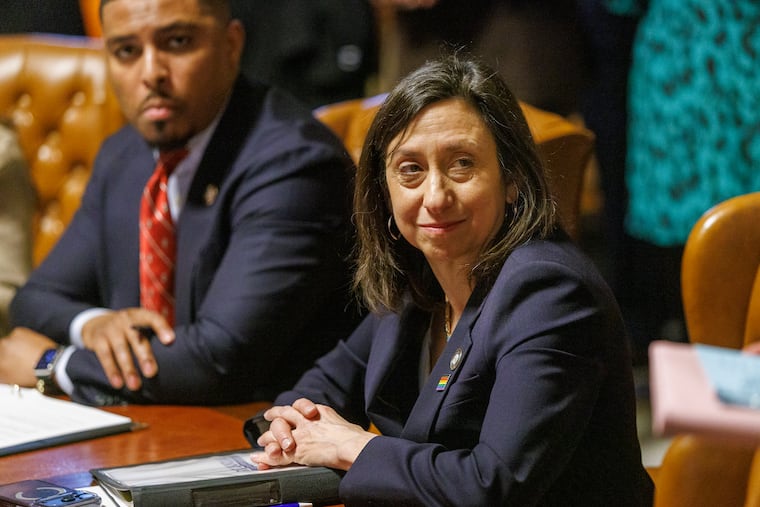
“At least in my world, we all thought that this race was very close,” said Kimberley Stuart, chair of the Camden County GOP. “We thought that it was neck-and-neck.”
It wasn’t. Sherrill walloped Ciattarelli by more than 13 percentage points.
And it wasn’t just Stuart’s circles that were wrong. Democrats and nonpartisan analysts similarly anticipated a tight race. Sherrill’s supporters spoke in urgent tones, afraid of another disappointment after the 2024 election.
So how did Republicans fail so miserably?
As they processed what went wrong, Republican operatives cited a range of issues in interviews with The Inquirer — from affordability and attack ads to the GOP’s ground game. But the most dominating factor is that voters are dissatisfied with Trump’s Washington.
Government shutdown: ‘The absolute worst timing’
Assembly member Michael Torrissi Jr., a Hammonton Republican who lost his reelection bid to a Democrat on Tuesday, confidently argued on Oct. 13 that Trump wouldn’t weigh down Ciattarelli because voters were more concerned about local issues, like their electric bill. Now he believes that Washington is fully to blame for the results of the race and that there’s nothing Ciattarelli and others could have done to control it.
He argued that the unaffiliated voters who could swing the race voted with “short-term memory,” as Trump has attempted to withhold federal food assistance during the federal government shutdown.
“This past week, the government is shut down, the SNAP program, the food banks, the air traffic controllers — everything’s a mess right now. … It was the absolute worst timing for New Jersey’s election,” said Torrissi, a Trump ally who represents parts of Atlantic and Burlington Counties and runs a fuel trucking company based in Vineland.
“Had the government stayed open, I really believe there would have been a really different outcome,” he added.
Ciattarelli didn’t even mention the government shutdown while stumping in South Jersey the day it began. He did not speak out against Trump’s administration when it threatened funding for the much-anticipated Gateway tunnel project connecting North Jersey and New York, later offering limited pushback when Trump said the project was terminated.
One Republican insider who did not want to be named because he was still processing the race said he was most surprised by Ciattarelli’s lack of support from unaffiliated voters, which his campaign had banked on.
He said that Ciattarelli and his team tried to make the case that New Jersey “is a dumpster fire and needs someone to change it,” a message they were confident would resonate with independents. It’s hard to blame any one thing Ciattarelli’s campaign did or said because the margins were so drastic, he said.
“When confronted with the decision of: change the state or send a message about your dissatisfaction on a more national, macro level, they chose the latter,” he said.
Too MAGA or not MAGA enough?
Gov.-elect Sherrill argued that Trump’s economic policies are making life harder for New Jerseyans. Meanwhile, Ciattarelli embraced the MAGA movement after being against the president and then keeping him at a distance during his previous two gubernatorial runs. He successfully courted Trump’s endorsement during a bitter primary competition against conservative radio host Bill Spadea and won the race decisively.
Trump’s endorsement was treated like treasure, but some argued Ciattarelli didn’t need it given how well established he already was with the state party.
After the primary, Ciattarelli continued to cozy up to Trump when some observers think he should have worked to differentiate himself. He praised the president’s “big, beautiful bill,” which made cuts to Medicaid and the Supplemental Nutrition Assistance Program. He gave Trump an A grade, struggled to name any major issues he disagreed with him on, and even managed to defend the president as he took a rare stance against him over a local military base.
Spadea said in a postelection interview with On New Jersey that Ciattarelli’s hesitance to push back on Trump about the Gateway project was a mistake, calling it “low-hanging fruit” that Ciattareli could have utilized to show he would stand up for New Jersey instead of being Trump’s yes-man.
Voters throughout the state pointed to Ciattarelli’s association with Trump as a turnoff.
“I don’t want any of that Trump B.S. in charge of Jersey,” said Jordan Page, a 19-year-old Burlington County voter.
On the other hand, some leaders of the most MAGA factions of the party argue that Ciattarelli did not embrace Trump enough and that his allegiance was unconvincing. Stuart said there were Republicans who stayed home because they never bought that Ciattarelli was a Trump supporter in the first place.
“It was odd to me that Jack had worked so hard to secure the endorsement of President Trump, but yet President Trump did not come to New Jersey in any meaningful way to support or to help Jack with his campaign,” Stuart said.
State Sen. Jon Bramnick, an anti-Trump Republican who lost the primary, argued that the results of the election prove what he has said all along: New Jersey Republicanism has to be moderate to be successful.
“If you don’t want to follow that formula because for whatever reason you’re 100% Trump, that’s fine, but you ain’t gonna win!” he said.
Taxes, messaging, and ground game
Michael Casey, a Republican organizer in New Jersey, doesn’t buy that it was all on Washington. He believes Ciattarelli took the biggest blow on taxes, a top issue for voters that both candidates centered on in the campaign.
Sherrill’s backers poured millions into ads that suggested Ciattarelli wanted to raise the sales tax to 10%, a claim based on comments he made noting Tennessee’s tax rate before saying “we’re going to look at what other states do and every option is on the table.” He later said he would not raise sales taxes.
Casey said he thought that the ad was an out-of-context “low blow,” but that voters believed it, leaving Republicans on the defensive on a topic they had the upper hand on against Democratic Gov. Phil Murphy in 2021.
“On the campaign trail, I had people coming up to me while I’m knocking at doors, at street fairs … they were afraid to vote for Ciattarelli because they were afraid their taxes were going to go up,” said Casey, who works for Scott Presler’s Early Vote Action, a group that tried to increase Republican turnout for the race.
Sherrill and the committees backing her spent about $23 million more on ads than Ciattarelli’s, according to AdImpact, a drastically bigger gap than their overall spending difference of a few million, according to New Jersey Election Law Enforcement Commission data two weeks out from the election.
Casey said Republicans were overconfident and should have better anticipated the opposition party being more energized than the one in the White House.
“I think we just need to remember the type of years that we’re in,” he said.
Stuart, whose committee had endorsed Spadea in the primary, said party leaders in the state need to be better at reaching people who are not traditionally Republican, including women.
“I think we fail miserably as Republicans because we don’t want to get our hands dirty, and we don’t want to talk to people that don’t look like us,” she said.
Ciattarelli said his campaign had been “too white” in 2021 and made efforts to diversify his staff and reach various demographic communities this time around. Yet he had a net loss of over 70,000 votes in the three counties where Hispanic residents have a plurality compared with his run in 2021.
Stuart said Ciattarelli was skilled at connecting with voters one-on-one, and saw him win over a nurse in the city of Camden who initially didn’t even want to meet him. But the campaign spent too much time rallying people who already supported him and not enough time explaining policy specifics, she argued.
“His team, I think, was more concerned with the rally and the limelight and the accolades than they were the people,” she said. “And I think that’s the problem with the Republican Party.”
Staff writers Alfred Lubrano and Joe Yerardi and graphics editor John Duchneskie contributed to this article.