Gov. Mikie Sherrill signed a law at a Salem nuclear plant that she hopes will (eventually) lower utility bills
New Jersey residents have seen their energy bills rise in recent years. Sherrill hopes more power generation in the state can help.
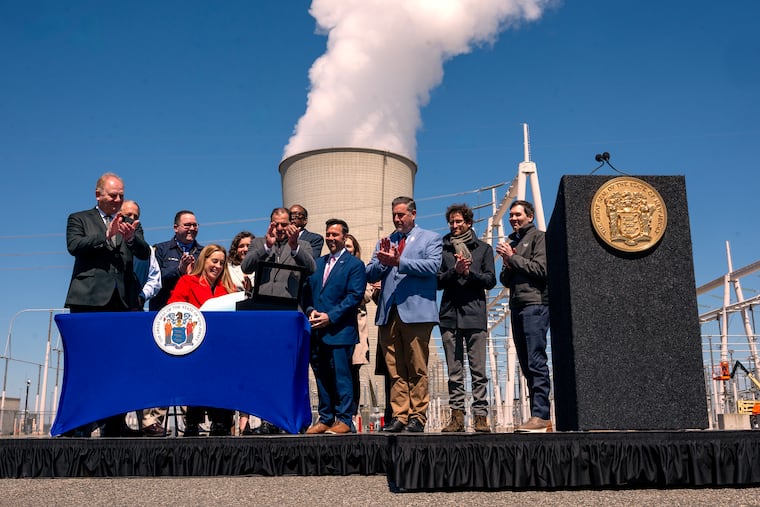
Sitting at a makeshift governor’s desk in front of the massive cooling tower in Salem County on Wednesday, New Jersey Gov. Mikie Sherrill signed a new law intended to make way for new nuclear energy projects in the Garden State.
Her hope is that more energy — of all kinds — can lower ratepayers’ bills that have skyrocketed in recent years. And demand is not expected to go anywhere, as the rise of artificial intelligence and the proliferation of data centers have brought new strains on energy systems.
“Across America, a nuclear renaissance is taking shape, with new plants, new partnerships, new funding, and new opportunities,” Sherrill said in front of the giant cloud of water vapor puffing into the air, which could be seen for miles over local farms and houses.
“New Jersey is uniquely positioned to lead,” she added. “We have the infrastructure, we have the workforce, the innovators, the experience. We know how to do this. And the potential benefits are huge.”
The new law
The new law modifies regulations that essentially blocked new permits for new nuclear facilities by requiring an outdated standard of radioactive waste disposal, Sherrill said.
“It was written in the 1970s, tied to a technological requirement that made sense then, but not today,” she said. “It’s a textbook example of the kind of inefficient government that I ran to change.”
The new law was championed by South Jersey lawmakers on both sides of the aisle, including Assembly member Cody Miller, a Gloucester County Democrat and prime sponsor of the bill.
“We know that nuclear is safe, it’s clean, it’s reliable, and the only way that we’re going to be able to address our energy crunch right now is additional generation. … The only way we’re going to be able to take control of our energy future is if we talk about expansion,” Miller said in an interview.
While some New Jersey-based environmental groups support nuclear power, environmentalist Jeff Tittel, the former director of the Sierra Club’s New Jersey chapter, called the new law “deeply flawed.”
He said the law weakens the Coastal Area Facility Review Act, a decades-old regulatory framework that seeks to protect the Shore by regulating residential, commercial, and industrial development.
He also criticized the way the new law gives more power to the New Jersey Department of Environmental Protection commissioner to approve projects, saying it “gives the DEP commissioner sweeping authority to waive critical safety standards.
“That’s not oversight — that’s a rubber stamp,” he added.
Ed Potosnak, the former executive director of the New Jersey League of Conservation Voters, is the acting DEP commissioner and was appointed by Sherrill.
Nuclear energy in New Jersey
New Jersey has three nuclear plants on an artificial island in the Delaware River called the Salem and Hope Creek Generating Station, which is operated by PSEG, a publicly traded energy company. The site generates 40% of the state’s energy and 80% of its clean energy.
Nuclear energy can be controversial in part because of high-profile tragic accidents like the 1986 Chernobyl disaster — which was caused by human error and design flaws — and the 2011 accident in Fukushima, which was caused by an earthquake and a tsunami. But as energy demands increase, lawmakers on both sides of the aisle have championed expanding nuclear power as a safe energy alternative.
Christopher Peters, an expert on nuclear power and associate teaching professor at Rowan University, said existing plants in the U.S. have safety features, and new technology would be even better.
“Commercial nuclear power has been around since the 1960s and we’ve had one major accident that’s been known in the United States, but that wasn’t definitely too detrimental to the public,” he said, pointing to a 1979 partial meltdown caused by a cooling malfunction at Three Mile Island outside Harrisburg.
The incident “caused a slight leakage of radiation into the atmosphere,” according to an Inquirer report from the time. The event led to sweeping changes in the industry, according to the U.S. Nuclear Regulatory Commission, and the U.S. Department of Energy announced last year it was steering a $1 billion loan to help reopen the site.
Building more nuclear in New Jersey
Sherrill also announced a new task force that will seek out new nuclear energy projects as she promises to find ways to generate more energy in an effort to control soaring utility rates and rising energy demands.
She said after the event that she wants to see an expansion on the artificial island in Salem.
“What I’d love to see is us building out more right here, because it was always anticipated we would have more reactors right here on this site,” she said.
The reactors are operated by PSEG, and the company already has an early site permit to expand its nuclear operations. But PSEG president Ralph LaRossa has been clear on earnings calls that the company is not willing to front the bill of building the site.
“We’re open for business. We want to make something happen down here,” LaRossa said Wednesday.
“We’re going to need a lot of partnership to make something like this happen,” he added. “We’re going to go out banging on doors and try to find as many partners as we can have.”
Sherrill said after the event that she wants to see the federal government invest in New Jersey nuclear power as part of a national approach to energy policy.
The governor has had a confrontational relationship with the Trump administration, but she said after Wednesday’s event that members of her administration have been in contact with the federal Nuclear Regulatory Commission and Department of Energy.
“If the federal government organizes this, as they’ve shown willingness to do, that could help us really have economies of scale,” she said. “We could build much more quickly as we develop the expertise and drive the costs down as we build out several different places with the same plan.”
A long haul plan
Brian Lipman, director of the New Jersey Division of the Rate Counsel, said in an interview that building a large reactor could take about 10 years, while a new kind of smaller reactor would take about five to eight. He supports the generation of new energy — including nuclear — as long as ratepayers are not the ones footing the bill to develop it.
“We need as much as we can get right now,” he said. “So I do think it’s an all-of-the-above kind of situation.”
The governor said last month at an event hosted by the Chamber of Commerce Southern New Jersey in Mount Laurel that she is well aware that nuclear energy is a longer-term goal while solar and battery energy is quicker and cheaper.
“I get told, ‘You know, Mikie, that’s like a 10-year proposition, you know, you won’t even be in office,’” she said.
“In 10 years, we’re just gonna still have this problem and not be producing this?” she added. “There’s this kind of short-term thinking, gimmicky mindset that we’ve got to get past as we really work to drive down costs.”
Staff writer Frank Kummer contributed to this article.