How this property tax relief program for New Jersey seniors could change under the state’s budget deal
Stay NJ, a property tax relief program for seniors in New Jersey, could change until the state's budget deal after Gov. Mikie Sherrill and Speaker Craig Coughlin made a compromise.
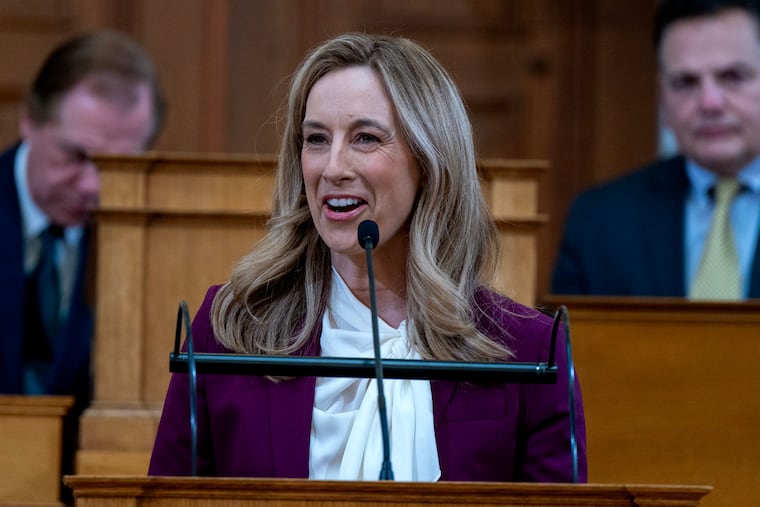
A nascent property tax relief program for New Jersey seniors has been at the center of budget negotiations between Gov. Mikie Sherrill and lawmakers as the state’s budget deadline quickly approaches.
That program, called Stay NJ, is expected to undergo changes that would slice the income eligibility by more than half, kicking off seniors that made hundreds of thousands of dollars and started reaping the benefit this year.
The benefit is currently available to seniors making less than $500,000, but that cap would be lowered to $200,000 under an agreement between the governor and legislative leaders, according to reports of closed-door budget talks. Those making less money would be eligible for a larger refund under the arrangement.
The proposal is a compromise between Sherrill, who pushed for cuts to the program, and House Speaker Craig Coughlin (D., Middlesex), a key player in budget negotiations who has championed Stay NJ.
As the name suggests, Stay NJ was created in 2023 to incentivize New Jerseyans to remain in the Garden State by providing refunds to eligible senior homeowners. The program was designed to start payments in 2026, so the very first checks had just begun going out when the first term governor presented her early March budget proposal.
She argued that the state could face a dire financial situation if there aren’t serious cuts.
Here’s what to know about the status of the Stay NJ program.
Is there a budget deal?
Sherrill, Coughlin, and State Sen. President Nicholas Scutari (D., Union) announced Tuesday that they came to a budget “agreement.” The closed-door deal wasn’t made public, and legislators continue to iron out the details ahead of the deadline this coming Tuesday.
They said the budget agreement totals $60.7 billion, the same total Sherrill proposed in March. The governor has touted her proposal as “fiscally responsible,” though it’s still the highest price tag in the state’s history.
The joint statement mentioned few details but cited a handful of measures, including Stay NJ.
The state leaders said their agreement ensures the program “is a sustainable benefit retirees can count on.”
The fate of other programs impacting South Jerseyans is less clear, including Rowan’s veterinary school, a program that provides healthcare to children that have experienced abuse, and resource centers that help Hispanic women get employment.
What is Stay NJ?
The property tax relief program issues refund payments to eligible seniors in quarterly installments. The first Stay NJ payments were issued in February with an average of $600 each, according to the state treasurer’s office.
Under the current policy, eligible homeowners over 65 years old who make under $500,000 a year are eligible to get refunds for as much as half their property tax bills. The refunds are capped at $6,500 in a year.
What did Gov. Sherrill want to change about Stay NJ?
Sherrill wanted to slice the eligibility cap in half so only seniors with an annual household income below $250,000 would qualify.
She also wanted to lower the maximum benefit to $4,000.
“That’s a fairer, more efficient use of taxpayer money,” she said in her budget address in early March.
Stephen Sigmund, a spokesperson for Sherrill, said at the time of her proposal that 90% of Stay NJ recipients would keep their benefits.
The AARP expressed outrage at her proposal as New Jersey seniors struggle with the cost of living. But critics of the program who believe it directs too much state money to higher earners praised her for wanting to rein it in.
So what’s actually changing?
According to reports of the budget agreement, Sherrill and legislators agreed on a compromise.
Sherrill agreed to steer an additional $100 million funding to the program, NJ.com reported.
Meanwhile, legislative leaders agreed to lower the income threshold to qualify for the program to $200,000, even lower than what Sherrill initially suggested.
And as part of the new plan, those earning the least would get bigger deductions, according to the report.
Seniors making $100,000 or less would qualify for up to $6,500; those making between $100,000 and $150,000 would be eligible for up to $5,000, and those making $150,000 to $200,000 would qualify for up to $4,000, according to the report.
Coughlin said at an AARP town hall that Sherrill’s proposed cap across the board of $4,000 was “too low,” and that he would “stand up for Stay NJ,” New Jersey Monitor reported earlier this month.
Spokespeople for the governor did not respond to a request asking for confirmation of the plan.