Tom Kean Jr. backs Trump on Iran and tariffs, if not local issues
Rep. Thomas Kean Jr. sought to distance himself slightly from President Donald Trump on Sunday as his Democratic opponent, Rebecca Bennett, reminded him of his years of loyalty to the president.
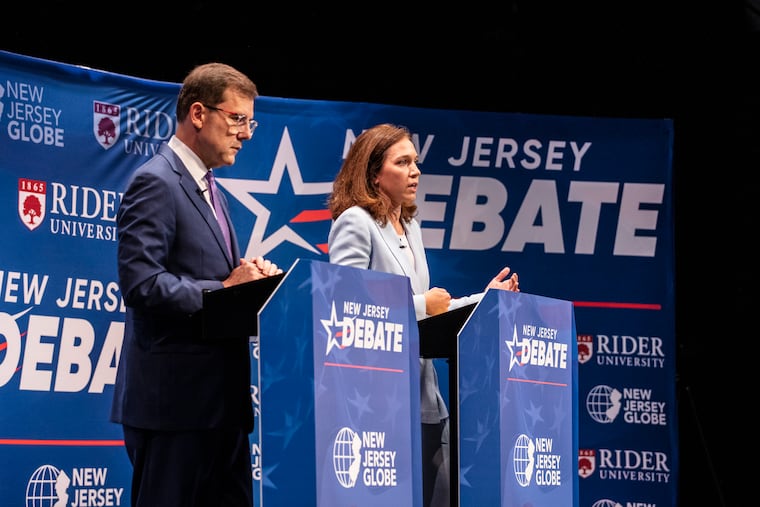
Rep. Thomas Kean Jr., a New Jersey Republican in a tight reelection battle, sought to distance himself slightly from President Donald Trump on Sunday as his Democratic opponent, Rebecca Bennett, pelted him with reminders of his years of loyalty to the unpopular president.
Kean began his opening comments during a debate in Rahway, New Jersey, by stating that he was willing to stand up to Trump’s efforts to strip funding from a critical Hudson River rail tunnel. “I will make sure that I counter anybody who gets in my way, including this president,” he said.
And for the first time, Kean clearly stated his opposition to the Trump administration’s plan to convert a warehouse in Roxbury, New Jersey, into an Immigration and Customs Enforcement detention center.
He also said he opposed Trump’s decision to change the name of Lake Ontario to “Lake America.” On key issues such as the war in Iran and the president’s tariffs, however, he maintained strong support for Trump’s policies.
“The president is justifiably using that to reduce costs for consumers,” Kean said of the tariffs.
His seat in New Jersey’s 7th Congressional District, which has seesawed between the two parties three times since 2018, is considered a prime pickup opportunity for Democrats as they try to retake control of Congress in November.
On Friday, in a sign of the volatility of the contest, The Cook Political Report shifted the race from “toss-up” to “leans” Democratic, despite the Republican Party’s 16,600-voter registration edge. An independent poll taken this month showed Kean trailing Bennett, a former Navy helicopter pilot.
Groups aligned with the Republican Party are pumping millions of dollars into the race. Kean and his Republican allies have booked $17.4 million in advertising, far outpacing Democrats’ $4.9 million, according to AdImpact, an ad analytics firms.
Sunday’s debate was the first time that Kean, 58, had subjected himself to extensive public questioning since being absent from Congress for nearly four months while being treated for what he has said was depression. The first question Kean was asked dealt with the lack of information he shared while hospitalized and missing from Congress from March through June.
“Nobody can plan a medical emergency,” he said. “And that was a medical emergency.”
Neither the debate’s moderators nor Bennett pressed him for additional details about his treatment or his fitness to continue to hold office for a third term.
“I’m glad that you got access to the care that you need,” Bennett said, “and I wish you a continued speedy recovery.”
Kean — the son and namesake of a former New Jersey governor — has never been known as a graceful speaker, even after 25 years as a politician. But he appeared confident Sunday as he parried for 90 minutes with Bennett. His wife, father and twin brother sat in the front row behind the moderators.
He stressed his experience and his unconditional support for Israel, noting that he would support sending U.S. troops to defend the country, if needed. He also tried to depict Bennett, a first-time candidate, as a puppet of the Democratic Party.
“You have not heard my opponent once tonight differ from the average Democratic member of Congress, who always votes the party line,” he said.
Bennett, 39, focused on Kean’s support for Trump’s policies, including his vote to slash Medicaid funding, as she worked to present him as out of touch with his constituents’ concerns.
She repeatedly mentioned his active stock portfolio and the trades he signed off on while absent from Congress, as well as the fact that he had not put his assets in a blind trust when he entered Congress, as he had promised to do. (Kean’s lawyer has said that doing so would preclude him from also taking “principled and pragmatic stands” against investing with foreign adversaries and selling American stocks short.) Bennett said she had sold all of her individual stocks before the race — although she refused, when pressed, to disclose the value of those sales or her net worth.
Bennett also spoke forcefully about the need to end the war in Iran.
“Any time we are going to put American service members in harm’s way, there needs to be a clear motivation, a clear objective and a clear exit strategy,” she said. “And we have not seen any of that from this administration.”
She repeatedly linked the war to the high price of gas as she stressed her goal of bringing down costs if elected. “The reason that we are seeing this increase in our gas prices,” she said, “is because of this unnecessary war.”
The two did share a moment of bipartisan agreement when asked about pineapple on pizza.
“I find that perfectly acceptable,” Kean said.
“I’ll eat it,” Bennett said. “But I wouldn’t put it on there myself.”
After the debate, the challenger lingered to take questions from reporters. Bennett said that if Kean opposes Trump’s efforts to block funding for the Hudson River tunnel, which is known as Gateway, he hasn’t been effective.
“Donald Trump has tried to hold up the funding for the Gateway tunnel,” she said, “and Tom Kean Jr. has been unable to do anything to make sure we’re actually going to get the funding back.”
Minutes after the debate ended, Kean quickly exited through a side back door, flanked by family members and aides.
He ignored a question about his differences with Trump as he climbed into a silver sport utility vehicle that was waiting for him near the exit.
This article originally appeared in The New York Times.