The CROWN Act gets closer to protecting Pennsylvanians from being fired for wearing Afros, braids, or locs
The act especially impacts Black men and women who are required to cut or straighten their natural hair, often using heat and harmful chemicals.
After being stuck in committee for four years, the Pennsylvania Senate passed the CROWN Act Wednesday with a vote of 44-3.
Passage of the act — an acronym for Create a Respectful and Open World for Natural Hair — means employers and school officials can’t bar people from jobs or schools for wearing their hair as it grows out naturally or choosing styles — box braids, twists, locs, or cornrows — that protect it.
The law applies to all Pennsylvanians, but especially impacts Black people. Black men who opt to wear locs or braids at work and school instead of close cropped Afros are often forced to cut them off.
In 2018, Buena Vista Regional High School wrestler Andrew Johnson cut his locks after a referee told him he could not compete in a South Jersey wrestling match with them.
But Black women, who, are often compelled and required to straighten their naturally curly coils in professional and school settings are the most will benefit the most from the new legislation.
“This law takes discrimination head on,” said Sen. Vincent Hughes (D-Pa.). “Natural hair is beautiful. This law protects Pennsylvanians by abolishing any notion that natural hairstyles are not appropriate in professional, educational, or public settings.”
Black women use scorching hot metal combs, flat irons, or blow dryers to press their manes into smooth styles. The hair remains straight until it gets wet and then it curls back up.
Some use relaxers. Stylists apply chemicals to the scalp to straighten the hair at the root, causing painful burns. This is a more permanent method, but the chemicals must be reapplied every few weeks when natural hair grows out.
In recent years, there has been growing concerns that frequent applications of chemical straighteners increase the risk of cancers of the reproductive system.
“That’s just too high of a price for conformity,” said Adjoa B. Asamoah, a Washington, D.C.-based Temple graduate and architect of the CROWN Act.
Asamoah worked with attorneys to draft legislation, and champions the bill in legislative houses around the country.
“I shouldn’t have to increase my likelihood of developing cancer to be upwardly mobile. That can’t be the cost,” she said.
Fed up with hair discrimination, Asamoah began working with lawyers on the CROWN Act in 2018.
California, New York, and New Jersey were the first states to pass the CROWN Act the following year. The U.S. House of Representatives passed the CROWN Act in 2020, but it got stalled in the Senate.
Pennsylvania is the 28th state to pass anti-hair discrimination laws joining New York, New Jersey, Delaware, and Maryland. Both Pittsburgh and Philadelphia enacted ordinances banning hair discrimination in 2020, but the Pennsylvania ruling protects people throughout the state.
Gov. Josh Shapiro is expected to sign the bill into law in the coming months.
The Pennsylvania bill amended the Human Relations Act, clarifying the term of race to include traits such as hair texture and protective hairstyles. The House passed the CROWN Act in 2023 but was later assigned to a Senate committee where it lay buried.
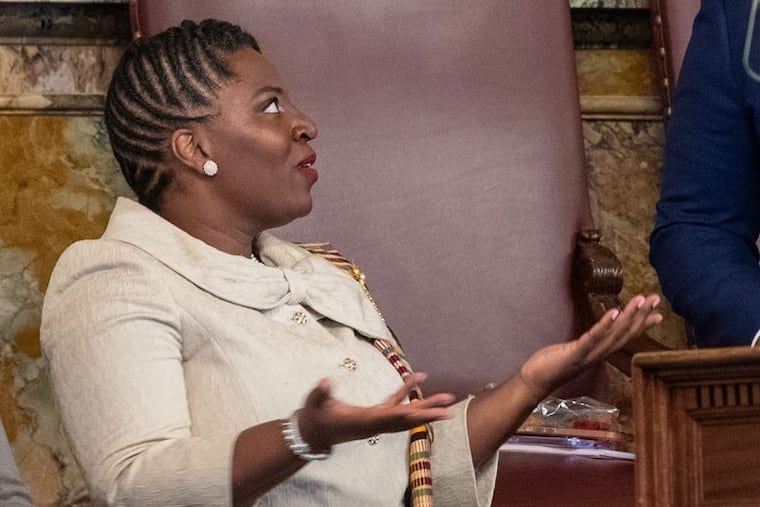
It passed the State House again in March, with a vote of 194-8, signaling strong bipartisan support. This time House Speaker Joanna McClinton (D., Phila.) a prime sponsor of the bill, refused to leave its fate up to chance. She worked with Republican Senate president pro tempore Kim Ward to move the bill to the Senate as part of the state’s budget negotiations.
“I told her the CROWN Act was an important piece of legislation for people in all the communities that we serve,” said McClinton, who wears her hair in natural protective styles. “I’m excited about what the future holds for women in the Commonwealth of Pennsylvania who won’t have to face another barrier to succeeding in the work place.
Former first Lady Michelle Obama recently reignited the discussion of Black women’s natural hair during interviews about her book The Look.
Obama didn’t wear braids during Barack Obama’s presidential term because she feared they would be a distraction, she recently told Sherri Shepherd on her daytime talk show.
However, upon returning to the White House in 2022 to unveil her official portrait, she wore braids gathered into a bun at the nape of her neck.
“I wanted to make a statement, ‘Y’all get out of our heads,’” Obama said. “I don’t want any man in any HR department making decisions about what is appropriate, how we look, [to be able to determine] our ability to wear wigs, locs, braids and extensions … Don’t hire or fire somebody based on something you know nothing about.”
Her comments drew ire of Republicans including Megyn Kelly who countered, saying the drama was all in Obama’s head.
That kind of disconnect, Asamoah said, is why the CROWN Act is needed.
“People have been discriminating against Black people’s hair for decades, and yes, it’s still happening,” Asamoah said.
“The important thing is that Black women can no longer be fired, passed over for a promotion, or have a job offer rescinded if we wear our hair in locks, braids, or twists … If someone tells you need to straighten your hair at your job, that’s now a violation.”