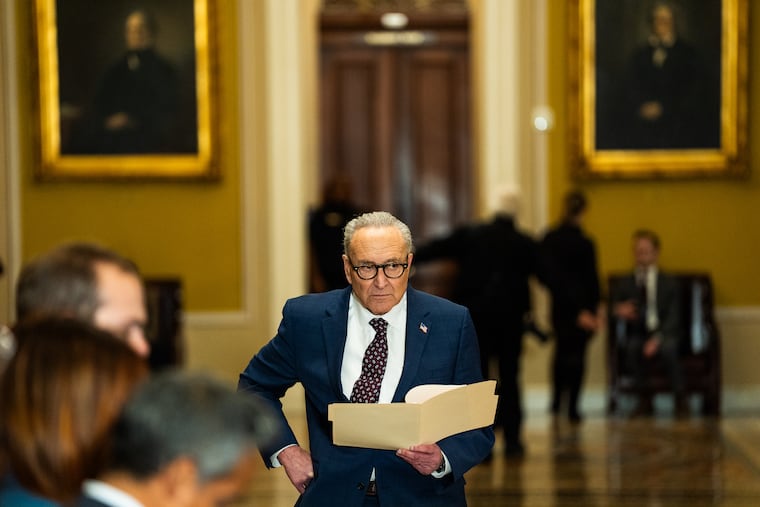
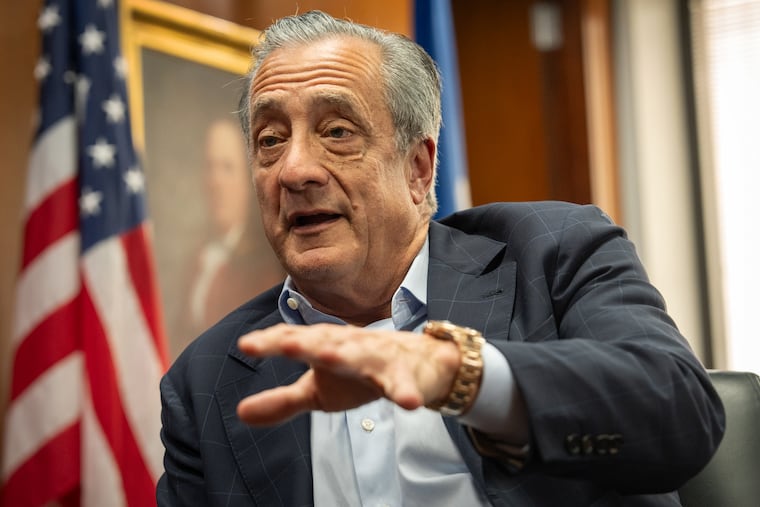
Bucks Sheriff-elect Danny Ceisler says he’ll act quickly to end controversial ICE alliance
The incumbent sheriff had defended his decision to assist ICE, insisting it would make residents safer and even potentially bring new funding and police equipment to the county.
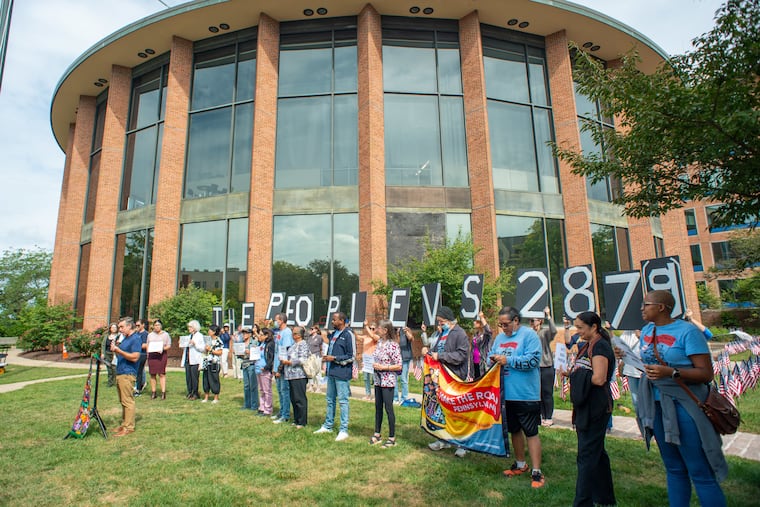
Bucks County voters on Tuesday did what protest and legal action could not, halting a controversial sheriff’s office alliance with ICE by electing a Democrat who has pledged to end the partnership.
Sheriff-elect Danny Ceisler said Wednesday that he will issue a moratorium barring deputies’ cooperation with ICE on his first day in office. From there, he said, he will figure out how to disentangle the sheriff’s office from the agreement signed by his predecessor.
Ceisler beat incumbent Republican Fred Harran by more than 10% of the vote in unofficial returns.
Ceisler and a cadre of immigration activists ― who saw an ACLU-led lawsuit falter ― had portrayed the election as the last chance to kill the affiliation, after a Bucks judge ruled last month that it had been legally implemented and could proceed.
Ceisler, an Army veteran who held a public-safety leadership post in Gov. Josh Shapiro’s administration, pledged during his campaign to “end this deportation partnership once and for all” if elected.
Harran, who led the Bensalem Police Department before being elected sheriff four years ago, said Wednesday that Ceisler will “have to answer for a person who becomes victimized by an individual that should have been deported. And he’ll have to sleep with that, and it’ll be on his head, not mine.“
His said his plans around the program had been misrepresented.
“Everyone knows my intentions. It was never making car stops on people who were dark-colored. My career speaks for itself in terms of my partnerships with the community.”
He had staunchly defended his decision to assist ICE, insisting it would make residents safer and even potentially bring new funding and police equipment to the county.
Ceisler called immigration the single biggest issue in this election.
“My goal was to provide an alternative which was a no-nonsense, reasonable approach to public safety,” Ceisler said Wednesday, noting that it was now “my responsibility to deliver on that.”
Officials with U.S. Immigration and Customs Enforcement declined to comment.
The partnership, which recently became active after months of planning, provoked backlash, including the lawsuit, public demonstrations outside the courthouse, and a repudiation by the Democratic-led Bucks County Board of Commissioners.
Nationally, only a few police agencies that signed on with ICE have dropped out of those agreements.
Ceisler’s victory was part of a Democratic sweep of county positions in a critical swing county that narrowly voted to elect President Donald Trump last year.
“I am walking on air,” said Laura Rose, a leader of Bucks County Indivisible, which supports immigrants and progressive causes. “Bucks County voters soundly rejected Sheriff Harran and his plan to turn county deputies into de facto ICE agents.”
In the spring, Harran and ICE officials signed what is called a 287(g) agreement, named for a section of a 1996 immigration law. It enables local police to undergo ICE training, then assist the agency in identifying, arresting, and deporting immigrants.
“Ceisler’s victory proves what we’ve always known ― 287(g) agreements don’t make us safer, they divide our community,” said Diana Robinson, co-executive director of Make the Road Pennsylvania, a plaintiff in the lawsuit.
The agreement with ICE “put Bucks County at risk,” and the election showed that “voters reject fear-based policies,” she said Wednesday.
Robinson and other opponents insist that turning local officers into immigration agents breaks community trust with the police and puts municipal taxpayers at risk of paying big legal settlements. ICE officials, however, say the program helps protect American communities, a force-multiplier that adds important staff strength to an agency workforce that numbers about 20,000 nationwide.
The number of participating police agencies has soared under Trump, with ICE having signed 1,135 agreements in 40 states as of Wednesday. Seven states, including New Jersey and Delaware, bar the agreements by law or policy.
The number of new agreements increases almost every day, and Trump has pushed hard for greater local involvement. On his first day in office he directed the Department of Homeland Security to authorize local police to “perform the functions of immigration officers” to “the maximum extent permitted by law.”
Shortly before the government shutdown, ICE was poised to begin backing its recruitment efforts with money, announcing that it would reimburse cooperating police agencies for costs that previously had been borne by local departments and taxpayers.
But activists focused on the difference between what Harran said he intended to do and the much broader powers conferred within the agreement with ICE.
Harran signed up for the “Task Force Model,” the most far-reaching of the three types of 287(g) agreements. It allows local police to challenge people on the streets about their immigration status and arrest them for violations.
Harran said his deputies would not do that. Instead, he said, they would electronically check the immigration status of people who have contact with the sheriff’s office because of alleged criminal offenses. Those found to be in the country illegally would be turned over or transported to ICE, if the federal agency desires, he said.
This suburban content is produced with support from the Leslie Miller and Richard Worley Foundation and The Lenfest Institute for Journalism. Editorial content is created independently of the project donors. Gifts to support The Inquirer’s high-impact journalism can be made at inquirer.com/donate. A list of Lenfest Institute donors can be found at lenfestinstitute.org/supporters.