‘More needs and less money’: Philly’s collar counties are preparing for tight budgets, tax increases
Counties are required by law to complete their budget for next year by Dec. 31. But they entered this year’s budget season facing uncertainty with federal funding and lack of clarity over state funds.
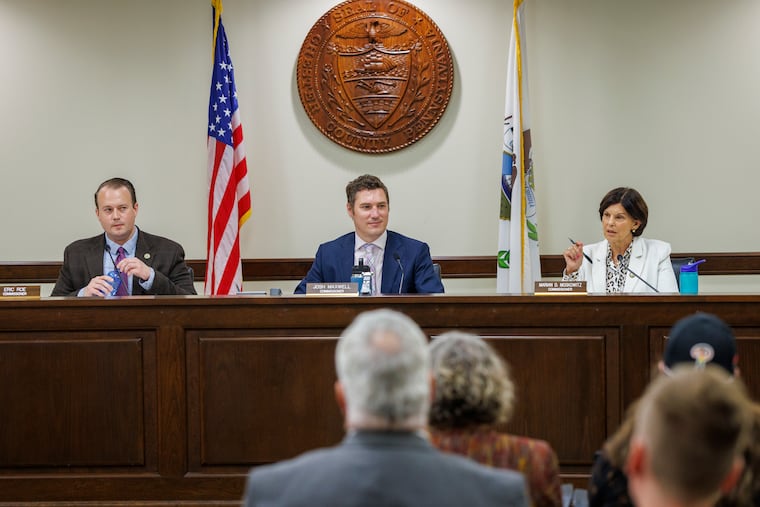
Across the Philadelphia suburbs, county leaders are tightening their budgets, and looking toward potential tax increases.
Counties are required by law to complete their budget for next year by Dec. 31. But they entered this year’s budget season facing uncertainty with federal funding and a lack of clarity over state dollars as lawmakers remained locked in a monthslong budget impasse that ended only Wednesday when the Pennsylvania General Assembly and Gov. Josh Shapiro approved a $50.1 billion budget.
“We were preparing for more needs and less money,” said Josh Maxwell, a Democrat who chairs the Chester County Board of Commissioners. And even as Washington and Harrisburg resolved their budget woes this week, they did little to resolve concerns at the county level.
The state budget included no funding for transit, a 2% cut to mental health spending, and stagnant funding on other services like 911 fees — frustrating local officials.
“I don’t think if the General Assembly had sent us a gold-plated demand or invitation to raise property taxes it could have been any clearer,” said Delaware County Council member Christine Ruether, a Democrat.
Counties in Pennsylvania can only increase their revenue by raising property taxes. By failing to provide additional funds for social services, county officials argued, the state had created a situation where counties would immediately or eventually have to raise property taxes.
“The people we serve … all their problems don’t suddenly go away because there’s a lack of funding to address the problem,” said Bob Harvie, a Democrat who chairs the Bucks County Board of Commissioners and is running for Congress.
“It will likely mean that this county will have to consider a tax increase because we need to meet the needs of those people.”
Bucks County has not yet released its proposed budget for 2026. But residents in Montgomery and Delaware Counties are likely facing tax increases.
On Thursday morning, Montgomery County unveiled its proposed budget for 2026, which included a 4% property-tax increase.
Delaware County’s executive director Barbara O’Malley told the all-Democratic council last week that the county would need to increase property taxes 19% to eliminate the county’s structural deficit. A healthy financial setting, she argued, was especially important as state and federal funding streams have become less reliable.
Both budgets were crafted before the state budget was released but county officials said they wrote the documents assuming stagnant funding from the state despite inflation.
“We kept it status quo,” said Dean Dortone, Montgomery County’s chief financial officer.
Chester County officials said they’ve taken a similar approach. The county, Maxwell said, had also looked for budget cuts throughout the year as federal grant cancellations created uncertainty.
“We’ve been cutting all year because we know that the federal and state governments are going to be flat or less funding,” Maxwell said, but if the state continues to leave funding flat for social services it will eventually have an impact.
“Over time it’s going to mean property taxes are ... going to go up more than they would have otherwise.”
Meanwhile, counties have spent the last several months backfilling for state funds that did not come during the impasse.
In Montgomery County, officials estimated the county had spent between $40 and $50 million from budget reserves to maintain services. Chester County officials estimated the county spent $40 million, while Delaware County officials reported spending $12 million monthly until October when the county was forced to reduce payments to social services providers.
Counties expect to be reimbursed by the state for those expenses, but it’s unclear how quickly those payments will come.
Delaware County declared a state of emergency Wednesday allowing them to more quickly distribute funds to local food pantries while the organizations wait for state and federal dollars to come through.
“It’s going to take a while for the money to trickle down and in the meantime if somebody can’t get food on the table it’s an issue,” Reuther said during the county’s board meeting.
This suburban content is produced with support from the Leslie Miller and Richard Worley Foundation and The Lenfest Institute for Journalism. Editorial content is created independently of the project donors. Gifts to support The Inquirer’s high-impact journalism can be made at inquirer.com/donate. A list of Lenfest Institute donors can be found at lenfestinstitute.org/supporters.