How 3 Pa. Supreme Court justices won retention — and why the process might never be the same
A new partisan tilt to the traditionally routine and sleepy judicial retention elections may create a ripple effects in the state’s highest court in the years to come, experts said.
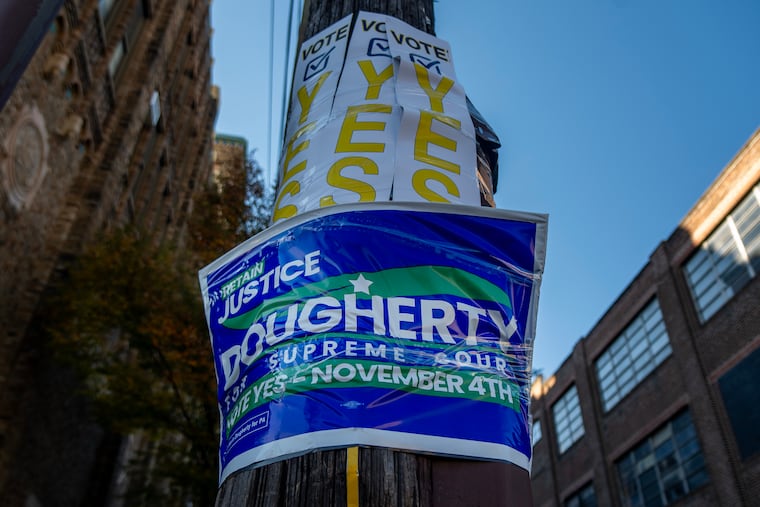
The biggest win for Pennsylvania Democrats in Tuesday’s election was a decisive victory for three liberal state Supreme Court justices.
Each of the justices — Christine Donohue, Kevin Dougherty, and David Wecht — will remain on the bench, with 62% of voters supporting their retention in a closely watched and historically expensive race. Pennsylvania on Tuesday saw 40% turnout statewide, which is higher than in most off-year elections.
Technically, the justices’ campaigns for retention were nonpartisan, and the jurists promise to continue to be nonpartisan actors while on the bench. But political battle lines emerged following a GOP effort to oust the three justices, who were originally elected as Democrats in 2015, to reshape the court’s balance. Democratic groups and their allies responded, outspending the Republicans 4-1 in a race totaling more than $15 million.
The justices’ nationally watched retention efforts garnered support from the state’s cities and suburbs — and from bellwether counties that voted for President Donald Trump in 2024 — as Democrats won up and down the ballot Tuesday in Pennsylvania and across the country. The justices even gathered support from some longtime GOP strongholds, according to an analysis by The Inquirer.
But a new partisan tilt to the traditionally routine and sleepy judicial retention elections emerged, and may create a ripple effect in the state’s highest court in the years to come, legal experts, party leaders, and academics said.
The justices had support across the state. Even some counties that voted for Trump in 2024 voted ‘yes’
Unsurprisingly, much of the “yes” vote to retain the justices can be attributed to the bluest and most populous parts of Pennsylvania. Montgomery County saw record turnout for an off-year election, and turnout for the state’s 8.9 million registered voters topped 40% statewide.
» READ MORE: The elections drew ‘amazing’ turnouts in both Pennsylvania and New Jersey
But a number of bellwether areas that often reflect how Pennsylvania will vote in presidential elections, such as Bucks and Erie Counties — as well as a handful of GOP strongholds — supported Trump in 2024, but also backed the efforts to retain the Democratic justices this year.
In all, 24 out of Pennsylvania’s 67 counties voted “yes” to retain the three justices. Of that group, 16 counties went for Trump last year, including some longtime GOP strongholds like Lancaster, York, and Cumberland Counties.
The comparison between the 2024 presidential election results and Pennsylvania’s lower-turnout, off-year election this year is not exact, said Christopher Borick, director of the Muhlenberg College Institute of Public Opinion. Democratic or independent voters upset with the Trump administration were more motivated to go to the polls this Election Day, compared with the high turnout in a presidential year like 2024 that brought out more GOP voters, he said.
» READ MORE: Party soul-searching, the Latino vote, and a South Jersey strategy: Takeaways from Tuesday’s election
Stephen Medvic, a government professor at Franklin and Marshall College, echoed that, adding that the anti-Trump voters and a “pro-Democratic wave” helped bolster the justices from facing a serious threat of losing their seats.
“These counties that went for Trump didn’t go by much. They were close enough in the presidential that you could’ve guessed in a big Democratic year … they were going to vote ‘yes,’” Medvic added.
The GOP ouster campaign against the judges was unsuccessful, but it still worked. In 41 counties, ‘No’ won
While the justices were ultimately retained, the Republican Party’s “vote no” campaign to oust them got through to most GOP-majority counties across the state.
Before this year’s Supreme Court election, judges and justices were almost always retained, and a majority of voters in every county voted in favor of their retention. Only one justice in the state’s history, Russell Nigro in 2005, was ever not retained. That ouster was due to a larger shake-up across Pennsylvania state government that year, rather than his ideology on the bench.
But that paradigm appeared to shift this year, following the GOP’s campaign to try to oust the justices — as three appeared on the retention ballot at once in a rare event — in hopes of eventually electing more conservative justices to the state’s highest court.
In 41 Pennsylvania counties, a majority voted against retaining the justices, an Inquirer analysis showed.
The GOP’s “no” campaign to oust the three justices was an effort to try to reshape the 5-2 liberal majority court ahead of the 2028 presidential election, and redistricting in the years that follow the 2030 U.S. Census. One Republican influencer, Scott Presler, called it a “once-in-a-lifetime opportunity” to change the makeup of the state’s highest court for years to come, citing some past decisions by the liberal majority court that Republicans disagreed with.
Voters were bombarded in the off-year election with commercials, ads, and mailers. More than $15 million was spent on the race, with most of the expenditures from Democratic groups.
As a result, the retention election was “contested more in a partisan space than some type of evaluation of their performance as a justice,” Borick said.
“It became more partisan in nature than any retention races ever had been before, with over $15 million in money spent on the race to sway Pennsylvania voters,” Borick said.
Experts don’t agree on whether retention races will continue to be partisan
There’s no agreement among legal experts, academics, or even party leaders about whether Pennsylvania’s judicial retention process will continue on a partisan track after this year’s multimillion-dollar campaign.
Eugene DePasquale, the Pennsylvania Democratic Party’s new chair and an attorney, said he hopes the parties won’t spend like this again in 2027, when two more state Supreme Court justices are up for retention, one conservative and one liberal.
But DePasquale said he can’t say for sure.
“My hope is that maybe once and for all, we defeated this being a political thing and we can let the voters get back to deciding whether the person has done a good job or not,” he added.
Sam Pond, a managing partner of Philadelphia-based law firm Pond Lehocky, which specializes in workers’ compensation, isn’t as hopeful about the future of judicial retention elections and said he is worried the political themes of this year’s race will threaten the court’s judicial independence.
“I think the politicization is here to stay,” Pond said. “It concerns me, because I think it really bastardizes and defeats the purpose of retention.”
There is a bit of a silver lining for those hoping retention elections won’t be entirely political, Borick said: While the state Supreme Court justices were retained with a resounding majority, the two Democrats elected to open seats on the state’s appellate courts were elected with a lower margin.
That means some Republican voters cast their ballot in support of the justices’ retention, while also supporting the GOP candidates in lower courts, he said.
“I don’t know whether this is going to be par for the course or not,” Medvic said. “A lot of resources were thrown at it, maybe too much, and in effect they just barely made a dent in the ‘yes’ vote.”
“I’m cautiously optimistic that we’re not going to turn retention elections into partisan battles from now on,” Medvic added. “But that’s certainly a possibility.”