Philadelphians are frustrated with the city’s snow storm cleanup. What does that mean for Mayor Cherelle Parker?
Snowstorms are infamous for their ability to undermine constituents’ faith in their mayors. The risk of fallout could be heightened for Parker, who campaigned on a promise to provide city services.
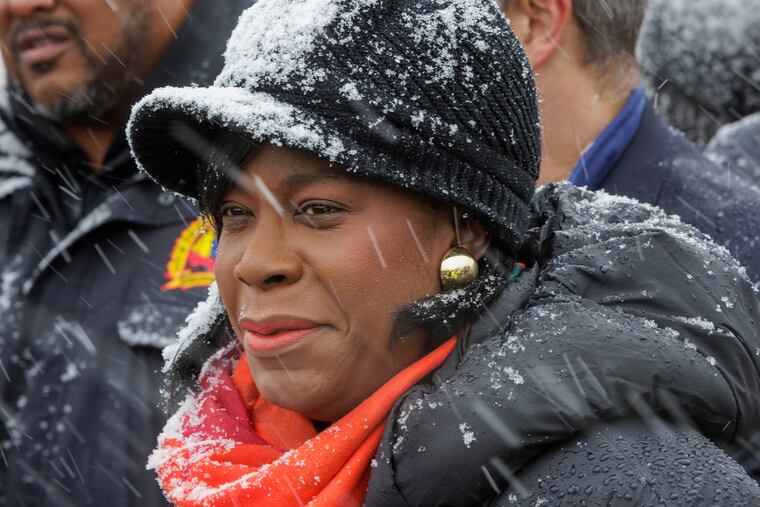
Mayor Cherelle L. Parker often says she isn’t a fan of “Monday-morning quarterbacks” and “expert AOPs” — her shorthand for so-called articulators of problems who don’t offer solutions.
Now she has a city full of them.
After a heavy snowfall followed by a week of below-freezing temperatures, Philadelphia’s streets are still laden with snow, slush, and ice; SEPTA buses are packed; and numerous cars are still stuck in the spots residents left them in 11 days ago.
The mayor acknowledged residents’ exasperation at a news conference at the Pelbano Recreation Center in Northeast Philadelphia on Wednesday, her first appearance dedicated to the city’s snow response since Jan. 26, the day after the storm walloped the region.
“For anyone who is frustrated right now about the ice, about the ability for all of the streets to be fully cleared, I want you to know that I understand,” she said. “Everybody can Monday-morning quarterback. … That’s cool. We can’t stop people from feeling the way they feel. But let me tell you something: We were prepared."
Parker said the city deployed 1,000 workers and 800 pieces of snow-removal equipment to deal with the emergency.
“We don’t promise to be perfect, Philadelphia,” she said. “We promise to go to war with the status quo and to fix things, to be doers. … We’re going to continue doing everything that we can to make sure all of this work is done.”
» READ MORE: Philly’s unplowed snow has slowed SEPTA and frustrated residents and businesses
Snowstorms are infamous for their ability to undermine constituents’ faith in their mayors. Over the years, they have been credited with ending political careers in Denver, New York, Chicago, and Seattle.
The risk of political fallout could be heightened for Parker, who campaigned on a promise to upgrade city services. When Parker ceremonially dropped the puck at Tuesday night’s Flyers game, she was greeted with boos from many fans at Xfinity Mobile Arena.
“Parker has pitched herself as the can-do mayor. ‘I’m not gonna deal with ideology. I’ve got principles, but I’m here to get the job done,’” said Randall M. Miller, a political historian and professor emeritus at St. Joseph’s University. “There’s that expectation you’re going to get this thing done.”
Parker also faced questions about her administration’s commitment to delivering core services during the eight-day city workers strike last July, when “Parker piles” of trash mounted around Philadelphia in the hot summer sun. She escaped that ordeal relatively unscathed after winning what she called a “fiscally responsible” contract largely in line with her goals.
» READ MORE: ‘They are my people’: Mayor Cherelle Parker on why she stood firm in the DC 33 city worker strike
But Miller said the mobility issues associated with snow removal have unique psychological effects for constituents.
“You’re cold, you’re miserable, and you’re trapped. You’re looking around like, ‘Who is confining me?’” Miller said. “You get angry at the mayor because the mayor said, ‘I’m here to provide public services,’ and public service isn’t being provided.”
The circumstances of this year’s winter weather emergency could also give Parker some breathing room. Municipal leaders in Pittsburgh, New York, Washington, D.C., and Providence, R.I., are all feeling the heat amid the polar temperatures, thanks to an unusually persistent cold snap that has hampered snow-removal operations.
» READ MORE: It’s ‘Groundhog Day’ in Philly this week as snow and ice persist
A slight reprieve in the weather this week, with highs peaking above freezing Tuesday and Wednesday, could help the city’s cleanup efforts. But officials warned Wednesday that temperatures are forecast to fall again by the end of the week.
“It’s not hyperbole to consider that we’re still under emergency conditions,” Dominick Mireles, who leads the Philadelphia Office of Emergency Management, said Wednesday.
Lessons from past Philly storms
By some measures, the city threw more resources at the latest storm than in the past, but got fewer returns.
After the legendary blizzard of Jan. 7, 1996, then-Mayor Ed Rendell deployed more than 540 snowplows, dump trucks, and other vehicles to clear away the record 30.7 inches of snow that fell over two days, according to an Inquirer report from that year. Officials bragged at the time that the fleet eclipsed the 300 vehicles marshaled by former Mayor W. Wilson Goode Sr. for the last major blizzard, in 1987.
Four days after the 1996 storm, the city said it hauled away 50,000 tons of snow, including truckloads famously dumped directly into the Delaware River and the Schuylkill. Officials also said that day that about 71% of roadways were passable, including around half of all side streets.
In February 2003, the city got walloped with 19 inches of snow, followed by days of subfreezing temperatures. Four days after that storm, the city said it had cleared 75% to 80% of city streets.
In 2016, Mayor Jim Kenney used 10,000 tons of salt and 1,600 city workers to clear away 22.5 inches of snow, clearing 92% of residential streets by day four — with a major assist from warmer temperatures a few days after the storm.
The 800 pieces of snow-removal equipment Parker cited that were used in the most recent storm are far more than even in the blizzard of 1996. She also said the city brought in a snow-melting machine from Chicago, saying workers had melted about 4.7 million pounds of snow, while scattering 30,000 tons of salt.
The result: More than a week after the end of the snowfall, about 85% of city streets had been “treated,” which includes salting, plowing, or both, according to the city.
But mobility nonetheless remains limited in much of the city, and officials pointed to the lingering icy conditions.
The prolonged freeze is “not unheard of, but it is unusual, and that stresses and makes the potential for a lot of not-great things to happen,” Mireles said. “It’s affecting the snow-fighting operation.”
An analysis of city plowing data shows that after the conclusion of the storm on Jan. 25, vehicles reached about 70% of city streets by the end of Monday. As the snow hardened, activity slowed by about a third on Jan. 27. Some parts of the city — including neighborhood-size chunks of South Philly — saw little plowing until five days after the storm or longer.
The psychology of snow
One reason voters punish mayors more harshly for failing to remove snow than for other problems is because of its omnipresence, from getting around the city to small talk about the weather, Miller said.
Even trash-collection problems tend not to get under residents’ skin to the same degree because they don’t shut the city down, he said.
“You are furious, and it’s day in, day out,” Miller said. “You’re constantly reminded.”
Parker has turned to private contractors to help with the snow-removal operation. And at Wednesday’s news conference, she touted the city’s efforts to deploy 300 “same-day pay and work” laborers earning $25 per hour to help manually clear streets and sidewalks.
» READ MORE: 300 ‘ambassadors’ to chip away at ice on Philly’s crosswalks
Those moves drew criticism Wednesday from the city’s largest union for municipal workers, District Council 33 of the American Federation of State, County and Municipal Workers, which went on strike for higher wages last summer.
“District Council 33 is deeply concerned by the City’s decision to bring in outside laborers for snow‐removal operations without any consultation or collaboration with our union," DC 33 president Greg Boulware said in a statement. “Our members deserve better, and the residents of Philadelphia deserve a snow‐removal strategy rooted in safety, foresight, and respect for the workforce that keeps this city running."
Miller said those efforts show the city is doing everything it can to clear the city’s streets and sidewalks.
“There’s been a great effort to try to deal with it, but Philadelphia is a very difficult place to manage in terms of snow because it’s got so many older streets,” he said.
But, he said, hearing about the city’s efforts is cold comfort to residents struggling to navigate their neighborhoods.
“The major thoroughfares, they’ve done a pretty good job. But folks are concerned with their neighborhoods. They’re not concerned with if they go down to Fourth and Market,” he said. “Once you start to hear those kinds of complaints, it’s hard to contain it.”
Parker said complaints will not deter her team. “Whenever we’ve been dealing with something challenging in government … there are some people who are expert articulators for problems,” she said.
Her staff, she said, “is not a team of expert AOPs.”
“This is a team of subject-matter experts who are doers and they are fixers, and we don’t cry,” she said. “Our job won’t be done until every street in the city of Philadelphia is walkable.”
Staff writers Ximena Conde and Anna Orso contributed to this article.