Funding for Mayor Cherelle Parker’s H.O.M.E. initiative will be delayed until next year
Council postponed a vote on legislation setting the program’s first-year budget, as some members seek to prioritize lower-income residents.
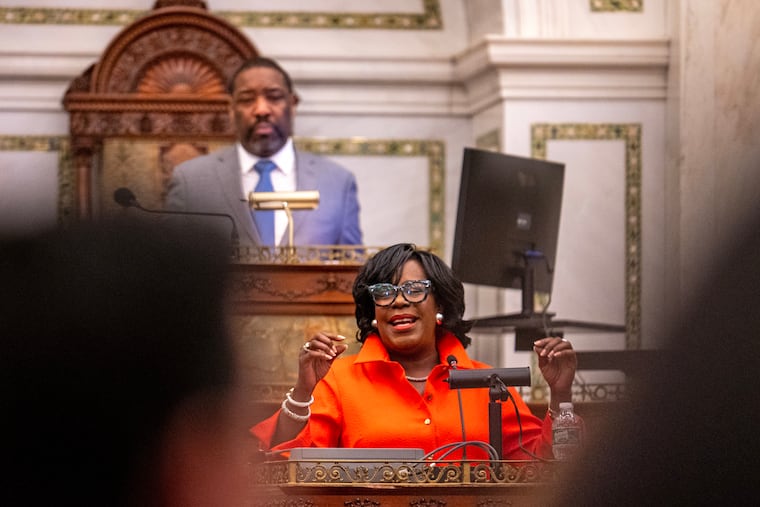
Mayor Cherelle L. Parker promised to build or preserve 30,000 homes in her first term. But much of her plan to reach that goal now won’t get underway until her four-year term is more than halfway over.
City Council this week again delayed a key piece of legislation that needs to pass before the Parker administration can sell hundreds of millions of dollars in city bonds, the primary source of funds for the myriad housing programs being created or expanded through the mayor’s Housing Opportunities Made Easy initiative, or H.O.M.E.
The delay comes as lawmakers negotiate to amend the legislation — a resolution setting the first-year budget for H.O.M.E. — to increase spending levels beyond the currently proposed $195 million and to lower income eligibility thresholds for some programs, prioritizing poorer residents.
The most recent setback came this week, when Council President Kenyatta Johnson canceled a Monday hearing to advance the resolution and declined to reschedule it before Thursday’s regular Council meeting, when the administration said the proposal would need to receive final approval for the first $400 million round of bonds to be sold in 2025. (The city plans to sell a second and final $400 million tranche of bonds in 2027.)
The administration sent Johnson’s office an initial draft of the resolution in July, but the Council president has repeatedly delayed advancing the measure throughout the fall.
» READ MORE: Here’s how Mayor Parker plans to spend $800 million on housing
“It is critically important to get the first-year spending plan right because what is agreed upon in the first year will influence all future spending for the H.O.M.E. program,” Johnson said in a statement explaining the cancellation of Monday’s hearing. “It is also essential that the final legislation include spending priorities important to City Councilmembers.”
Parker is known as a hard-line negotiator who rarely cedes ground, and Johnson’s delays might be meant to send the signal that if she doesn’t bend on Council’s demands, he won’t meet her timelines.
The saga marks a rare moment of discord between Parker and Johnson, who have worked hand in glove on most issues since both took office in January 2024 — including the passage of the initial package of legislation related to H.O.M.E. last spring.
» READ MORE: Mayor Cherelle Parker and Council President Kenyatta Johnson are trying to bring back the ’90s in City Hall
In a hearing last week, Johnson appeared to side with lawmakers, led by Housing Committee Chair Jamie Gauthier, who were pushing for the administration to lower income thresholds for some H.O.M.E. programs, saying the city should prioritize the neediest Philadelphians.
Parker has proposed expanding income eligibility requirements in some cases so that the programs can also be accessible to middle-class residents, saying she does not want to pit “the have-nots vs. the have-a-littles.”
‘Pit one against the other’
Even with the bonds delayed until next year, the mayor does not appear to have given up the fight to maintain her vision for the housing initiative. At an unrelated Council hearing on the school district on Tuesday, Parker brought up the H.O.M.E. initiative unprompted.
She then called out four Council members who have middle-class constituencies that are likely to benefit from increased income thresholds for housing programs: Curtis Jones Jr., whose district includes Roxborough and Overbook; Anthony Phillips, who represents East Mount Airy and West Oak Lane; Mike Driscoll, of the Lower Northeast; and Katherine Gilmore Richardson, who represents the city at large but is a Democratic ward leader for Wynnefield.
“I am unapologetic about making sure that constituents represented by you … should not be left out of any investment that we make in the city of Philadelphia,” Parker said. “Every community can be lifted up with the work that we are doing, so I won’t let us pit one against the other.”
The remarks, however, effectively pitted members with poorer constituencies against those with middle-class bases. Johnson represents Southwest Philadelphia and the western half of South Philly; Gauthier’s district covers much of West Philadelphia.
Despite the dustup, it remains unlikely that a lasting fissure has emerged in Parker and Johnson’s relationship, given that they still share many policy priorities and can benefit each other politically.
“Council President Kenyatta Johnson and I have an amazing working relationship,” Parker, a former Council member, said in an interview Monday. “Council has a right to do its due diligence. If I hadn’t been there, if I wasn’t a former staffer in there, maybe it would be foreign [to me]. No. We’re going through the process, and I have to trust the process.”
Additionally, Johnson standing up for Council members’ concerns over the H.O.M.E. budget may help shield him from questions about whether he is overly compliant with the mayor’s agenda.
“Both branches of government remain committed to ensuring the H.O.M.E. program is implemented transparently, equitably, and in a way that maximizes benefits to Philadelphia residents,” Johnson said in his statement. “Taking extra time to finalize these critical elements will result in a stronger, more effective program.”
Tracking progress
The administration is not waiting for the H.O.M.E. bonds to be sold to start notching wins for Parker’s 30,000 housing units goal. The city’s Philly Stat 360 website has already begun tallying units built and preserved during her tenure.
To be sure, some of the mayor’s strategies for the H.O.M.E. initiative do not require bond money. For instance, Parker has led a shake-up of the Land Bank, which she hopes will accelerate the redevelopment of unoccupied city-owned parcels into housing, and she won Council approval last spring for zoning changes meant to streamline building.
But the potential infusion of $800 million is undoubtedly the centerpiece of the initiative. The money will help launch programs like Parker’s One Philly Mortgage, which aims to provide 30-year fixed-rate loans to qualified homebuyers, and will buttress existing ones like the Basic Systems Repair Program, which has been credited with preventing the displacement of low-income residents who end up moving if they cannot afford needed home repairs.
“It’s never been done in the history of our city, and we do that together in partnership with each other, and that’s what we’re working to do right now,” Parker said.
Staff writers Jake Blumgart, Kristen A. Graham, and Anna Orso contributed to this article.