The danger next door
Hundreds of Philadelphians live next to dangerous abandoned buildings. L&I stopped using a tool meant to track vacant properties.
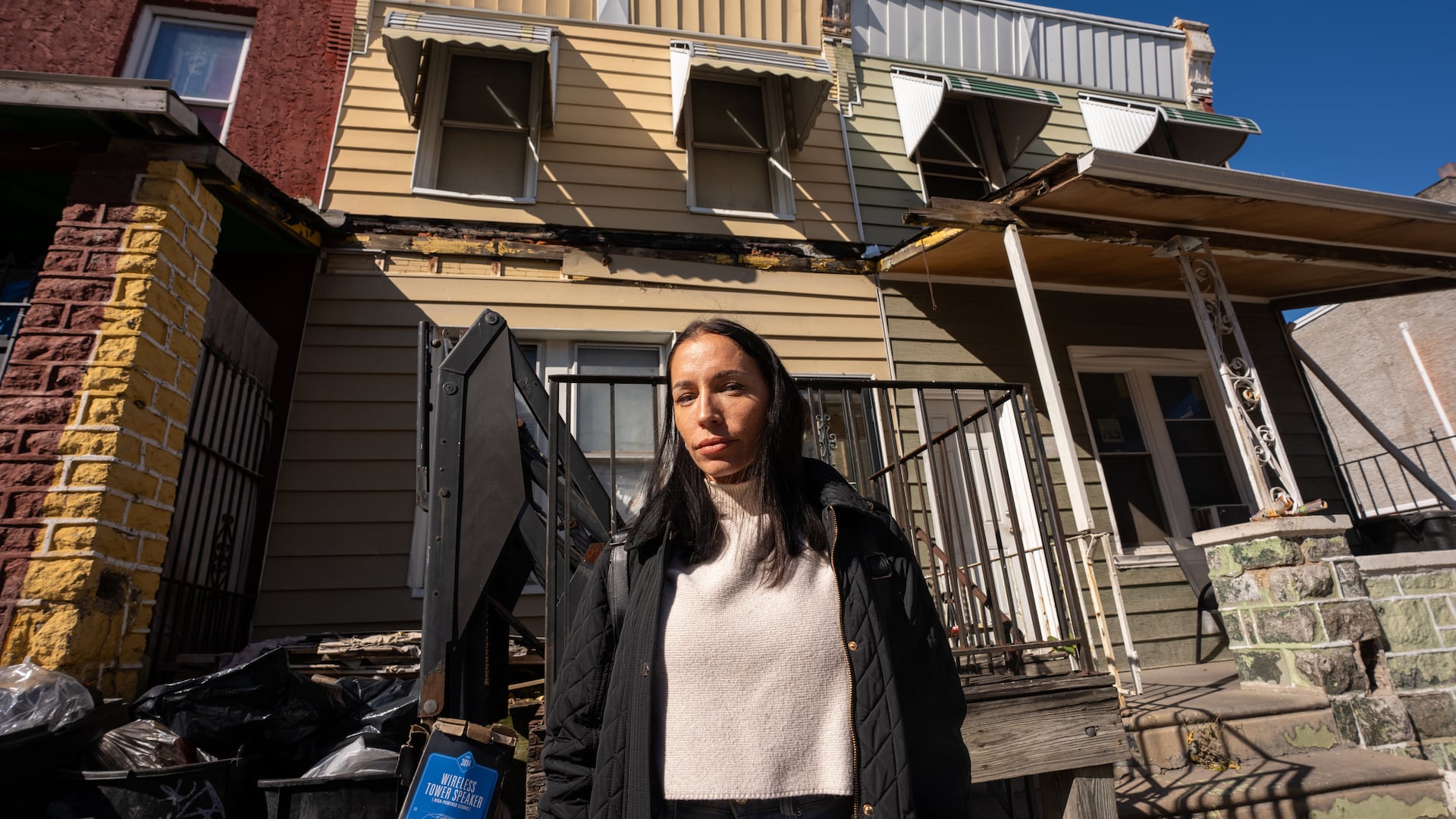
Emily Phillips and her family never slam doors or walk too heavily inside their North Philadelphia rowhouse. They’re afraid of what too much movement could do to the vacant house next door.
In early August, a back window and part of a wall came crashing down during harsh winds and rain. An inspector for the city’s Department of Licenses and Inspections declared the vacant rowhouse “imminently dangerous,” which means it is at risk of collapsing.
“I never know when something’s going to actually happen,” Phillips said in late October. “We know it’s just a matter of time. … I’m so scared right now.”
Across Philadelphia, families are living in a limbo of anxiety next to buildings that the city has determined are unsafe or imminently dangerous. The buildings at greatest risk of collapse are usually vacant.
Philadelphians rely on the city to keep an eye on vacant properties that are or could become dangerous. And in 2016, the city rolled out a method for determining which properties were likely to be vacant. L&I’s commissioner at the time said the inventory tool was making the department more proactive in protecting the public from deteriorating vacant buildings.
But L&I officials now say the department no longer uses the tool. They said the department mainly relies on residents’ complaints and its list of vacant property licenses — which L&I admits is a massive undercount — to monitor empty buildings.
L&I points out that property owners are responsible for securing vacant properties and repairing dangerous buildings, and the department steps in as resources and laws allow.
Around the time Inquirer reporters spoke with Phillips, the city’s spreadsheet of likely vacant properties listed about 8,000 vacant buildings — a potentially serious threat to their neighbors. An Inquirer analysis of the city’s list of imminently dangerous buildings showed that 79% of those also appeared on the list of likely vacant buildings.
Just under half of those vacant and imminently dangerous buildings were rowhouses, which are especially risky to neighbors because of shared walls. This risk is not borne equally by all of Philadelphia’s residents.
Nearly eight in 10 of all such rowhouses are in the poorest 25% of the city’s zip codes. The zip code with the most such rowhouses — 19132, where Phillips lives — has a median income of $31,000, according to the latest Census Bureau data. Philadelphia’s median household income is $61,000.
Seven in 10 vacant rowhouses that the city identified as imminently dangerous are in the 34% of the city’s zip codes that are predominantly Black. Roughly nine in 10 residents in 19132 are Black.
Dianna Coleman, a community activist who lives in Southwest Philadelphia, called vacant properties “one of Philadelphia’s most pressing and overlooked crises.”
While we recognize that the city has taken steps ... the pace is way too slow, the resources too scarce, and the strategy too weak.
When Coleman and a group of residents in Southwest and West Philadelphia came together last summer to organize around quality of life issues, residents’ top concern was fixing vacant properties. They partnered with the grassroots social justice nonprofit OnePA and launched their first campaign — asking the city to deal with abandoned buildings and vacant lots.
“While we recognize that the city has taken steps — demolishing some buildings, addressing some lots — the pace is way too slow, the resources too scarce, and the strategy too weak,” Coleman, cochair of OnePA West/Southwest Rising, said at a news conference this summer. “Unsafe buildings are left standing for years, growing more hazardous, pulling down property values, and pushing people out of their homes.”
The city’s questionable vacancy data
About a decade ago, the city started using an algorithm that takes feeds from a variety of datasets (such as whether a property has had its water cut off) to determine whether a property is likely to be vacant.
City officials celebrated the tool when it launched.
“Protecting the public from deteriorating vacant, abandoned properties as they grow more and more likely to collapse is critical to L&I’s mission,” former L&I Commissioner David Perri said in a 2016 news release announcing the index. “The Vacant Property Model and dataset are making us more proactive and strategic in carrying out that mission.”
But the reliability of the city’s list of likely vacant buildings and lots was recently called into question by individuals who have worked closely with the tool and collaborated with city officials in the past.
For more than three years, Clean & Green Philly, a nonprofit that — until its closure earlier this year — used data to help Philadelphians deal with vacant properties in their neighborhoods, relied on the city’s tool in combination with other data to identify vacant properties in greatest need of addressing.
But last year, founder Nissim Lebovits and the organization’s former executive director, Amanda Soskin, noticed something was wrong.
For years, the city’s list of suspected vacant properties had hovered somewhere around 40,000 records — buildings and land combined. But then, according to Lebovits and Soskin, that number plunged to around 24,000 in June 2024.
“And at first I was like, ‘OK. Something’s probably broken,’ and we looked into it,” Lebovits said. “And we realized that the city’s actual underlying datasets were no longer reporting the same number of vacant properties.”
The spreadsheet was showing only about 14,000 records as of this June, according to Lebovits and Soskin.
Then at some point between June and early November, the index grew to about 37,000 total properties.
Inquirer reporters began investigating the connection between vacancy and structural deficiencies in buildings after the April collapse of an abandoned rowhouse in Sharswood. At that time, L&I offered the vacancy index while asserting it could not provide detailed information about the data and referring reporters to CityGeo, the department that developed and maintains the index.
At no point during an hour-long interview with the department’s chief data officer in early June did city officials mention any concerns about the reliability of the data.
Reporters learned about issues with the data when Lebovits and Soskin wrote an article for The Inquirer’s opinion section later that month detailing their concerns. They wrote that city sources told them the process of collecting and publishing vacancy estimates “was quietly discontinued after [Mayor Cherelle L.] Parker took office.”
In an email, a CityGeo spokesperson said the city has not stopped updating the index, asserted that its accuracy depends on continued updates from various departments, and noted that CityGeo pauses updates “every few years” for “a month or so” to ensure the tool continues to work, most recently this past summer.
The spokesperson did not respond to questions about why the index’s size had varied so greatly recently. Lebovits and Soskin told The Inquirer that nobody from the city reached out to them after their article was published.
“My big takeaway here is that the lack of transparency around this dataset is a major liability,” Lebovits wrote in an email. “Having so little accountability regarding data production and quality seriously hampers any community groups trying to use these data and undermines the credibility of the City’s vacancy work.”
‘Very, very scary’
When Phillips’ landlord, Samantha Wismann, bought the house on North Woodstock Street in 2020, she didn’t know that its neighbor was vacant.
Wismann noticed the house looked a little shabby, but it wasn’t until Phillips moved in the following year that the women saw no one lived there. They didn’t know how long it had been vacant, but they watched it quickly deteriorate.
Most pressing back then was the collapsing porch roof, which was dragging down the roofs of the porches on either side of it.
Someone eventually tore it down. But the rest of the home remains in disrepair.
“It’s very, very scary,” Wismann said in October, “because eventually, if it’s not handled, it’s gonna come down.”
Cracks snake between the homes.
From the women’s backyard, through the door-sized hole in the back of the neighboring house, they can see past splintered beams and an abandoned refrigerator, beyond the staircase that leads to the second floor, and straight through to the front door.
Then there’s the tree that’s growing inside the vacant house. It has pushed outward through bricks and plaster and busted a second-story window. The tree’s branches tower over the homes, and some have reached the window of the bedroom where Phillips’ grandchildren stay.
L&I’s Contractual Services Unit is responsible for inspecting unsafe and imminently dangerous properties and administers the city’s demolition program. The unit has 10 members and openings for two more inspectors, said Basil Merenda, commissioner for L&I’s Inspections, Safety & Compliance division.
“We’re out there doing our job,” he said. “We’re out there making sure that these unsafe and [imminently dangerous] properties are properly addressed through procedures and that public safety is always being maintained.”
But a 2024 report by the City Controller’s Office said the unit used to have 15 inspectors, which the office said was not enough to keep up with inspections of unsafe and imminently dangerous properties.
Merenda said L&I is “making do with what we have” and mobilizes inspectors in other units when needed.
After L&I declares a property to be unsafe or imminently dangerous, it must issue notices to the property owner, who is responsible for repairs. The department can take unresponsive owners to court and pursue demolition in emergency situations, such as when a property is likely to collapse, is next to an occupied building, and has recent structural failures, Merenda said. The city demolishes imminently dangerous buildings in order of the risk officials determine they pose.
The city charges owners for tear-down costs and places liens on properties if they do not pay.
L&I was unable to say how many such tear-downs the department has conducted this year and referred questions about the cost of demolitions — and the proportion of those costs recouped from owners — to the city’s Department of Revenue. The revenue department did not provide any figures to The Inquirer.
“In many, many cases, property owners surface at the last minute and request a continuance, request a temporary restraining order from us going in and demolishing the property,” Merenda said. “And you know, that’s the purview of the courts. It’s beyond us.”
In the meantime, people living next to dangerous properties are left in the dark.
Frustrated with L&I
After the back of the abandoned rowhouse on North Woodstock Street opened up this summer, Phillips led an L&I inspector through her home so he could see.
“He went in the backyard, he looked over and was like, ‘My god!’” Phillips said. “I said, ‘Yeah, I can see right through their house.’ And he looked up and was like, ‘It’s a tree!’ I said, ‘Yeah, the tree is pushing the house out.’”
The inspector put an orange “imminently dangerous” notice on a front window, and Phillips and her landlord thought they wouldn’t have to worry much longer. But days after the notice went up, it was ripped down.
The property has attracted rats and mice. Water leaked into Phillips’ basement until her landlord reinforced the shared wall with concrete.
For months, her landlord got no response from the city to her calls and emails asking for help.
On Nov. 20 — 3 ½ months after the partial collapse — an L&I inspector visited the vacant rowhouse to post a “final notice” that the owner must repair or demolish the home or else the city will have it demolished.
Kate and Dan Thien are trying to live with the vacant property next to their rowhouse in Port Richmond as they wait for the city to respond to their 311 complaints.
When they bought their house in February 2024, they saw that the neighboring backyard was a mess, but they didn’t know the house was vacant.
Renters who had lived in what is now the Thiens’ home had used and maintained the neighboring backyard. But it quickly became overgrown. Neighbors later told the Thiens that the home had been vacant for more than a decade.
“Pretty much the entire neighborhood knows about this house,” Kate Thien said.
She and neighbors on the other side have filed complaints with the city. The property has racked up 19 violations since 2012. Public records show that the city cited the property for “high weeds” last fall and most recently inspected it last December. The property passed inspection.
A year later, a weed tree’s branches stretch above and behind the Thiens’ two-story home. Tree roots are growing into their home’s foundation and cracking the concrete. Trees are “very rapidly growing” as Thien waits for the city to do something, she said. She worries about her home’s property value as the situation worsens.
“It’s not going away,” she said.
Annette Randolph and her husband, Dennis, live in a Point Breeze rowhouse next to a home that’s been vacant for more than a decade and that the city classifies as unsafe, a step below imminently dangerous. Four generations of her family have lived in her home. She hopes she’s not the last.
A tree growing inside the vacant house burst through its back roof, next to a tarp-covered hole. Randolph has had to repair her own roof because of damage from next door. Water gets into her basement.
The home’s legal owners are dead. A scheduled sheriff’s sale in 2011 for overdue property taxes gave Randolph hope for a resolution. But right before the sale, someone paid part of the tax bill to stop it.
Now, “for sale” signs hang in the front windows, and a contractor showed up last week. Randolph hopes any work on the house won’t damage the one she’s called home for 66 years.
She has lost track of the number of times she’s called 311 about the situation. She’s felt helpless. When she needed new homeowner’s insurance, companies told her they wouldn’t insure her or would charge more because of the attached vacant and unsafe house.
“L&I and the city I blame for allowing this type of stuff to happen,” Randolph said.
Merenda said L&I hears neighbors’ complaints, “and we’re going to try to take action as efficiently and properly as possible.”
“I want to make, during my watch, L&I more accessible, responsive, and accountable to the neighbors, stakeholders, contractors, developers, average citizens, the City Council,” he said.
Neighbors band together
In September 2024, OnePA West/Southwest Rising launched its campaign to get the city to deal with abandoned properties.
The group created a list of 20 of the worst ones as submitted by neighbors. Among the vacant buildings, some had collapsing porches, one’s basement had flooded and damaged a neighbor’s house, and one’s walls were crumbling. Some had squatters, including a property where human waste was dumped in the backyard.
City Councilmember Jamie Gauthier’s office got the group a meeting with staff at L&I this January.
As a result, this summer, the group celebrated successes: five lots cleaned by the Pennsylvania Horticultural Society, three properties cleaned and sealed by the city, five properties whose owners the city took to court, and three properties that were repaired and returned to use.
The group believes it was able to get L&I to act because it had the weight of a Council member behind it.
“I do think L&I is overwhelmed. I don’t think they have enough staff to really stay on top of this,” said Eric Braxton, project director for OnePA West/Southwest Rising. “But clearly there are people in leadership that care about our communities and are trying to do the right thing.”
Now the group plans to push for systemic change. It wants the city to make small repairs to stabilize vacant buildings and charge the owners.
“There’s a gap in the system when it comes to dealing with unsafe abandoned buildings,” Braxton said. “The result of that is that those buildings just get worse and worse until they are imminently dangerous and have to be demolished.”