The Sixers need to reconnect with the region. Jameer Nelson is their best hope.
Nelson was quick to point out that he's from Chester but was "adopted" by Philadelphia. That matters, and that's why his voice is so important in the Sixers' decision-making process.
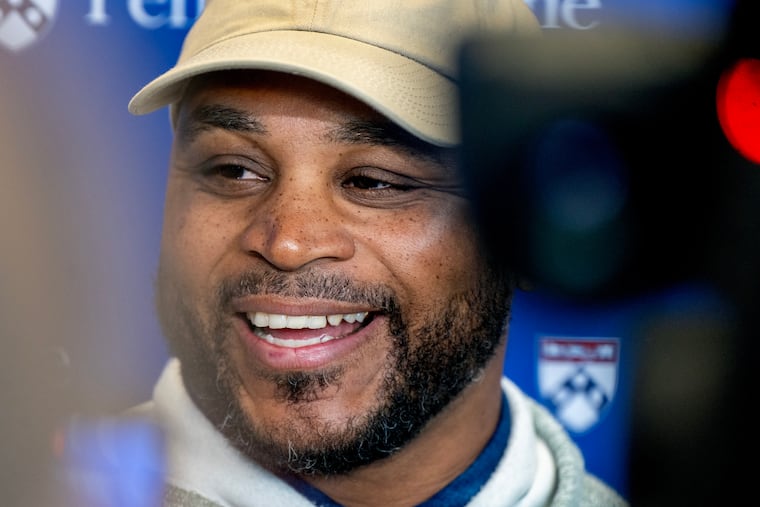
Jameer Nelson took care to draw a distinction that was important to him and should be important to the franchise that has promoted him.
“Growing up in this area — everybody keeps saying Philly — I’m a Chester native,” he said Monday. “Philly adopted me.”
There’s a difference between the two, as anyone who has lived and followed basketball in the Philadelphia area long enough can tell you. Chester is a small, forever struggling city with its own glorious hoops history, with a high school program that has won eight PIAA boys basketball championships, with its own heroes and legends, the 76ers’ executive vice president of basketball operations among them.
When Nelson mentioned his favorite players as a kid, he name-dropped Charles Barkley and Allen Iverson. Any Chester aficionado would have chided him for leaving John Linehan and Zain Shaw off his list, and he laughed in acknowledgment of the omission.
That contrast might not seem to mean much. But it said everything about Nelson’s potential value to the Sixers, to his ability to provide at least some of the institutional memory and understanding of the market that the organization has lacked for so long. “No one more capable,” Phil Martelli, Nelson’s coach at St. Joseph’s, said in a text message Monday.
He knows Philadelphia and Chester and knows they aren’t quite the same. He knows what it was like here in 2001, when Iverson led the Sixers to the NBA Finals, and he knows what it was like in early 2004, when Nelson himself led the Hawks in that magical unbeaten regular season and that run to the Elite Eight.
He knows what will play here and what won’t, who can play here and who can’t.
“Understanding the landscape and understanding what this team means to the city, I can bring that,” said Nelson, who had a 14-year playing career in the NBA. “I can help everybody in the building understand that because I understand it. Growing up, I was one of the people who are doing what people are doing now.”
Too few people among the Sixers’ previous power players have had that background, and no member of the current leadership has it. Harris Blitzer Sports & Entertainment president Bob Myers lives in California. Mike Gansey, the Sixers’ new president of basketball operations, reminded people at the team’s headquarters in Camden that he “just got here” after growing up in the Cleveland area and working for the Cavaliers for 15 years. And managing partner Josh Harris splits his time between Miami and his $28 million mansion in the Georgetown section of Washington, parachuting into town for home games and the latest hiring/firing news conference.

Mike Sielski alerts
Nelson still is third in the pecking order at best within the Sixers’ basketball hierarchy, behind Myers and Gansey. But at least his new title might afford him a louder, stronger voice when it comes time to draft, sign, or trade for players the Sixers hope to have here for a while. Myers said aloud Monday what anyone who has followed this team already knew to be true: “We’ve got to find an identity. We just don’t have one.” That assertion goes beyond the Sixers’ style of play.
It gets to the character and attitude of the players, the coaches, everyone in the organization. It gets to the Sixers’ giving themselves a better chance of making better decisions. For every time they’ve recognized that Tyrese Maxey or VJ Edgecombe had the mental and emotional makeup to cut it here, they’ve failed to see that Ben Simmons and Markelle Fultz didn’t, that James Harden and Paul George and mercenaries like them, stars who require a softer setting, were unlikely to thrive or to be embraced.
“Anytime you can put somebody in a leadership role who understands and embraces it and is reared here, it’s an advantage,” Myers said. “I don’t know to say it was a negative last year or in years past, but I do think most people would agree this is a uniquely spirited community, and having someone who knows that and grows up and feels that — and the responsibility that comes with it — I love that Jameer is in the place he’s in.”
» READ MORE: The Mike Gansey era has begun. Where do the Sixers go from here? | David Murphy
The Sixers under Harris need Nelson’s instincts and experience and all the additional help they can get in that regard. A longtime NBA executive noted recently that in professional sports, you often can trace a franchise’s excellence or stability to the geographical proximity and familiarity of its owner. Does the person in charge live where the team is based? Did they grow up there? Do they truly understand the city and its fan base?
Spurs managing partner Peter Holt has deep familial ties to San Antonio. The Heat’s Micky Arison has lived most of his life in Miami. Joe Lacob was a Warriors season ticket-holder for nearly 10 years before he bought the team in 2010. Jeffrey Lurie relocated from Boston and took the time to learn what Philadelphia was all about. Ed Snider and John Middleton were already here to know.
James Dolan is a surveillance-happy nepo-Boomer who, after a quarter-century of mismanaging the Knicks, finally stumbled into ecstasy thanks to Leon Rose, William “Worldwide Wes” Wesley, and Jalen Brunson. But Dolan’s also a native Long Islander who felt the heat in New York — the city where rebuilding isn’t allowed — every time one of his cockamamie attempts to quick-fix his franchise went awry.
» READ MORE: The NBA thinks it solved its tanking problem. But some La Salle researchers might have a better fix.
Too often since Harris took control of them in 2011, the Sixers have acted as if they’re content to be interesting, to settle for the sugar rush of another roster shake-up and a sold-out arena instead of putting in the demanding, patient work that leads to genuine and lasting success. “You can’t buy championships,” said Myers, who won four of them as the Warriors’ general manager. “You have to go through it to get them.”
Whether it’s the pain of Sam Hinkie’s Process or the cost of exceeding the league’s luxury-tax threshold, Harris’ Sixers have shown a reluctance to make such sacrifices, and their status in the city and their performance come the second round of each year’s playoffs have sunk because of it. If nothing else, in Jameer Nelson, out of Chester and adopted by Philadelphia, they have someone who can remind them that the hard way is what this region prizes and rewards, the only way that works.