Bradley Carnell opens up about what drives him and his tactics as Union manager
“I believe in it so much, and this is who I am,” he said of his attachment to the Union's high-octane ways. It's not how he coaches a soccer team, it's how he lives his life.
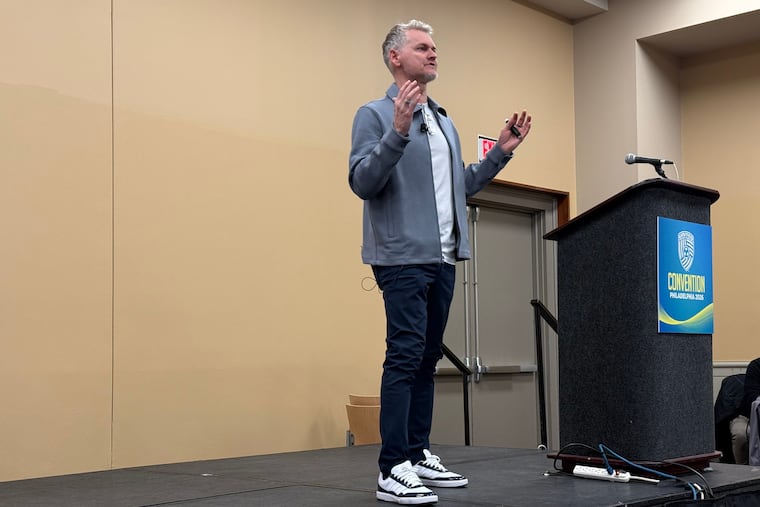
Bradley Carnell can be pretty reserved in public. It’s not that he doesn’t like being on camera, but you aren’t always going to get too much from him in a news conference.
At the United Soccer Coaches convention a few weeks ago, the Union’s manager got a different opportunity. It was his first time at the longstanding event, and he spent an hour on stage talking about his coaching methods.
Carnell’s journey has taken him a lot of places. The Johannesburg, South Africa, native turned pro at age 16 in his home country, then at 21 moved to the first of four clubs he played for in Germany. He played 40 times for the Bafana Bafana, including at the World Cup in 2002.
After hanging up his cleats in 2011, Carnell started his coaching career at the University of Johannesburg. From there, he had two assistant jobs with South African pro clubs, then moved to the U.S. in 2017 to join the New York Red Bulls’ staff. He’s been in this country ever since, and the Union are his third coaching stop in MLS.
What has stayed constant over the years? One thing is how he sees the sport.
“Überzeugungstäter,” he said, a word learned while living in Germany. “A perpetrator. I’m a criminal of the game model that I’m presenting today.”
» READ MORE: Bradley Carnell orchestrated the Union’s success in 2025. His second season in charge matters more.
This produced some amused looks, and not just because of the multiple languages involved. Carnell was not surprised.
“I believe in it so much, and this is who I am,” he said. “Not because I’ve learned the game that way. It’s just because I live my life in a certain way.”
You can get that sense at an average Union practice, where Carnell, 49, often is right in the middle of the fray.
“When setting up a game model, one, it’s based on previous experiences of your playing days: caching influences, but also DNA, how I live my life every single day,” he said. “Fast, energetic, proactive, on the front foot — these are all terms that are coming to life now because it’s just who I am. If I’m playing Monopoly with my family, I’m trying to win the game in the quickest way possible.”
» READ MORE: What’s the secret sauce at the Union’s youth academy? Here’s a taste of it.
The manager who had the most influence on Carnell was Ralf Rangnick, who coached the young left back at German club VfB Stuttgart from 1999 to 2001. Ragnick is known as one of the founding fathers of “gegenpressing,” the high-octane tactics that spread all over Germany and eventually worldwide.
Those ideas have stayed in Carnell’s mind for a quarter of a century.
Inside the playbook
Carnell put up a slide that laid out four principles: “Hunting” to gain possession high up the field; “swarming” to regain the ball after losing it; “striking” to try to get to the opponent’s goal within 10 seconds; and “waves” of attacking moves.
He talked a lot over the course of his session about the defensive side of things, especially “rest defense”: how the centerbacks position themselves when their teammates have the ball up the field.
» READ MORE: Quinn Sullivan ‘would love to be the face’ of the Union. When he returns from a torn ACL, he just might be.
He also took an interesting question from the audience about man-to-man vs. zone defending.
“I don’t mind going one-for-one at the back,” Carnell said. “It’s not man-marking. So if they cross over the center back axis, I’m not going to say to you, ‘Go with him and track him all over the field.’”
If this brought the term “matchup zone” to anyone’s mind, it hasn’t been used much in soccer. But if it ever was going to be, the city that produced John Chaney would be an appropriate place to start.
But the most interesting stuff, as it is for Union fans, was what he said about attacking.
Quality on the ball is valued over time on the ball, a point Union fans have certainly learned by now. And Carnell laid out his “baseline” for how he wants his team to score: 60% in transition, 30% on set pieces, and 10% in possession.
“We can go quick — I say [with] quality on the ball, you can always get quicker,” Carnell said. “But if you try to go too quick, then there’s going to be turnovers. So, progressive quality over speed. We can always learn to get quicker in this transitional phase of the game.”
» READ MORE: Japhet Sery Larsen got an assist from Mikael Uhre as he decided to join the Union
Last year, the Union scored around 50% of their goals in transition, 30% from set pieces, and 20% in possession. That wasn’t quite what Carnell had aimed for. How did he react?
“We don’t see it as a failure,” he said. “We just see it as an adaptation. To every team you inherit, or every team you go to in terms of me joining here a year ago at the Philadelphia Union, we see certain trends, character traits in players, in how we can get this effectiveness.”
Some highlights of the year
The Union ranked well in some stats he likes. They were second leaguewide in shots taken within 10 seconds of gaining possession, at 2.84 per 90 minutes. They were also second in percentage of first passes of a possession that went forward in transition, at 45.5%. And they had the fewest passes per shot sequence, at 2.3 per 90 minutes.
“Reactions quicker than the opponent can get themselves organized against,” Carnell said.
» READ MORE: Cavan Sullivan looks ahead to what should be his biggest year yet with the Union
He put up some tactical graphics on his slides to illustrate the plays he wants. He also showed some videos of notable plays that the Union made last year, and they really made the point.
Carnell said “one of my favorite moments of last year” was a goal the Union scored on May 30 at Montreal: a counterattacking dash that covered almost the entire field in 12 seconds in just the second minute of the game.
Another goal Carnell liked came on April 19 at home against Atlanta. The visitors had the ball, but only briefly: Kai Wagner and Jovan Lukić teamed up to jam Brooks Lennon just short of the midfield line.
Danley Jean Jacques was nearby, and started dashing upfield. Three passes in eight seconds later, he had his first goal in a Union jersey.
“In our game model we’re saying, ‘Go put out the fire,’” Carnell said. “’Go win the ball as high as you can. Be brave. Be brave and hunt in numbers.”