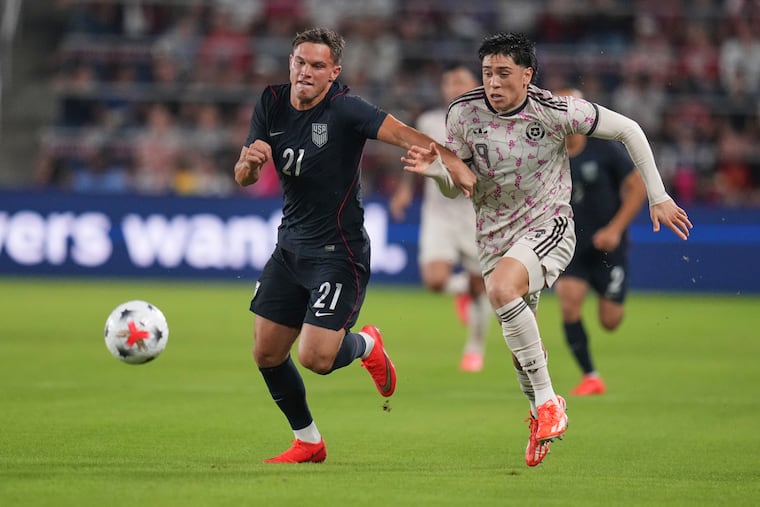
Mauricio Pochettino isn’t thinking yet about all the details of his USMNT World Cup roster
It will be hard enough for Pochettino to pick the 26-player squad. But it will be just as vital to decide how many players he’ll take at each position.

In a few months, U.S. men’s soccer team manager Mauricio Pochettino will have to make some of the toughest choices he has ever made in his decorated coaching career.
It will be hard enough to pick the 26-player squad for a World Cup on home soil. But it be will just as vital to decide how many players he’ll take at each position: centerback, outside back, the many kinds of midfielders, and forwards.
His life will be made a little easier by the number of goalkeepers being set by rule at three. But all those other choices will cause plenty of headaches, and debates among U.S. fans.
“It’s difficult to now tell you if we are going to bring a number of centerbacks or fullbacks or strikers or midfielders,” he said in a news conference Thursday in Miami. “The way that we build the roster, it’s always about having the possibility to be very flexible, to have the possibility also to change during the game.”
Pochettino alluded to the big tactical change he installed in the fall, switching from the program’s longtime 4-3-3 setup to a 3-4-2-1. The switch sparked the team’s five-game unbeaten run to end 2025, but it also posed new questions.
The biggest arguably is at centerback. That position can have a big effect on the overall balance because it changes the outside backs’ playing style and takes a midfielder off the field.
» READ MORE: Projecting the USMNT’s World Cup roster
Pochettino didn’t address centerback directly, for the reason he noted above. But he did acknowledge that “if we want to play with fullbacks that go forward, we bring more forwards and less wingers.”
The injury list will also matter a lot, of course.
“Until we really know the possibilities of the players that we are going to have available, it’s impossible to say if we are going to bring more or less” at any given position, Pochettino said. “It’s a domino effect that if something changes, [it] sometimes affects another.”
He summed it up like this: “I think the combination is always going to be to first have the players available, and then [address] how we are going to approach, in the tactical way, the games.”
Winter transfers could have an impact
It would be natural for fans to expect the March squad, which will play star-studded Belgium and Portugal in Atlanta, to be a preview of the World Cup roster — not that it has to be all 26, but at least be on the way there.
» READ MORE: Noahkai Banks knows he’s getting a lot of USMNT hype, but he isn’t thinking about the World Cup yet
Pochettino indicated he would like to think that way, too, but players’ health comes first.
“It’s true that now we are close to the World Cup, and it’s true that it’s going to be difficult to bring some new players because I think we don’t have time,” he said.
“But, already, we had time to assess all the players, more than 70 players that we saw during one year and a half — I think we have a very good idea. Now it’s about to wish that our players will be fit and will be in very good form for us to select the right players to try to compete in our best way.”
Right back Alex Freeman could have a lot at stake in March. The 21-year-old son of former Eagles wide receiver Antonio Freeman made a $4 million move to Spain’s Villarreal on Thursday. Villarreal currently is fourth in La Liga and was just eliminated from the Champions League.
It’s a big bet for Freeman to make on himself so close to the tournament. Pochettino said the player asked for advice on the move, and the manager gladly gave some.
» READ MORE: Brenden Aaronson is on a hot streak with Leeds United at an ideal time for his World Cup hopes
“I said, ‘You need to be very natural and take what you believe is the best option for you, for your family, and, of course, for your people that advise you,’” Pochettino said.
“For sure, always for me, it’s important that the player feels happy, feels comfortable, [but does] not to want to be in a comfort zone. This type of thing that happens is because they want to improve, they want to grow, and I think it’s an amazing challenge that we need to support and help,” Pochettino said.
Ricardo Pepi might be the next major American to change clubs. English Premier League club Fulham wants to buy the 23-year-old striker from the Netherlands’ PSV Eindhoven and has upped the ante to $38 million to try to seal a deal this winter.
That’s an even bigger gamble. Any striker needs to be playing and scoring regularly to secure a place on the U.S. depth chart, but Pepi was one of the closest cuts to miss the 2022 World Cup.
Still, Pochettino backed the move.
» READ MORE: USMNT stalwart Antonee Robinson is finally healthy again, and hopes to get back to the national team soon
“When you change, it’s because you are convinced that you’re going to be in a better place than the place that you are, no?” he said. “And I think that is why always I am very optimistic, I’m very positive on all the moves.”
Criticizing one of his own
Pochettino was asked about Tim Weah’s recent remarks to French newspaper Le Dauphiné Liberé that ticket prices for this summer’s World Cup are “too expensive.”
“Football should still be enjoyed by everyone,” said Weah, who plays for Marseille. “This World Cup will be good, but it will be more of a show. … I am just a bit disappointed by the ticket prices. Lots of real fans will miss matches.”
Pochettino’s response got fans’ attention, too.
» READ MORE: U.S. Soccer aims to build buzz for this summer’s World Cup, but many fans care about ticket prices
“First of all, I think players need to talk on the pitch playing football,” he said. “It’s not his duty to evaluate the price of the ticket. And then also, my job, my duty, is to prepare the U.S. men’s national team in the best way to perform. We are no politician, we are sports people, that only we can talk about our job.”
The prices were set by FIFA, world soccer’s governing body, and not by U.S. Soccer, which proposed considerably lower prices in its bid book.
“I think if FIFA does something or takes some decision, they know why, and it’s their responsibility to explain why, but it’s not to us to provide our opinion, our responsibility is to perform,” Pochettino said, coincidentally sitting in FIFA’s Miami offices.
“The person that is in charge of the federation, maybe he can give his opinion, but I am the head coach of the [U.S.] federation. And I think we have the organization that is over us, FIFA, that is doing an amazing job around the world, uniting people, because I think FIFA unites people.”
He added that “the media need to ask directly [to] FIFA, and for sure you are going to receive a very good answer.”